
Utilities, energy facilities, water treatment plants, and transportation hubs face unique security challenges. These operations power communities, manage essential resources, and keep the nation running. A single breach disrupts services and triggers costly compliance issues.
Your critical infrastructure needs a security approach that prevents incidents rather than documents them. Perimeter security does more than deter theft. It ensures operational continuity, meets regulatory requirements, and provides confidence that your facility has multiple layers of protection working together.
Unique Risks in Critical Infrastructure Security
Critical infrastructure faces high-stakes security threats. These sectors share one characteristic: their operations are essential to national security, economic stability, and public safety.
These elevated risks explain why standard security approaches fall short for critical infrastructure protection:
Increasing frequency and sophistication of attacks: Threats have evolved from simple copper theft to coordinated physical attacks plus hybrid threats that combine physical and cyber elements.
High cost of disruption: Financial losses extend beyond stolen assets. Operational downtime, project delays, emergency repairs, regulatory fines, and lost service revenue create additional costs.
Danger of cascading failures: A breach at one facility impacts a wider network and affects dependent systems. The energy sector exemplifies this risk, as all other industries rely on electric power and fuel. Disruption in one sector creates vulnerabilities across the entire critical infrastructure ecosystem.
Significant regulatory and compliance pressure: Organizations face intense oversight from federal bodies such as the North American Electric Reliability Corporation (NERC) and Cybersecurity & Infrastructure Security Agency (CISA). Failure to meet physical security standards leads to steep fines, mandatory corrective action plans, and potential loss of operating licenses.
The Benefits of Proactive Critical Infrastructure Protection
Critical infrastructure organizations need proactive prevention, not reactive cleanup. A perimeter security strategy built on integrated layers delivers three core benefits that form the foundation of protection.
1. Deter Threats and Prevent Intrusion Attempts
An active boundary differs from a passive one in the sense that robust perimeter security stops incidents before they begin. Unlike a standard chain-link fence, an electric fence delivers a medically safe but memorable shock that repels intruders upon contact. This deterrent prevents criminals from attempting to access your site.
2. Enable Early Detection and Rapid Response
Integrated sensors provide instant notifications the moment someone touches, cuts, or climbs your perimeter. These alerts specify the location and nature of the attempted breach, allowing your security team to respond immediately.
With video surveillance, monitoring teams can instantly verify the alarm and assess the threat level. They can distinguish between animal contact and human intrusion, confirming response without delay or false dispatches.
An early warning creates a critical response window that lets law enforcement or security staff arrive while the threat remains outside your core facility.
3. Ensure Operational Continuity and Resilience
Deterrence and detection serve one business goal: to keep your site operational. For critical infrastructure, a single breach disrupts essential public services that entire communities depend on.
Perimeter security is an investment in uptime and resilience. It prevents operational disruptions by stopping the theft of essential components such as copper wire and transformers. It also mitigates vandalism damage that forces equipment offline for repairs.
Components of a Foundational Perimeter Security Strategy
Addressing risks requires moving beyond single-point security solutions toward a defense-in-depth approach. A foundational strategy combines several key components, with each layer reinforcing the others to create comprehensive protection. These integrated perimeter security solutions work together to deter, detect, delay, and document threats.
The Foundation: An Active Physical Barrier
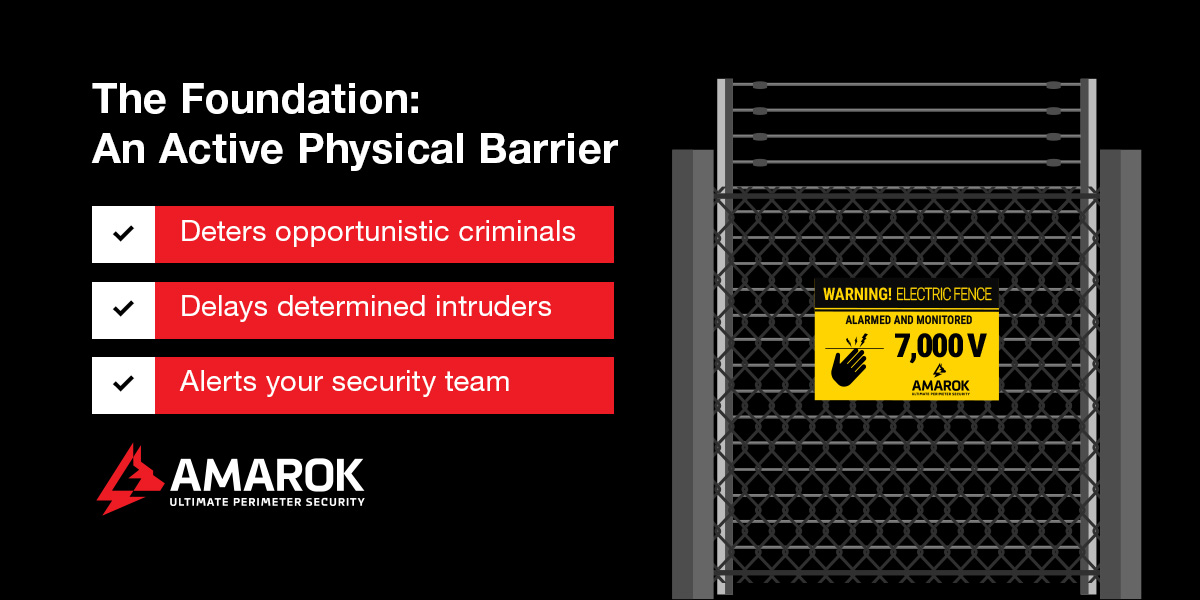
A monitored deterrent forms the backbone of a perimeter security strategy. Electric fencing solutions create a physical and psychological barrier that prevents unauthorized access. Unlike passive fencing that criminals breach quickly and quietly, an electric fence delivers a safe pulsed shock that repels intruders while triggering an alarm.
This foundation achieves multiple security objectives at once:
Deters opportunistic criminals: Imposing height and clear warning signage make the site an unattractive target.
Delays determined intruders: Electric shock and alarm activation create an immediate barrier that slows breach attempts.
Alerts your security team: The fence acts as a sensor, detecting tampering, cutting, or climbing attempts the moment they occur.
Integrated Technology: Surveillance and Smart Analytics
Technology layers provide verification, tracking, and evidence-gathering capabilities. Integrated video surveillance lets security teams visually confirm alarm events instantly, distinguishing legitimate threats from false alarms caused by weather or wildlife.
Commercial video surveillance systems capture high-quality footage that documents incidents for law enforcement and insurance claims. Advanced camera systems with analytics can detect unusual movement patterns and trigger alerts before someone reaches the perimeter fence.
For sites requiring extra support, remote mobile monitoring extends these capabilities by adding professional oversight. Trained monitoring personnel then assess threats as they happen and coordinate immediate response with law enforcement.
Closing the Gap: Access Control and Alarm Systems
Securing entry and exit points completes your perimeter defense by controlling legitimate access while deterring unauthorized entry. Two key technologies can close gaps in your security perimeter:
Access control: Access control systems regulate who enters and exits your facility, creating an auditable record of all access events. These systems use credentials such as key cards and PIN codes to grant entry only to authorized personnel. License plate recognition documents vehicles upon entry.
Alarm-based lighting: When a perimeter fence triggers an alarm, the alarm-based lighting system instantly floods the affected zone with bright light. This response makes intruders visible to security staff and nearby witnesses, often making them flee before completing a breach attempt.
Modern Perimeter Strategies Satisfy Regulatory Demands
A multi-layered perimeter security approach serves dual purposes for critical infrastructure organizations. It provides operational protection while addressing the nonnegotiable standards mandated by government and industry oversight bodies.
CISA provides detailed guidance for protecting national assets across all critical infrastructure sectors. These guidelines stress the importance of layered physical security that identifies, assesses, and responds to threats before they materialize into incidents.
For utility perimeter security, NERC’s critical infrastructure protection (CIP) standards establish mandatory requirements for physical security at bulk electric system facilities. Standard CIP-014 requires utilities to conduct risk assessments, identify critical facilities, and implement comprehensive physical security plans that include perimeter protection.
An integrated perimeter security system supports compliance with these mandates. It provides the threat identification capability, creates the layered defense structure, and generates the documentation that regulators require. Organizations that implement comprehensive perimeter security find that regulatory compliance becomes a by-product of operational protection rather than a separate burden.
Secure Your Critical Infrastructure with AMAROK
A multi-layered perimeter security approach delivers measurable results for critical infrastructure organizations nationwide.
AMAROK’s security-as-a-service model combines The Electric Guard Dog® Fence, integrated video surveillance, Gate Access Control, and alarm-based lighting into one unified system. We handle permitting through our government relations and compliance team. We install your customized solution with no up-front costs, and provide 24/7/365 support through our nationwide network of trained technicians. You pay only a manageable monthly subscription fee that protects your property, people, productivity, profits, and reputation.
Take a proactive approach to critical infrastructure protection. Get a free risk assessment and discover how AMAROK strengthens your security posture.