
National vehicle theft numbers dropped in 2025, catching the attention of site managers and business owners who oversee commercial vehicle fleets. A decline sounds like good news, but it raises a harder question. Does a lower number mean less risk for your property, or is it masking risk that hasn’t gone away? The uncertainty doesn’t disappear just because a headline statistic improved.
Coordinated law enforcement action, new anti-theft technology, and stronger penalties influenced the drop. However, they don’t replace strong perimeter security. Understanding the trend helps you protect your site.
Vehicle Theft Experiences a Historic Decline Nationwide
According to the National Insurance Crime Bureau (NICB), vehicle theft fell to 659,880 incidents in 2025, a 23% decrease from the previous year. This decrease marks the second consecutive year of decline. 2024 previously had the largest single-year decrease in 40 years, with 17%. The 2025 data still indicate that a vehicle was stolen roughly every 48 seconds.
Hyundai and Kia models made up 14% of all vehicle theft incidents, down from 16% in 2024. The Hyundai Elantra, Honda Accord, and Hyundai Sonata were the three most stolen models nationally.
Factors Driving the Decline
Closer law enforcement coordination with industry organizations, automaker technology upgrades, and stronger criminal penalties influenced the decline in vehicle theft incidents.
Coordinated Law Enforcement and Industry Action
NICB agents partnered with law enforcement to target theft rings nationwide and internationally. A data exchange platform was also launched in 2025 to strengthen stolen vehicle detection. Additionally, the NICB-State Fraud Bureau Intelligence Network was created, which is the first of its kind in the U.S. anti-fraud ecosystem. These efforts led to 248 organized ring investigations, 30,319 recovered stolen vehicles, and 12,653 vehicle inspections domestically. Internationally, NICB located more than 3,400 stolen vehicles and repatriated 2,331 of them.
Automaker Anti-Theft Technology
As some of the top stolen models, Kia and Hyundai once sold vehicles that lacked engine immobilizers. This safety and security gap fueled a viral social media trend teaching thieves to start affected vehicles. In response, both automakers rolled out free software updates that extend the theft alarm and require a key to be physically in the ignition switch. Hyundai also distributed window decals to warn would-be thieves that the car has anti-theft protection. The phased software rollout began in early 2023 and continued for several months.
The National Highway Traffic Safety Administration (NHTSA) encourages immobilizer systems as standard equipment on new vehicles. The agency also requires labeling major vehicle components to help authorities trace stolen parts.
Strengthened Criminal Penalties
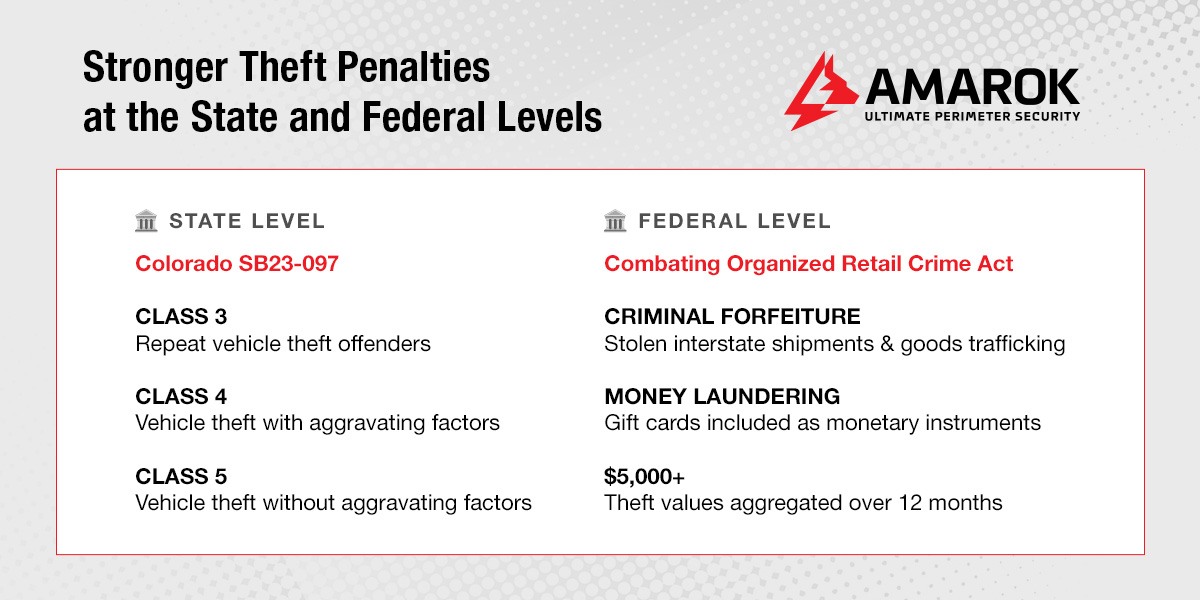
The strengthened penalties at the federal and state levels have contributed to the decline in vehicle theft.
For instance, Colorado’s SB23-097 is a law that replaced penalties that depended on the stolen vehicle’s value with three severity-based felony tiers:
- Class 3 felony for repeat vehicle theft offenders
- Class 4 felony for stealing a vehicle while meeting another specified aggravating factor
- Class 5 felony for vehicle theft activities without aggravating factors
Nationally, in July 2025, NICB’s president and CEO testified before the U.S. Senate Judiciary Committee in support of the Combating Organized Retail Crime Act. This bipartisan act is a bill that would:
- Allow criminal forfeiture for theft of interstate shipments and trafficking in stolen goods.
- Expand money laundering statutes to cover gift cards as monetary instruments.
- Enable prosecutors to aggregate theft values of $5,000 or more over 12 months for federal charges.
What the Landscape Looks Like for Commercial Properties
A falling national number doesn’t mean every property carries less risk. Fleets remain vulnerable to external theft without proper precautions. Vehicles treated as cargo also face continued risk as cargo theft schemes evolve. You need to understand what the landscape looks like to adjust your security strategy as needed.
Theft Remains Concentrated in Urban Markets
The largest states and the densest metropolitan areas experience the most vehicle theft incidents. Theft activities require a motivated offender, a suitable target, and the absence of someone watching or protecting the property. Dense urban areas, along with distribution hubs, produce more of all three at once. Since more vehicles sit parked in one place and more people move through anonymously, the odds drop that anyone is watching.
Organized Theft Networks Have Shifted Strategies
Strategic theft is on the rise, especially among cargo operations. This mode of theft involves exploiting human trust to hand off goods, including trucks and vehicle cargo, instead of breaking in to steal them. This method is often done through double brokering, where criminals steal a legitimate carrier’s identity to pass the broker’s vetting checks and secure the load. The shipment disappears once they get hold of it.
In 2024, 1,445 stolen vehicle exports were recovered nationally, intercepted at ports before reaching overseas buyers.
How Perimeter Security Solutions Mitigate Vehicle Theft Risks
Strong perimeter security keeps criminals from accessing your facility. Whether you manage a vehicle fleet, a trucking business, or another commercial operation, you need advanced physical security solutions to protect your site from common vehicle theft tactics. Look for comprehensive, integrated solutions that make it easier to notify law enforcement. The best solutions include:
- Electric fencing: An electric fence serves as a physical barrier around your perimeter to prevent criminals from reaching valuable goods. It encourages the most motivated crime groups to take their planned activities elsewhere.
- Video surveillance: Cameras capture intrusion attempts and provide visual confirmation for law enforcement. On their own, they serve as passive observers, which makes them more valuable when integrated with your other security solutions.
- Remote monitoring: Continuous oversight from trained security specialists enables a prompt response during a breach attempt. It also offers peace of mind when you can view live footage from any device when you’re away from the site.
- Access control:Gate Access Control systems control who enters the site through credential-based authorizations while generating accurate logs for documentation.
Protect Your Commercial Property With AMAROK
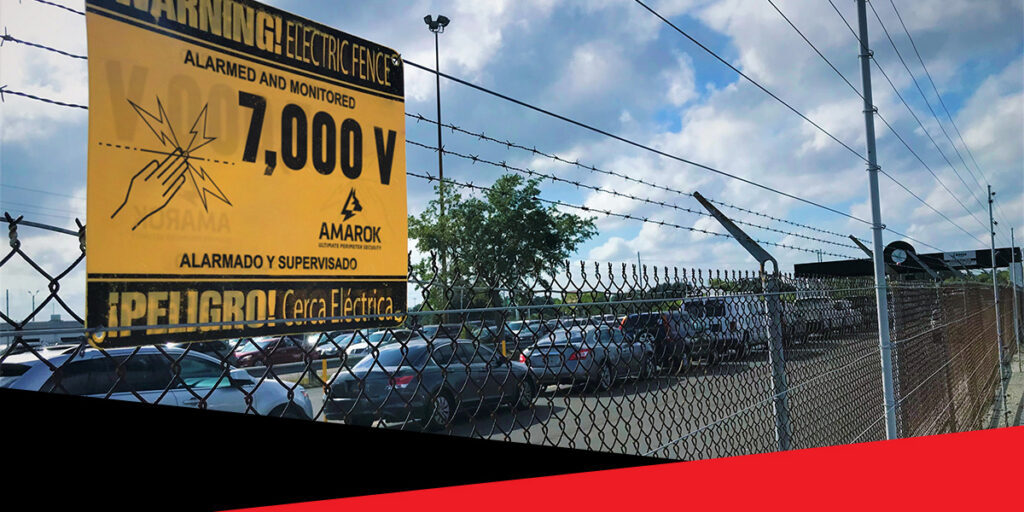
At AMAROK, we help commercial properties protect their vehicles and other valuable assets through our security-as-a-service model. The Electric Guard Dog® Fence prevents 99% of external theft after installation, making unattended vehicles harder to reach. The fence comes with up to 7,000 volts of pulsed shock every 1.3 seconds. This medically safe fence is built to discourage would-be intruders from making second attempts. Plus, it’s customized to your unique risks and location, considering local crime data and regulations.
Pair the fence with FORTIFEYE® for video surveillance and continuous remote monitoring. Security specialists monitor your site and notify you immediately of suspicious activities. They also coordinate with law enforcement and provide visual confirmation. You can view live and recorded footage from any internet-connected device.
Fully streamline your entry and exit operations through Gate Access Control, which also integrates with the fence. It lets you control site access through credential readers, intercoms, and specialized gate locks, depending on your needs. All our solutions come with one manageable monthly fee, with no up-front cost. Receive your free risk assessment today to determine your fleet’s vulnerabilities.