
Major cargo heists dominate headlines, and for good reason. Criminals are evolving their tactics faster than many shippers can adapt. What used to require bolt cutters or brute force now happens more tactically through deception, fraudulent credentials, and exploited communication gaps. Stand-alone security measures no longer stop determined thieves who manipulate the system rather than break it.
The good news is that shippers have more control than they realize. You can harden your facility with a multi-layered security strategy that addresses both strategic and physical threats. The lessons from recent high-profile cargo theft reveal clear, actionable steps to prevent cargo theft and protect your operations before criminals reach your gate.
Why Strategic Theft Is the New Normal
Cargo theft tactics have shifted dramatically. Criminals no longer rely solely on physical force to steal freight. Instead, they exploit what industry experts call “strategic theft.” These schemes are built on deception, fraud, and process loopholes rather than brute strength. Instead of breaking through your perimeter, criminals convince someone to let them in.
In 2025, cargo theft resulted in an estimated $725 million in losses in the U.S. and Canada. The financial scale is staggering, but the root cause is often misunderstood. The core issue is manipulated information and broken communication. Today’s criminals are using social engineering, fraudulent credentials, and gaps in your verification processes to bypass security entirely.
Organized crime has turned cargo theft into a calculated operation, targeting the weakest points in your system with precision.
3 Common Weak Points Criminals Exploit
Strategic theft succeeds because sophisticated organized crime rings target specific vulnerabilities in the logistics process. Understanding where criminals strike, and how, is the first step toward building a defense that actually works. These are the three most common failure points shippers face:
1. Flawed Identity Verification at the Gate
Deceptive pickup schemes are among the most common tactics criminals use to gain access to cargo. The methods vary, but the goal is always the same: bypass verification protocols by appearing legitimate.
Common tactics include:
Fake IDs and forged documentation: Criminals present falsified credentials that look authentic enough to pass a visual inspection.
Impersonating legitimate carriers: Thieves pose as representatives from trusted trucking companies, complete with branded uniforms and paperwork.
Exploiting weak verification systems: Facilities that rely on manual checks or outdated processes are easier to deceive.
An even more advanced threat called the Trojan Driver scam has also emerged. With this method, organized theft groups infiltrate the hiring process of legitimate carriers. Once hired, the criminal has legitimate access to facilities and insider control of trucks. Detection is nearly impossible until the freight disappears.
2. Gaps in Communication Between Shipper, Broker, and Carrier
Lack of real-time, verified communication creates opportunities for fraud. When there’s no constant communication, a fraudulent actor can intercept a load or redirect it by providing conflicting but plausible information. One party assumes another has verified details, but no one actually confirms the facts.
In many modern incidents of theft, freight is redirected through manipulated information and broken communication without anyone realizing it in the moment. The problem isn’t a lack of data, but rather the assumption that the data is correct. Criminals exploit this gap by inserting themselves into the communication chain. They pose as a broker to issue new pickup instructions or a carrier representative to change delivery locations. By the time anyone notices the discrepancy, the cargo is long gone.
3. Unsecured Yards and Perimeters
Organized theft groups target cargo at every point in the supply chain, including unsecured yards. While strategic theft dominates the conversation, physical theft opportunities still exist, often enabled by weak perimeter security. An unmonitored or easily breached perimeter makes your facility an attractive target. Criminals may conduct surveillance before executing larger strategic heists or conduct smash-and-grab operations.
Criminals evaluate facility security from the outside, and if your perimeter looks easy to breach, they’ll test it. Weak fences, poor lighting, and blind spots signal that your facility lacks the deterrents needed to stop theft before it starts. This is especially true for high-value food and beverage loads, which are frequently targeted due to their resale value or demand.
A Framework for Cargo Theft Prevention
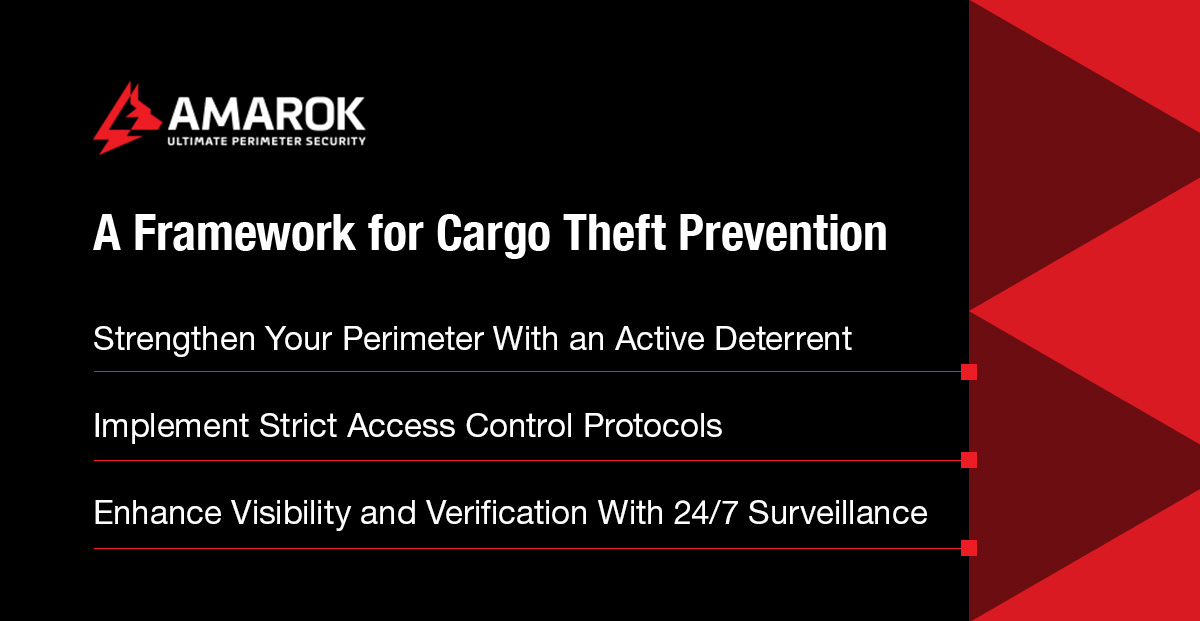
Shippers can take direct action to harden their facilities against both strategic deception and physical intrusion. The solution is a multi-layered approach that addresses vulnerabilities inside your four walls and at your fence line. Warehouse security solutions create a resilient system where each layer reinforces the next, making it exponentially harder for criminals to succeed.
Layer 1: Strengthen Your Perimeter With an Active Deterrent
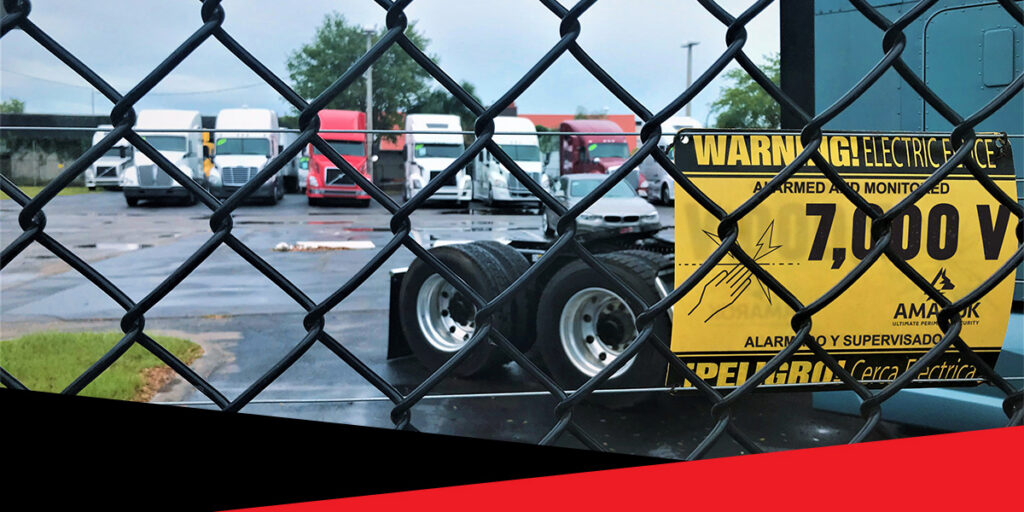
The first step in securing your facility is making it an undesirable target. Electric fencing solutions actively deter criminals by delivering a visible barrier and immediate physical response at the fence line. Distribution center security requires a perimeter that deters intruders before they reach your assets, not just alerts you when they’re already inside.
Electric fencing offers distinct advantages over traditional barriers:
Active deterrent: Unlike chain-link or barbed wire, electric fencing delivers a safe but memorable pulsed shock that immediately deters intruders.
Visible warning: The fence’s design signals to criminals that your facility is serious about security.
Integrated alarm systems: Perimeter alarm and lighting systems activate the moment someone touches the fence, alerting security personnel in real time.
Cost-effective coverage: Electric fencing protects large perimeters without requiring constant human monitoring.
Layer 2: Implement Strict Access Control Protocols
Identity verification at every entry point is critical to stopping deceptive pickup schemes. Automated access control systems reduce the risk of human error by requiring credentials that can’t be easily forged or socially engineered. These technologies ensure only verified personnel and vehicles enter your facility.
Effective access control includes:
Credential readers: Require keycards or PIN codes that are challenging to duplicate.
Automated logging: Every entry is recorded with a timestamp, creating an audit trail for accountability.
Integration with surveillance: Access control systems work alongside commercial video monitoring to verify that the right person is presenting the right credentials.
Multi-factor authentication: Layering multiple verification methods makes it exponentially harder for criminals to gain entry.
Layer 3: Enhance Visibility and Verification With 24/7 Surveillance
Comprehensive video surveillance provides an indisputable record of who’s on-site and what’s happening at every moment. This layer helps verify that the right driver is picking up the right load and provides evidence if an incident occurs.
Remote mobile monitoring ensures security teams maintain watch even when there’s no staff physically present. Building intrusion detection systems add another layer of protection, alerting you the moment unauthorized access is attempted. Together, these tools create a complete visibility network that leaves no blind spots.
Secure Your Facility and Prevent Cargo Theft With AMAROK
Criminals won’t wait for you to catch up. The most effective defense starts with understanding your vulnerabilities and implementing a security strategy that stops theft before it happens.
AMAROK specializes in perimeter security solutions designed to harden facilities against both strategic deception and physical intrusion. From electric fencing that deters criminals at the fence line to access control systems that verify every entry, AMAROK provides the layered protection shippers need to stay ahead of evolving threats.
Take control of your facility’s security. Request a free risk assessment, and discover how AMAROK can help you move from risk to resilience.