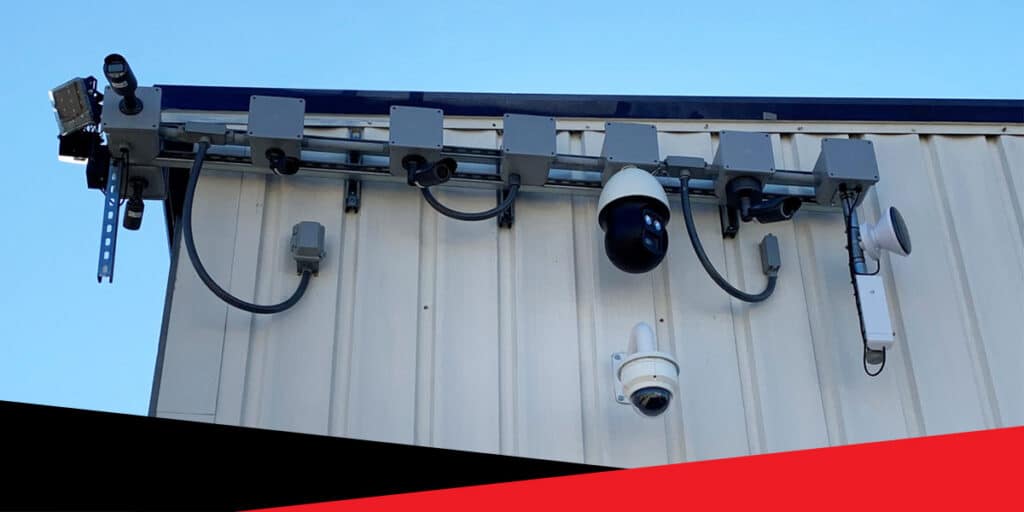

If you’re a government contractor, using surveillance cameras that comply with the National Defense Authorization Act (NDAA) could be mandatory for securing the contracts your business relies on. If not, choosing NDAA‑compliant cameras is still highly recommended to reduce your cybersecurity and supply chain vulnerabilities while maximizing the partnerships available to you. Many business leaders are reluctant to get into the regulatory weeds, and are uncertain if their cameras comply or whether switching to a compliant system is worthwhile.
In this guide, you’ll discover the benefits of using NDAA‑compliant surveillance cameras, how to know if your system meets the mark, and what to do if your current cameras don’t comply.
What Is NDAA Compliance for Surveillance Cameras?
NDAA compliance means your video system does not use restricted surveillance equipment or services identified in Section 889 of the NDAA. You can check the Federal Communications Commission’s “covered” list for regular updates to the entities to avoid under Section 889. Section 889 requirements extend beyond the brand on the camera.
Compliance requires that none of the covered manufacturers or their affiliates has produced a substantial or essential part of your system. This includes the camera’s chipset, firmware, recorders, video management software, and any connected cloud services.
Who Needs NDAA‑Compliant Cameras?
NDAA Section 889 compliance is mandatory for federal agencies. Contractors and grant‑funded organizations also typically need to comply to satisfy procurement rules for government contracts and award conditions for federal grants.
Even if your team does not sell into the public sector today and does not plan to do so soon, your customers or partners might. NDAA‑compliant camera systems support procurement readiness, positioning you as a secure supply chain partner. All businesses can benefit from using NDAA-compliant camera systems, because this minimizes the risk of vulnerabilities arising from untrusted components or firmware.
The Benefits of NDAA‑Compliant Security Cameras
NDAA‑compliant surveillance camera systems offer several benefits in government contracting and beyond. These range from opportunity access to cost control and cybersecurity.
Cybersecurity and Supply Chain Risk Mitigation
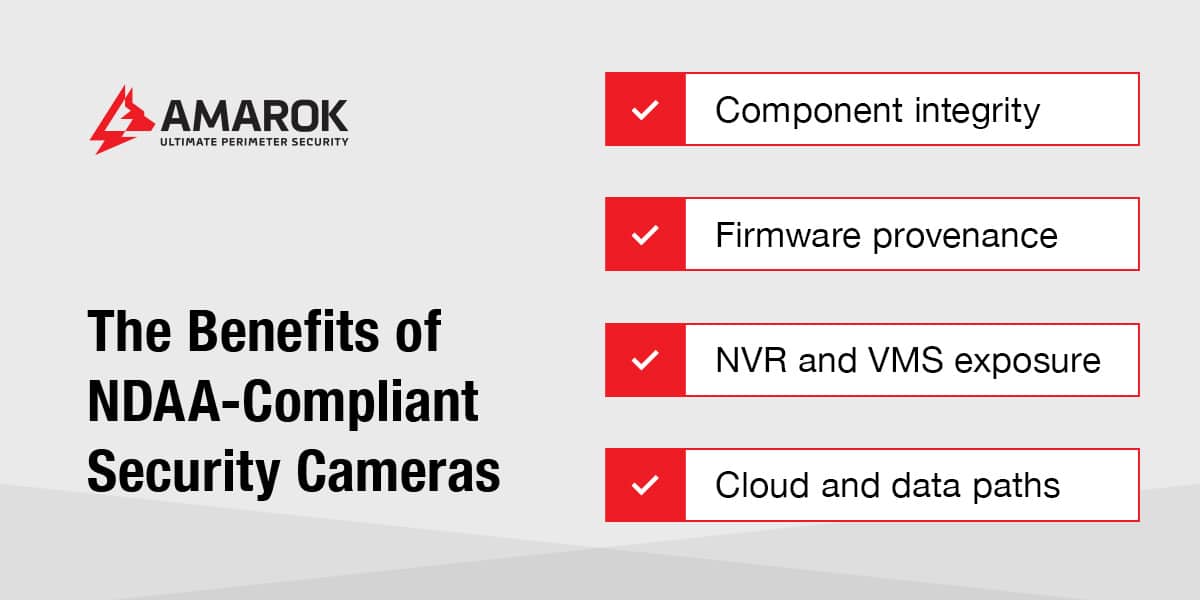
A security system is only as strong as its weakest link. NDAA compliance helps to ensure you can trust every part of your surveillance camera system to protect your business and your customers. The supply chain and cybersecurity advantages of NDAA‑compliant cameras include:
- Component integrity: Cameras that look compliant may still use restricted chipsets or image processors, which could become vulnerabilities. Verifying NDAA compliance prevents hidden dependencies from slipping into your security posture.
- Firmware provenance: Unsigned or opaque firmware can introduce vulnerabilities or create audit uncertainty. Sourcing your camera system from an NDAA‑compliant partner reduces that risk.
- NVR and VMS exposure: Network video recorders (NVRs) store and manage video streams. Video management software (VMS) runs the interface, recording rules, analytics, and integrations. Either can include third‑party modules from restricted vendors. A compliant video surveillance system avoids this blind spot.
- Cloud and data paths: Some systems rely on external cloud services for updates, analytics, or storage. If those services are tied to a covered entity, you inherit the security and compliance risks.
Procurement Readiness
When a bid or renewal requires proof of compliance, you can respond quickly with the right documentation. Ensuring compliance in advance reduces the risk of late‑stage disqualification or change orders and helps move your contract to award on schedule.
Continuity and Cost Control
If noncompliance surfaces during a bid, renewal, or audit, you may face a choice between losing the opportunity and rushing through last‑minute replacements, with unplanned expenses and downtime. Investing in compliance in advance helps to keep your budget and operations on track.
Brand Protection
Maintaining NDAA compliance in your video surveillance system demonstrates to your customers, partners, and insurers that your business prioritizes security at the component level. It strengthens your brand’s trustworthiness and opens doors for new client relationships.
Risks of Noncompliance
Whether or not your revenue depends on government contracts, ignoring NDAA compliance can be risky. Understanding these risks is important for making an informed choice between an NDAA-compliant system and noncompliant alternatives:
- Cyber exposure: Untrusted chipsets or opaque firmware can introduce vulnerabilities and unexpected data flows, raising the risk of compromise across your networked systems.
- Supply chain uncertainty: Without NDAA-compliant sourcing, model revisions, new firmware, or vendor acquisitions, covered components can be introduced, forcing midlife replacements when discovered.
- Partner and customer friction: Many enterprises include NDAA language in vendor reviews and security questionnaires. Noncompliance can stall onboarding, delay renewals, or disqualify bids, even outside the public sector.
- Emergency costs and downtime: If noncompliance surfaces during a review, you may face rush pricing for hardware and installation services. You may also need to halt planned work for unplanned swap‑outs.
- Contract and grant eligibility: For government contracts and federally funded work, covered equipment can render an offer ineligible for award, extension, or renewal.
Is My Surveillance Camera System NDAA-Compliant?
A system is NDAA-compliant when none of its substantial or essential components come from covered manufacturers or services listed under Section 889. This applies to the whole stack, not just the camera badge. The chipsets and firmware inside the cameras, NVRs, VMS, and any connected cloud services must all be free of covered technology.
The most reliable path to NDAA compliance is sourcing from an NDAA‑compliant partner instead of vetting every component yourself. A qualified partner does the heavy lifting on supply chain scrutiny and provides the documentation you need for assurance. If you already have a camera system installed, contact the manufacturer to ask whether they can document that their system is compliant.
That said, your organization may still be expected to make a “reasonable inquiry” to ensure your system remains compliant, as well as keep records to validate compliance. Records that are worth keeping on file include:
- A current vendor attestation of NDAA compliance for the specific models you deploy.
- A model and component summary (or bill of materials equivalent) and a firmware provenance statement.
- Confirmation that recorders, VMS, and any cloud services are covered by the same compliance scope.
- A basic cadence of checks you use to revalidate compliance before bids, renewals, or major firmware changes.
Choose AMAROK for NDAA-Compliant Monitored Surveillance
Businesses across industries are seeing the value in NDAA-compliant systems, but knowing whether your system meets the requirements can be challenging without a supportive security partner. When you’re ready to simplify NDAA compliance while protecting your property, AMAROK can help.
AMAROK only carries NDAA-compliant video surveillance equipment. All of our video surveillance cameras and systems come from NDAA-compliant manufacturers, and we maintain contact with regulatory bodies to stay up to date with any changes in the list of banned manufacturers. To check whether your current video surveillance system is compliant, download AMAROK’s Quick Reference Card.
If you’re ready to install a new system, explore our video surveillance solutions with 24/7/365 live monitoring by security professionals for real-time threat verification and intervention when it counts. Our integrated perimeter security solutions, which all start with The Electric Guard Dog® Fence, prevent 99% of external theft for over 9,000 customers.
Contact your local AMAROK security expert to discuss compliant video surveillance solutions for your facility.