CLIENT
Class I Railroad Companies
OUR EXPERTISE
- The Electric Guard Dog® Fence
- FORTIFEYE® 24/7 Remote and Mobile Video Monitoring Systems
- Law Enforcement Support Capabilities Via Analytics & Insights
GOALS/OBJECTIVES
- Proactively protect freight and infrastructure at rail yards and storage sites
- Decrease police dispatches for false alarms
- Consistent site security to maintain top customer relationships
- Control access and visibility across vast rail yards
The Stakes of Railroad Security
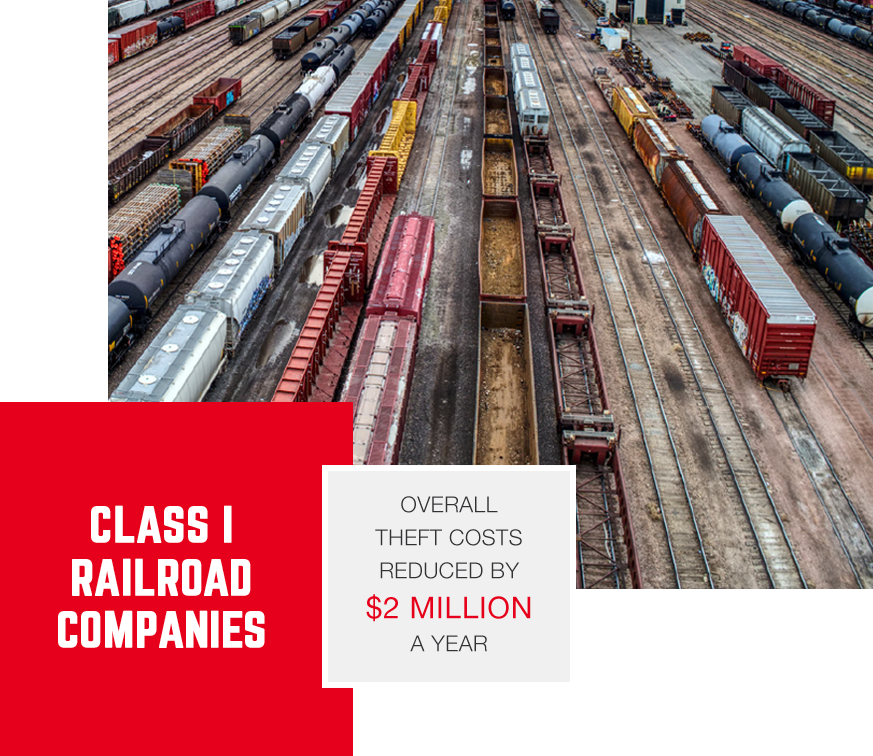
Railroads represent the backbone of North American freight transportation. Defined by annual operating revenues exceeding $900 million and expansive, multi-state networks, these carriers move high-value cargo across thousands of miles of open rail infrastructure every day. With that scale comes a unique security challenge: vast, exposed rail yards for storage and maintenance that are difficult and costly to protect with traditional methods.
According to the Association of American Railroads, Class I railroads lost more than $100 million in 2024 due to criminal groups increasingly targeting freight shipments, with an estimated 65,000+ thefts annually, but only one in ten thefts results in an arrest (Trains Pro, 2025).
Railroad operators typically rely on different methods to be more efficient, like guards, cameras and fencing but those methods have proven to have gaps. While guards play an important role, the costs add up quickly across multiple sites, and even the most robust force cannot be everywhere at once. Additionally, traditional approaches do little to deter today’s opportunistic, fast-moving, and increasingly coordinated criminals.
Beyond physical breaches, rail theft carries significant financial risk. Under U.S. law, railroads operate as common carriers and are generally liable for loss or damage to goods in transit under federal statutes such as the Carmack Amendment (49 U.S.C. § 11706) (Cornell Legal Information Institute). This means theft is both a security issue and a direct loss that affects operating margins and impacts customer trust.
Challenge: Persistent Theft Causes Operational and Financial Impact
Across multiple rail operations, security leaders faced a persistent and costly problem: repeated theft and vandalism across large, open facilities that were difficult to secure. Specifically, auto ramps and rail yards experienced ongoing criminal activity over several years, exposing vulnerabilities in perimeter coverage and response capabilities.
Criminals consistently targeted high-value, easily resold components, including batteries, tires, wheels, wiring harnesses, and catalytic converters. In auto ramp environments, entire passenger vehicles were at risk. When vehicles were stolen, the railroad was typically responsible for reimbursing customers for the full vehicle value — making each incident a direct financial loss rather than a recoverable claim.
Some locations reported up to a dozen theft incidents per site annually, with one rail operator estimating cumulative losses from theft-related incidents alone at more than $11 million.
Another major issue was the ongoing false-alarm problem. For example, if an alarm is triggered in a remote area for any reason, such as an animal passing by, the railroad police department would be needlessly dispatched, creating a steady drain on resources while increasing pressure on railroad police departments already stretched across large territories. A typical false alarm costs an average of $1,000 per dispatch, and one railroad was experiencing two unactionable alarms per month across 11 lots, resulting in $264,000 in annual operational losses.
For security leadership, the challenges became a risk affecting profitability, reputation, and confidence in existing security operations.
Solution: Proactive, Customized Crime Prevention
Initially, operators explored familiar options such as expanding guard coverage or deploying solar camera trailers. However, those approaches only increased operating costs without addressing the fundamental challenge: expansive rail properties cannot be monitored effectively by personnel alone, and cameras without an active deterrent remain inherently reactive.
Interest in The Electric Guard Dog® Fence grew as rail police leaders learned that AMAROK already supports many other the major Class I railroads nationwide, making it a proven approach within the rail industry rather than an experimental alternative.
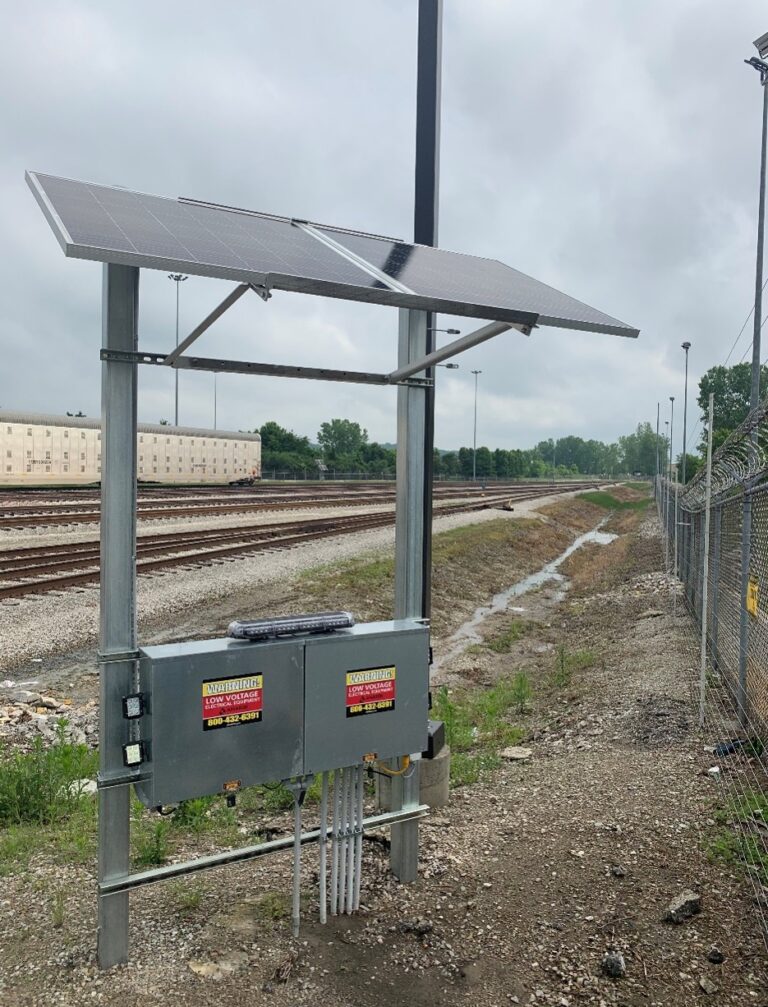
AMAROK specializes in implementing customized electric perimeter fencing solutions tailored to each site’s layout, operational flow, and access requirements. For railroad customers, configurations include controlled, flexible gate and entry options designed to support rail operations without impeding movement, while establishing a continuous, protected perimeter and liability coverage.
In some cases, integrated solar FORTIFEYE® camera to fence systems have been added to provide alarm verification and actionable intelligence. Rather than deploying specialized forces for every alarm event, police teams can reserve resources for confirmed incidents only, based on the live feed from the specific location of the attempted intrusion. This capability enables railroad police departments to improve officer safety, accelerate response times, and eliminate unnecessary deployments. For large, complex rail yards, this approach effectively puts eyes on the entire site, creating immediate awareness when a breach attempt occurs.
Results: Costly Thefts Turn into Controlled Deterrence
Overall, rail customers who partner with AMAROK have seen meaningful operational efficiencies across their sites. Theft attempts were stopped or dramatically reduced, reimbursements tied to stolen vehicles declined accordingly, and police departments gained improved situational awareness and heightened efficiencies across their territories.
False alarms cost about $1,000 per dispatch. For a railroad with 11 lots, just two false alarms per site each month can drive $264,000 in annual losses while pulling police away from real threats.
BY THE NUMBERS
- 99% reduction of theft since installation
- Reduced overall theft costs by $2 million a year
- Includes $500K+ gained in annual operational efficiencies
- ~$225K saved over five years with electric fencing vs. guard-based security
- Nearly $600K annual saving versus comparable camera solutions
- Improved uptime with fewer operational disruptions
- Average 5X ROI from loss prevention, operational efficiency and budget reallocation
STRATEGIC ADVANTAGES
- Deters theft before it happens, not after losses occur
- Proven at Class I scale under strict security standards
- Reduces operational friction across rail police teams
- Improves officer safety through validated, real-time intelligence
- Supports expansion to additional sites with confidence
- Delivers long-term partnership, not just installation