
Two facts are true when discussing your business’s physical security. Your people are both a primary line of defense against criminal activity and your strategy’s weakest link.
Providing your staff with a security awareness incentive can be an effective solution. These incentives actively engage employees to build their skills and confidence in identifying and reporting suspicious behavior. As a result, your organization can better protect its assets and reputation against the damage caused by crime.
Why Is Staff Awareness Important to Physical Security?
Staff awareness is a cornerstone of physical security since it transforms your people from potential risks into active protectors.
This strategy is especially important given the rising cost of crime. For example, the average financial loss in a cargo theft incident in the third quarter of 2025 was over $336,000, double that of the same period in 2024. And the financial consequences only increase when you account for loss of customer trust and decreased future revenue opportunities.
Employees who are aware are more likely to identify potential vulnerabilities and escalate their concerns or offer solutions, helping prevent costly theft before it occurs. Greater awareness also delivers benefits like:
- Reduced human error: Engaged, trained staff know to avoid simple mistakes such as propping open doors or admitting unauthorized visitors.
- Enhanced red-flag identification: The more aware your employees are, the better they can recognize unusual activities and unauthorized people.
- Improved emergency responses: Higher awareness helps support quick, decisive action that can minimize potential negative impacts.
- A more holistic security posture: Sophisticated thieves can bypass advanced systems through human error. Employee awareness increases the likelihood that your team complements your technology rather than unintentionally undermining your security measures.
Additionally, employee training programs aimed at greater awareness offer a tangible return on investment (ROI) for your business. Studies have reported that security training initiatives can produce between three and seven times the investment cost in terms of ROI. Some companies have noted as much as 300% ROI, generating $4 of value for each dollar spent.
Effective Staff Incentive Strategies
While awareness programs typically begin with foundational security training, it’s only the first step. Creating lasting behavioral change requires additional incentives that reinforce and reward security-conscious actions. Consider the following incentive approaches, which you can tailor to match your organization’s unique security needs and culture.
Recognition-Based Programs
Recognition-based programs are cost-effective ways to boost employee morale and express appreciation for the value of your people’s contributions. When employees know their efforts matter, they’re more likely to be invested in your business’s success and remain engaged. Tying that recognition to specific actions positively reinforces the behavior and increases the chances of it continuing.
Ideas for recognition-based initiatives include:
- Highlight individuals in a “Security Champion” spotlight in company communications, such as internal newsletters.
- Provide displayable security awareness certificates or badges.
- Acknowledge contributions during team, department, or company-wide meetings.
- Grant annual awards for outstanding security vigilance.
- Reward specific actions with personal thank-you notes from senior leadership.
- Dedicate a section of your intranet or a common employee dashboard to individual security awareness success stories to showcase measurable impacts.
Gamification Approaches
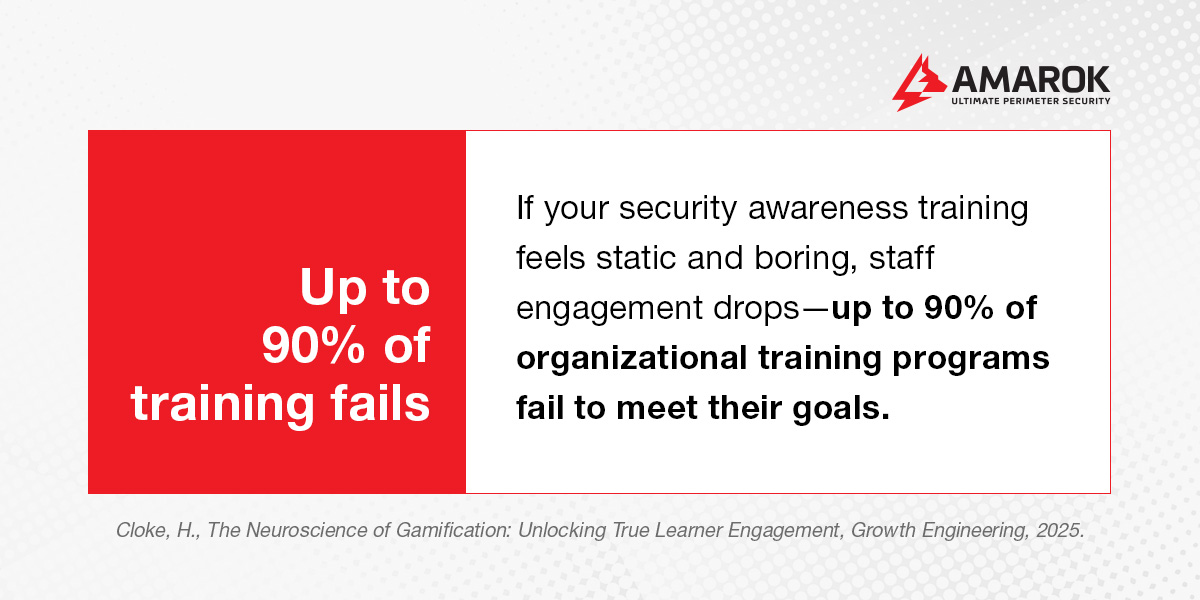
If your staff perceives your security awareness initiatives as static and boring, they’re less likely to engage. Your efforts are also less likely to succeed, with up to 90% of organizational training programs failing to reach their goals.
Gamification changes the odds by transforming the experience into one that’s dynamic, fun, and enjoyable instead. These programs directly tap into everyone’s reward systems, like a sense of achievement. In response, the brain triggers the release of dopamine, which increases motivation to continue progressing.
Ways to incorporate this approach into your broader strategy include implementing:
- Security awareness point systems with redeemable rewards.
- Inter-departmental security awareness challenges or departmental competitions for the highest level of security compliance.
- Digital leaderboards tracking participation in security initiatives.
- Monthly security trivia competitions.
- Security simulation exercises with achievements.
- “Spot the risk” photo challenges.
- Security scavenger hunts around company facilities.
- Mobile app challenges test security knowledge.
- Virtual badges for completing security milestones.
Tangible Rewards Systems
While recognition is always appreciated, a tangible rewards system can often drive loyalty and motivation even further. A more material “prize” can feel more rewarding, especially when staff can share the experience with others. These programs can also help you attract and retain top-level talent, offering additional organizational value.
Options to consider include:
- Gift cards for reporting potential security vulnerabilities.
- Additional paid time off for completing training modules.
- Premium company merchandise for security contributions.
- Technology gadgets for consistent participation.
- Meal vouchers for quick reporting of security issues.
- Preferred parking spots for security awareness winners.
- Movie or event tickets for heightened security.
- Small cash bonuses for contributing to the prevention of security incidents.
- Team lunches for collaborative security improvements.
- Group outings for teams with exceptional security records.
- Team budget increases for security improvement proposals.
Successful Implementation of Security Awareness Incentives Among Employees
After you’ve determined the best staff incentives to reflect your goals, these tips can help you implement your program successfully.
Assess Your Current Security Posture
Any initiative to strengthen physical security should start with an honest assessment of where you’re at currently. You need to know your team’s existing feelings toward security, their awareness levels, and which incentives will resonate with them. Consider gauging readiness and engagement with activities like:
- Staff surveys that establish baseline awareness, attitudes, and incentive interests.
- A thorough evaluation of your business’s security strengths and its potential risks.
- Identification of which departments or teams may need more targeted or personalized training to heighten awareness.
Create Measurable Security Goals
Ensuring your goals are measurable is equally important as setting them. It’s the only objective way to know whether staff incentives are working, or whether you need to adjust your approach. Align your goals with specific metrics you can use to track progress, such as:
- Reductions in unauthorized access attempts.
- Staff training completion progress over 30, 60, and 90-day periods.
- Incentives achieved and pursued, especially if you’re testing a mix of initiatives.
- Employee satisfaction with the programs.
Build a Security-First Culture
It’s easy to be enthusiastic about a program during its roll-out. However, the initial motivation can quickly drop off without consistent reinforcement. This reality underscores the importance of communicating regularly with your team to sustain buy-in. Practical ways to do so include:
- Maintain regular updates about security awareness progress and wins.
- Use multiple communication channels to share key security messages.
- Keep security conversations positive rather than fear-based.
- Provide context for why specific security measures matter to your business.
- Ensure leadership visibly models and champions security-conscious behaviors.
- Integrate security awareness into standard onboarding and regular workflows.
- Celebrate security successes as prominently as other business achievements.
- Create an environment where reporting potential security concerns is welcomed and rewarded.
Pair Your People With AMAROK for Ultimate Perimeter Security
Building a security-aware team is a critical step, but robust 24/7/365 protection goes beyond people. You need multi-layered perimeter security solutions that proactively stop crime before it happens. With AMAROK, your organization can implement a unified system to safeguard your people, your property, and your profits.
Request a free risk assessment, find your local expert, or connect with us online to get started.