
Property owners often experience frustration with slow police responses to theft incidents at industrial and commercial sites. In many cases, alarms trigger or staff call the police, but may arrive too late to intervene or may not be able to respond immediately.
Despite their best intentions, police departments nationwide face challenges that affect their ability to respond to property crimes. Understanding these constraints helps business owners recognize the weaknesses in security strategies that rely on a swift police response. In this guide, you’ll learn five reasons why commercial theft isn’t a top priority for police and discover proactive security solutions that prevent theft without depending on law enforcement response times.
1. Law Enforcement Is Understaffed
Law enforcement agencies across the United States are experiencing staffing shortages. Recruitment rates remain low, while recent years have seen high rates of resignation and retirement. This labor crisis forces police to make difficult decisions about resource allocation.
With few officers available to respond to calls, dispatchers must triage every request for service. This means that violent crime and immediate threats receive priority, and officers may only be available to respond to theft calls several minutes or even hours later, once the suspects have already fled. As a result, while law enforcement is critical to addressing crime, depending on police intervention alone to stop attempted break-ins is not an effective security strategy.
2. Police Are Overloaded
Modern policing covers violent crime, mental health crises, traffic accidents, and community engagement duties in addition to property crime. Together with staffing shortages, this broad scope of law enforcement widens the gap between the number of property crime incidents and the availability of police to respond.
3. Other Incidents Are Prioritized
Police departments use formal dispatch protocols that categorize calls by priority level. For example, a typical priority structure would include:
- Priority 1: Emergency calls involving an immediate threat to life.
- Priority 2: Emergency calls involving an immediate risk of major property loss or damage.
- Priority 3: Crimes in progress that present no significant threat of serious physical injury or major property damage.
- Priority 4: Calls that do not require an immediate response but that are likely to lead an officer’s investigation to apprehension.
- Priority 5: Request for service where the officer’s primary function will be fact-finding, reporting, or rendering assistance.
- Priority 6 and below: Calls for traffic enforcement, parking control, abandoned vehicles, and other less urgent needs.
Commercial break-ins typically fall into priority level 2 only if police can arrive in time to intervene while the crime is in progress. If this is not feasible or the call comes in after the suspects have fled, the incident would be priority level 4 or 5.
This partly explains the low clearance rates for property crimes. For example, from 2025 to 2026, the FBI Crime Data Explorer records around half a million incidents of burglary nationwide, with less than 20% being solved.
4. Crimes Are Quick
The gap between theft execution time and police response times adds to the challenge for businesses relying on reactive measures. For example, thieves can steal a catalytic converter, strip copper wiring, or hook up an equipment trailer and disappear in under five minutes.
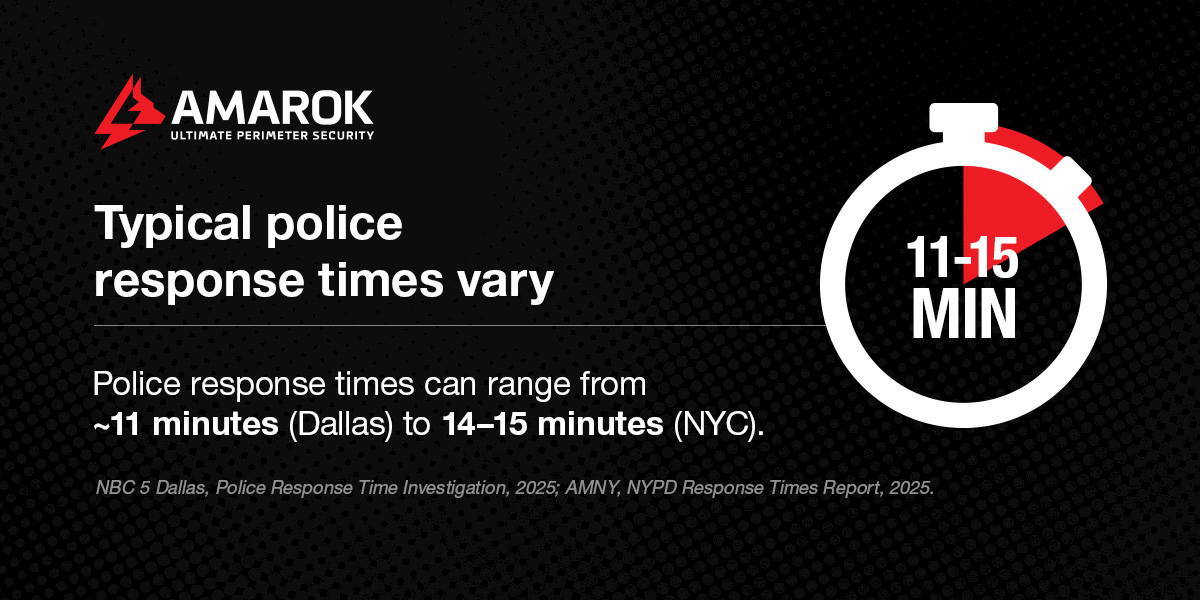
Police response times vary widely. For example, police in Dallas, Texas, aim to respond to Priority 1 calls within 8 minutes, though 2025 saw average citywide response times around 11 minutes. Average New York City response times are around 14-15 minutes. Unless you have barriers to slow them down, criminals have enough of a head start to finish the job and escape before responders arrive.
5. False Alarms Are Distracting
Traditional alarm systems often generate false alerts, with 94% to 99% of alarm activations resulting from noncriminal triggers like wind, animals, or equipment malfunctions. To reduce wasted resources, many jurisdictions have adopted verification policies that require confirmation and often video or other evidence before police respond to alarms. While this adds an extra step, businesses with proper verification protocols in place may experience swifter police response times in jurisdictions where police prioritize verified alarms.
How to Stop Theft When Response Times Are Slow
While you should always report actual or attempted crimes on your property to law enforcement, this may not be enough to prevent theft or vandalism. You need a reliable, multi-layered security strategy to deter, detect, and delay any criminals attempting to access your property. This posture increases the chance of law enforcement arriving in time if necessary, but more importantly, it stops criminals from setting foot on your property.
Stop Criminals With Strong Barriers
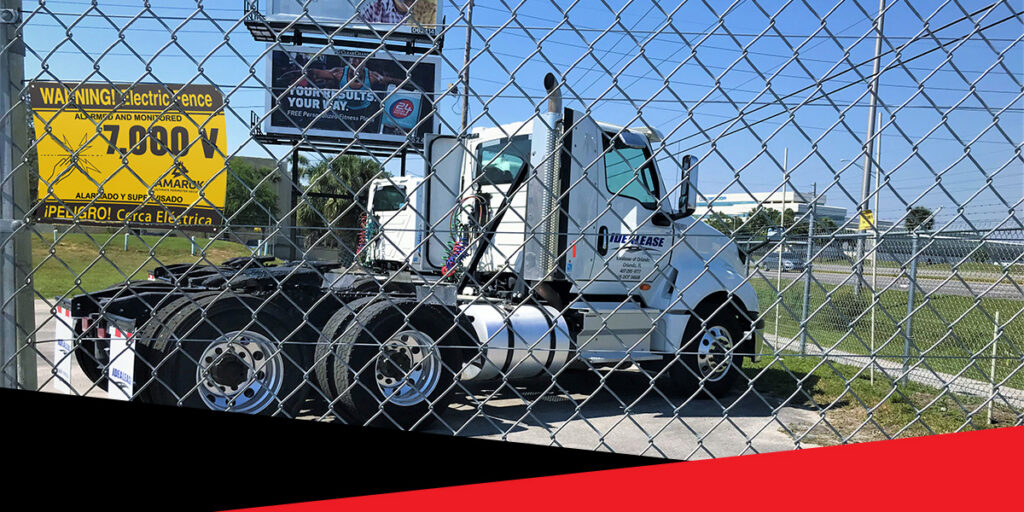
Standard chain-link fencing offers minimal resistance to determined thieves, as they can penetrate this barrier in seconds with a pair of bolt cutters. Electric fencing, on the other hand, reliably deters and delays would-be intruders to stop them from exploiting slow police response times. An electric fence’s imposing height, yellow shock warning signage, and safe but memorable shock upon contact make the prospect of trespassing less attractive and stop most would-be thieves in their tracks.
Expose Intruders With Perimeter Alarms
While building alarms can add an extra layer of security, alarm-based perimeter lights and sirens expose intrusion attempts at the property perimeter, triggering a response before intruders reach valuable assets. Loud sirens and ultra-bright LED floodlights destroy anonymity, create strong psychological pressure to flee, and enhance the quality of surveillance footage.
Secure a Faster Police Response With Video Verification
In jurisdictions requiring verification before prioritizing a police response, capturing real-time footage when attempted breaches occur is essential to securing quick law enforcement support. In time-sensitive situations, the key to successful video surveillance is active monitoring. A video surveillance solution that includes a 24/7 professional monitoring service ensures that criminal behavior is detected and documented immediately so law enforcement can prioritize your incident. The footage can also support investigations and insurance claims.
Take Control of Your Security With AMAROK
Police departments with limited resources will always prioritize life-safety calls over commercial property theft. Even when responders are available, there’s no guarantee they will catch a smart criminal who has a head start. The solution is to implement a multi-layered security system that stops criminals before they gain access to your property and buys time for police to arrive if intrusion attempts persist.
AMAROK provides perimeter security solutions for commercial properties nationwide. Our solutions, including The Electric Guard Dog® Fence, alarm-based lighting, and monitored video surveillance, prevent 99% of external theft for over 9,000 happy customers. After a free risk assessment, we’ll work with you to create a multi-layered security system tailored to your site’s vulnerabilities and install it at no up-front cost. You’ll only pay a manageable monthly fee that covers compliance management, installation, and lifetime maintenance.
Find your nearest AMAROK expert today to protect your property with solutions that never sleep.