
When choosing a perimeter security provider for your commercial business, it can be challenging to determine which one best suits your needs. While most claim to offer products with high-level protection against intruders, there’s more to choosing a provider than assessing their equipment.
Beyond supplying effective security hardware, your security provider should act as a risk management partner for your industrial site or facility. The quality of your perimeter security is critical for protecting your people, assets, and property. Site security managers need more than high-quality products. They need a partner that offers comprehensive solutions, liability protection, operational efficiency, maintenance services, and reliability.
Explore what to look for when choosing a security provider and learn more about the importance of partnering with the right team.
The High Stakes of Selecting the Wrong Security Partner
Today’s commercial security threats are more sophisticated, organized, and persistent than ever before. Criminals increasingly target industrial facilities, construction sites, and distribution centers using coordinated tactics to exploit weak perimeter defenses. As theft methods evolve, businesses need more than physical barriers. They need a proactive security partner that anticipates risks before incidents occur.
With tens of thousands of jobsite burglaries occurring every year and high levels of cargo theft in 2025, your perimeter security is a critical element of your overall risk management strategy. Choosing the wrong security provider or opting for a vendor-only service can leave your site with major gaps that criminals will exploit.
The risks associated with selecting the wrong security partner include:
- Operational downtime: Choosing a provider that will not maintain or repair your system can leave you vulnerable. When any element of your perimeter security needs attention, time is of the essence. Sourcing and waiting on third-party technicians can leave your site open to threats or prevent operations from continuing as usual.
- Financial liability: If your security provider fails to deliver fully compliant, safe equipment, you could be liable for injuries to your personnel and trespassers alike. If there are no warranties or indemnities in place, your business may be financially responsible for rectifying security lapses and accidents.
- Compliance fines: You could face penalties for installing noncompliant electric fencing or barriers that violate local zoning or international safety codes. Using noncompliant equipment can lead to fines, legal penalties, and even lawsuits. It’s important to choose a provider with proven certifications and compliant products.
- False confidence: Many providers offer partial warranties that don’t cover all equipment or parts. In the case of equipment failure, you may think you are covered when, in reality, that’s not the case. The best security partners offer full liability protection and indemnification.
Operational downtime extends beyond delayed repairs. A disabled gate, damaged fence, or failed detection system can interrupt deliveries, delay production, and force teams to halt operations until vulnerabilities are resolved. Every hour without full protection increases financial exposure and operational pressure.
False confidence can be equally damaging. Imagine discovering after a break-in that a warranty excludes the failed component responsible for the breach. The business expected complete protection, yet unexpected repair costs and uncovered losses quickly followed. A trusted security partner eliminates uncertainty by providing transparent coverage, dependable service, and clear accountability.
The Top 4 Most Critical Areas When Choosing a Perimeter Security Provider
Here are the most crucial areas to consider when determining the right perimeter security provider to partner with.
1. Comprehensive Liability Protection and Indemnification
Comprehensive liability protection provides confidence that your security investment protects both your property and your business interests. While warranties address product defects, indemnification helps shield your organization from specific legal or financial liabilities resulting from covered incidents. Together, these protections reduce risk and strengthen long-term business continuity.
When comparing different security providers, it’s important to understand the difference between a warranty and an indemnity. While warranties are undoubtedly important, they only serve to contractually assure the quality and conditions of a product or service. Providers who offer indemnification, on the other hand, promise to reimburse the buyer for a specific liability.
Before signing a contract, ask the provider to explain their liability coverage in plain language. Request documentation that outlines:
- Policy limits
- Exclusions
- Insurance certificates
- Indemnification terms
Verify that coverage extends across the entire solution instead of selected components. Reputable providers welcome these conversations because transparency demonstrates confidence in their products, installation practices, and ongoing service commitments.
The best perimeter security partners provide both product warranties and indemnities, protecting you from liability in the event of a faulty or inadequate system. Comprehensive liability protection can also prevent your insurance premiums from increasing.
2. Maintenance and Repair Policies
Integrated maintenance keeps every component performing as designed throughout the system’s life cycle. Scheduled inspections, preventive servicing, software updates, and rapid repairs or replacements extend equipment longevity. A comprehensive maintenance program also helps identify emerging issues before they can affect daily operations.
Many providers offer a vendor-only approach to security, leaving buyers to handle maintenance and repair on their own. Instead, you need a comprehensive, full-service solution that goes beyond supplying equipment.
A vendor-only approach often shifts responsibility to the customer after installation. Businesses must coordinate third-party technicians, source replacement parts, and absorb unpredictable service expenses. These delays create unnecessary security gaps that increase operational risk. Choosing a provider that owns installation, monitoring, maintenance, and replacements creates a single point of accountability. This approach leads to faster response times, predictable costs, and greater confidence in system performance.
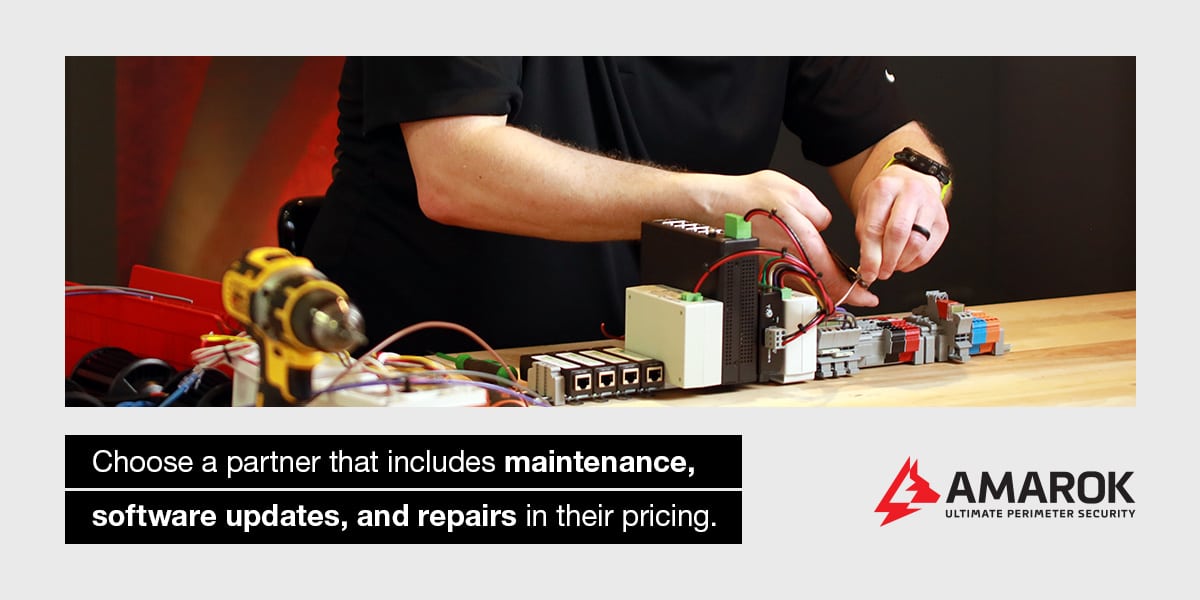
The most effective security systems are often the most advanced, which can make maintenance complex. To avoid hidden costs, choosing a partner that includes maintenance, software updates, and repairs in its pricing is essential.
Look for a company that includes maintenance services as part of its monthly fees at a predictable cost, rather than vendors that charge premiums for emergency service calls. Traditional vendors may not provide maintenance services at all, forcing businesses to pay for third-party services.
3. Verified Compliance and Safety Standards
Compliance standards establish consistent benchmarks for safety, reliability, and system performance. Certifications such as IEC, ANSI, UL, and ASTM confirm that products have been evaluated against recognized technical requirements instead of manufacturer claims alone. Selecting compliant equipment shows a commitment to protecting employees, visitors, and property.
Compliance is about more than paperwork. Choosing a provider with fully compliant solutions is the only way to protect yourself from voided insurance policies and liability for on-site injuries.
When comparing security partners, opt for one that adheres to internationally recognized standards and has all required independent certifications. For example, the world’s most trusted safety codes for electric fences include:
- IEC 60335-2-76
- ANSI/UL 69
- ASTM F3296-19
Ask prospective providers how they maintain compliance throughout installation, maintenance, and future replacements. Independent testing, third-party certifications, and documented inspection processes provide evidence that systems continuously meet applicable standards. A provider committed to regulatory compliance helps reduce legal exposure, supports insurance requirements, and ensures that your perimeter security solution operates safely under real-world conditions.
4. Reputation and Proven Track Record
Strong reputations are built through consistent performance over many years. Beyond reading testimonials, investigate how long the provider has served your industry and whether they support facilities similar to yours. Ask about customer retention rates, average contract length, and examples of long-term partnerships.
Any security vendor can give you a sales pitch, but it’s important to practice due diligence and conduct your own research into each company’s track record and reputation. The most competitive security providers will have multi-site capabilities, robust partnerships, long-term customer retention, and a track record of successfully protecting their customers’ assets.
There are many ways to look into a company’s reputation, including:
- Testimonials: Researching customer testimonials is one of the best ways to ascertain a company’s reputation. Beyond the provider’s website, you can explore public reviews on Google Reviews, Yelp, Trustpilot, and industry-specific sites.
- Awards and media coverage: Industry-leading security service providers will likely have multiple awards. At the very least, they should have positive media coverage that supports how they present themselves.
- Customer references: Consider contacting two or three of each provider’s previous customers for honest referrals. The companies you are considering should be happy to provide these references.
Request case studies that demonstrate measurable results, including theft reduction, improved operational efficiency, or decreased security incidents. Evaluate the provider’s service network, technician availability, and response times across multiple locations. Industry memberships, independent certifications, and established partnerships also indicate credibility. Taking these additional steps helps separate experienced security partners from vendors focused only on making the initial sale.
Frequently Asked Questions
Choosing a perimeter security provider affects every aspect of your organization’s risk management strategy. The right partner delivers more than equipment by providing expertise, long-term support, regulatory compliance, and dependable service. These frequently asked questions address concerns businesses have when evaluating perimeter security providers.
How do I choose the right security system for my commercial property?
A full-service perimeter security provider should deliver more than equipment. Look for a partner that manages system design, installation, ongoing maintenance, software updates, compliance support, and technical expertise. The best providers also offer liability protection, responsive customer service, and proactive monitoring to keep your perimeter security operating at peak performance.
How can I verify that a perimeter security provider is qualified?
Start by reviewing the provider’s certifications, compliance documentation, and insurance coverage. Ask for customer references from businesses with similar operational requirements and request case studies demonstrating measurable results. You should also evaluate their maintenance capabilities, service network, and experience supporting facilities across multiple locations.
Why is compliance important for perimeter security systems?
Compliance helps ensure your perimeter security system operates safely, reliably, and according to recognized industry standards. Providers that follow requirements such as IEC, ANSI, UL, and ASTM demonstrate their commitment to quality and safe installation practices. Choosing compliant solutions can also reduce legal exposure, support insurance requirements, and protect your organization from unnecessary liability.
Compliance is more than a regulatory requirement. It’s an essential part of an effective long-term security strategy.
Why AMAROK Is the Ultimate Perimeter Security Partner
AMAROK delivers a full-service perimeter security solution that satisfies all four critical areas, including the following advantages:
- Liability protection: AMAROK, as sole owner of The Electric Guard Dog® Fence, guarantees that it will protect and defend you. AMAROK is backed by $11 million in liability insurance and will defend its customers, who are contractually added as additional insured.
- Maintenance: Unlimited maintenance and repair services are included in one manageable monthly fee as part of our security-as-a-service model.
- Compliance: All of our systems are IEC-compliant, and we adhere to the internationally recognized standards of UL, ANSI, ASTM, and SANS. Our products also benefit from independent NRTL/SGS certifications.
- Reputation: With over 9,000 commercial properties protected and partnerships with industry professionals, we are proud to have a reputation for being the smarter approach to perimeter security.
Contact AMAROK for Perimeter Security You Can Rely On
Choosing a security provider is about more than buying the right equipment. By partnering with an industry-leading company, you can benefit from business continuity, extensive support, and guaranteed protection. At AMAROK, we offer a turnkey solution that integrates multiple layers of security that protect your property, people, and profits.
Schedule your free risk assessment today and learn more about how our solutions stop theft before it happens.