
Security systems are crucial for businesses to safeguard physical assets, including equipment, inventory, and sensitive information. A secure environment also fosters a sense of safety among employees. Adding video surveillance and remote monitoring to your perimeter security in addition to electric fencing helps create a multi-layered approach that keeps criminals off your property.
Every commercial property has unique security requirements, so building a custom solution is essential to protect your assets. One of the primary decisions when designing your security system is choosing the best type of video recorder.
Network video recorder (NVR) and digital video recorder (DVR) are two types of security systems used to monitor and record video footage. DVR systems use analog cameras connected by coaxial cables. NVR systems use Internet Protocol (IP) cameras connected through network cables.
Understanding the difference between NVR and DVR is important so you can choose the best system for your business.
How DVR Systems Work
Analog cameras capture raw video footage in DVR systems. These cameras are connected to the DVR via coaxial cables, which transmit the unprocessed video signals. Once the signals reach the DVR, they are processed by an analog-to-digital (AD) encoder, converting the analog footage into a digital format. This digital video can then be stored on a hard drive or other storage medium for later viewing.
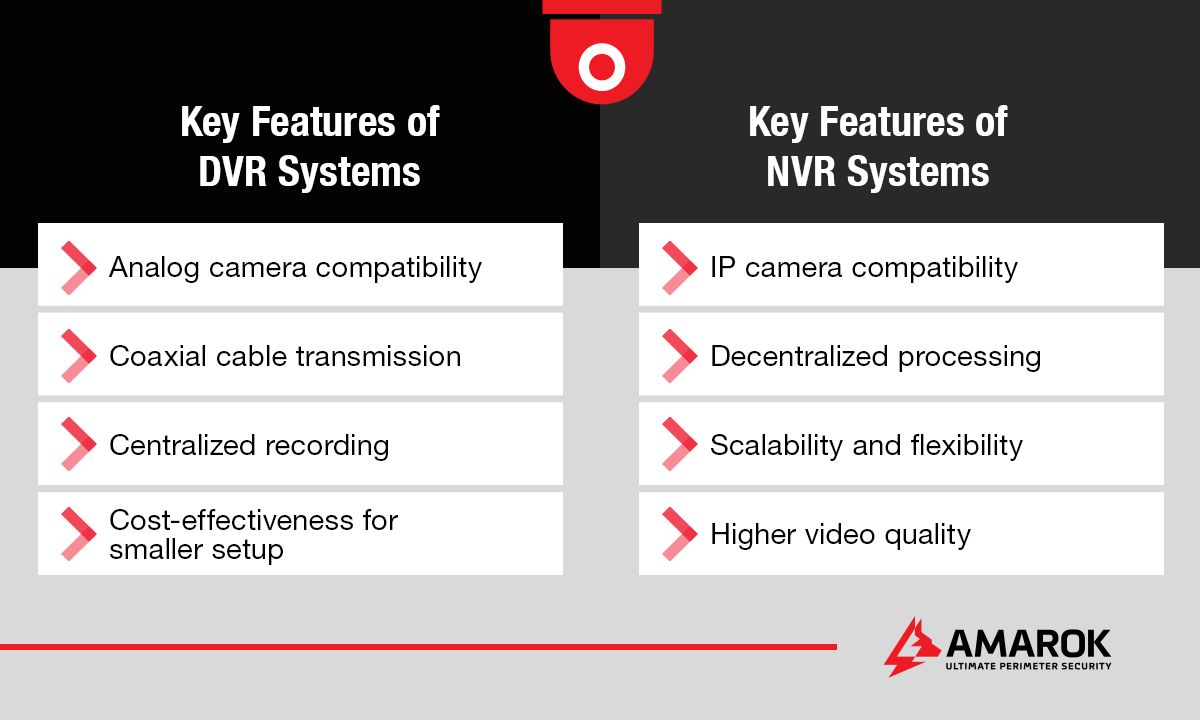
The key features of DVR systems include:
- Analog camera compatibility: DVR systems are primarily designed to work with analog cameras, which offer more simplicity than IP cameras.
- Coaxial cable transmission: The cameras connect to the DVR using coaxial cables, which transmit video signals over a distance. These cables use a separate power source to work the cameras.
- Centralized recording: DVR systems allow for centralized recording of video footage, so it’s easy to manage and access recorded data from a single location.
- Cost-effectiveness for smaller setups: These systems are a popular choice for small businesses as they are generally easier to set up and more affordable.
How NVR Systems Work
NVR systems are designed to record and store video footage from digital security cameras. These systems use IP cameras to capture high-resolution video and audio data. The cameras process the video data internally, then transmit it to the NVR via Ethernet cables or Wi-Fi. The NVR primarily functions to record and store this processed footage so users can view and analyze it later. Unlike DVR systems, where video processing occurs at the recorder, NVR systems handle this at the camera level.
NVR systems include the following key features:
- IP camera compatibility: NVR systems work with IP cameras to capture and process digital video data, providing higher quality footage compared to analog cameras.
- Decentralized processing: Video data processing happens at the camera, allowing for more efficient data handling and enabling features like video analytics.
- Scalability and flexibility: NVR systems can easily accommodate additional cameras without significant changes to the existing setup. This flexibility allows businesses to expand their surveillance systems as needed.
- Higher video quality: NVR supports higher resolutions, often in HD or 4K for clearer, more detailed video footage.
DVR vs. NVR: Pros and Cons
When comparing the security capabilities of DVR vs. NVR, both options are suitable in their own way. The main difference is the way each one processes video data.
Advantages of DVR systems include:
- Lower-cost analog cameras: DVR systems use analog cameras, which offer more affordability than IP cameras. This makes DVR a budget-friendly option for businesses looking for basic security measures.
- Existing infrastructure utilization: If a business already has coaxial cables installed from a previous system, it can save on installation costs by reusing this infrastructure.
- Simpler setup for existing systems: DVR systems are normally easier and quicker to install, especially where coaxial cables are already in place.
- Lower initial costs: Depending on the number of cameras, the overall cost of setting up a DVR system is generally lower.
Disadvantages of DVR systems include:
- Lower video quality: DVR typically offers standard definition video quality. Some businesses may need higher resolutions for detailed monitoring purposes.
- Limited scalability: DVR systems have fixed inputs, restricting the number of cameras that can be added. This fact can be a drawback for properties that may need to expand their security coverage.
- Less flexible camera placement: Cameras need to be near power outlets. Cables have maximum lengths, which limits the placement options for cameras and reduces the overall coverage.
In comparison, NVR systems offer the following benefits:
- Higher quality with IP cameras: IP cameras used in NVR systems are capable of higher video quality. The resolution often ranges from HD or 1080p to 4K to provide clearer and more detailed footage.
- Use of Ethernet cables: Ethernet cables are thinner and easier to install than the thicker coaxial cables. Ethernet cables can also transmit power, video, and audio through a single cable. DVR systems need a separate power source for cameras.
- Superior video quality: The digital nature of IP cameras allows for better image clarity and detail, making it easier to identify individuals and objects.
- Easier installation: With wireless cameras or PoE technology, installing NVR systems can be more straightforward.
- Highly scalable: NVR systems are highly scalable, allowing businesses to easily add more cameras as their security needs grow.
- Greater flexibility: NVR offers greater flexibility in camera placement. The cameras only need to be connected to the same network rather than directly to the recorder. This feature enables more versatile security setups.
The main downside to NVR systems is the higher initial cost. The price tag is generally higher than for DVR systems, which can be a barrier for some business owners.
How to Choose the Best Video Recorder to Keep Your Business Secure
Selecting the right video recorder is a critical step in enhancing your overall perimeter security strategy. Follow this guide to determine the best option for your business needs:
- Integration with other security solutions: When planning your security system, consider how your video recorder will work alongside other technologies. Examples include Gate Access Control, alarm systems, perimeter alarm-based lighting, and electric fencing. Integration helps create a more comprehensive and effective multi-layered security solution. NVR systems, for example, often provide more flexible integration options for monitoring the perimeter.
- Investment capacity: Assess how much budget you have to spend on a security system. DVR systems are more cost-effective upfront, but NVR options offer better long-term value.
- Level of security required: If you need basic surveillance, DVR will typically suffice. If your site is situated in a high-crime area or requires advanced features, NVR is preferable.
- Likelihood of future expansion: NVR systems are highly scalable, allowing you to easily add more cameras as your business expands.
- Technical expertise: NVR systems can be more complex to install and manage as they require a robust network infrastructure. If your team lacks experience with network devices, a simpler DVR option may be a better starting point.
- Camera selection: The type of cameras you plan to use will influence your choice of video recorder. NVR systems work best with IP cameras, whereas DVR systems are compatible with analog cameras.
- Remote access needs: If remote access to security footage is essential for your business, NVR will allow you to view live feeds from anywhere. DVR typically requires physical presence for access, which is less ideal for businesses with multiple locations.
Enhance Your Business’s Perimeter Security With AMAROK
Whether you choose to use an NVR or DVR system, video surveillance is an essential component of a multi-layered security strategy. AMAROK makes it easy to integrate video surveillance, monitoring, and electric fencing with FORTIFEYE™. Deter would-be intruders and detect any unauthorized individuals with multiple layers of security in one effective solution.
AMAROK is an award-winning perimeter security solutions provider, safeguarding more than 8,000 sites across a wide range of industries.
Experience the smarter approach to perimeter security. Request a free expert threat assessment today to get started.