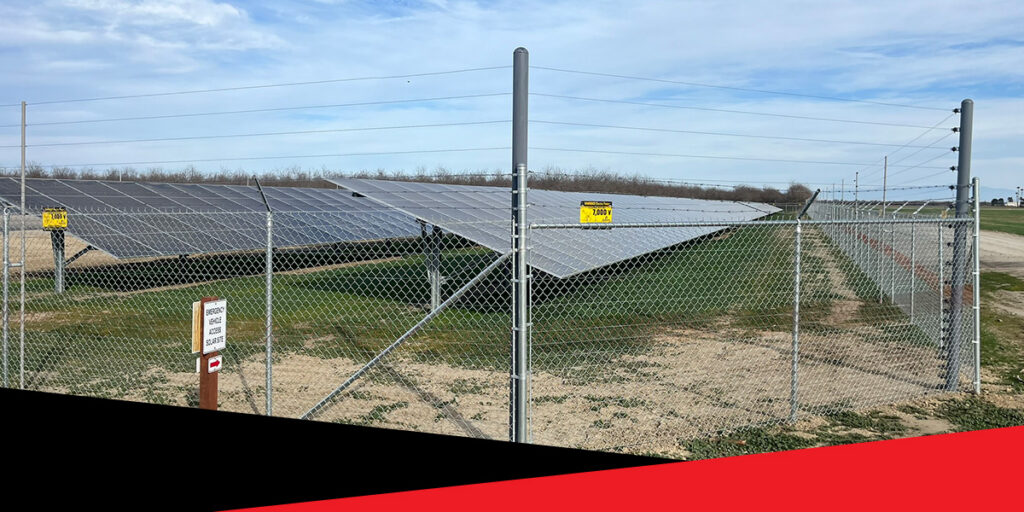

Remote industrial sites and harsh locations come with challenges that standard perimeter security often cannot address. These environments, prone to extreme weather and corrosive atmospheres, degrade security systems and reduce their reliability. Unexpected system failures force teams to react to incidents after breaches occur. For extreme environments, reactive security and manual investigations strain limited staff and increase alarm fatigue, especially in noisy areas.
What Defines an “Extreme Environment” for Security Infrastructure?
Extreme environments are defined by more than just occasional storms. These locations have chronic, sustained conditions that steadily degrade security infrastructure. Over time, this degradation reduces equipment lifespan, undermining system reliability that endangers your people, property, and bottom line.
In these settings, security infrastructure faces unique environmental and physical challenges that speed up component wear, including:
- Thermal stress: This involves constant heat or cold and even extreme temperature fluctuations that go beyond operational temperature ranges. Thermal stress is a common challenge for modern IT infrastructures.
- Chemical attack: Corrosive gases, salts, or industrial pollutants erode metals and seals. Businesses in coastal logistics are especially vulnerable.
- Particulate intrusion: Dust, sand, and salt particulates are operational hurdles that infiltrate housings or bearings, a challenge common at mining sites.
- Infrastructure isolation: Sites without grid power, stable communications, or quick maintenance access, such as remote utility stations, need reliable perimeter security infrastructure.
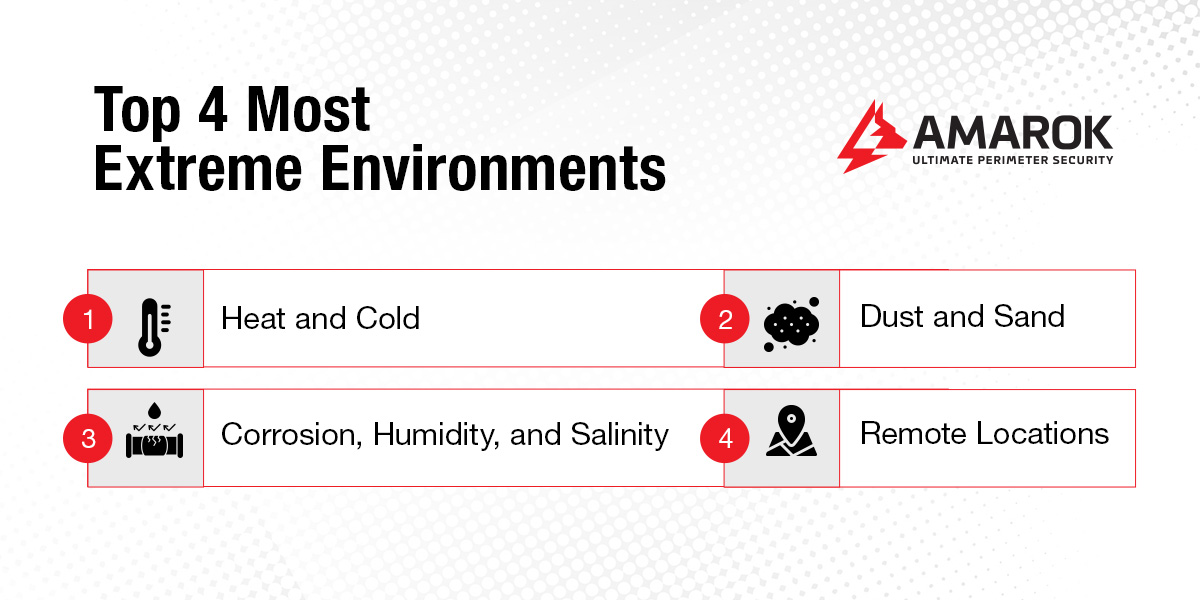
Top 4 Most Extreme Environments
Extreme environments expose perimeter security systems to constant, predictable stress. These conditions vary by location, but each one creates distinct failure points that compromise detection, reliability, and response.
1. Heat and Cold
Temperature extremes damage hardware. In cold climates, metal contracts and seals stiffen, making sensor housings more brittle. Temperatures also impact your perimeter barriers, roads, access paths, and your building’s structural integrity. Batteries, even those used in electric vehicles, lose capacity at low temperatures and can fail altogether if they freeze. In hot climates, electronic components overheat, reducing lifespan and increasing failure rates.
Repeated heating and cooling cycles, known as the freeze-thaw cycle, also stress structural components and can crack housings or circuit boards. If a camera sensor overheats repeatedly, its image clarity degrades, and it may go offline. If batteries dip below their temperature limit, they can’t sustain operations through a single night or an extended power outage.
2. Corrosion, Humidity, and Salinity
Coastal and industrial sites expose perimeter security systems to corrosive conditions. Salt in ocean air accelerates rust on metal parts. Industrial pollutants, such as sulfur compounds, attack seals and electronics. ISO 9223 categorizes corrosivity levels from midrange C3 to high-range C5. Components not rated for these levels often show signs of rusted housings and compromised connections.
High humidity leads to internal condensation within enclosures. Water droplets on boards cause shorts and recurring system failures. In HVAC-poor equipment cabinets, humidity cycles between day and night can deposit microscopic corrosion on connectors or contacts. In chemical plants, airborne acids attack coatings and metal parts, reducing service life.
3. Dust and Sand
Dust and sand create a constant, abrasive assault on moving parts, even on non-autonomous solar panels. This sandpaper effect also gradually erodes edges on housings, seals, and fasteners. Particulates infiltrate small gaps in casings and build up around sensitive camera components. Over time, lens clarity degrades, alarms clog, and mechanical cooling components fail.
Ingress Protection (IP) ratings help quantify this risk. Ratings such as IP65 specify dust-tight performance, but many outdoor units fall short in open desert conditions. Cooling fans and vent systems often draw fine particles into enclosures, making active cooling systems a liability instead of an asset. Engineers must choose passive cooling designs and sealing methods that resist particulate intrusion even when dust levels are high.
4. Remote Locations
Remote facilities such as solar farms, pipeline terminals, and mining sites face isolation challenges. These locations often lack stable grid power and reliable wired communications. Extreme weather makes the power grid vulnerable, and blackouts can be prolonged without access to immediate services. Satellite or long-range wireless links can introduce communication gaps and latency, which delay alerts, reducing real-time situational awareness.
In remote environments, perimeter sensing systems that depend on wired connectivity often fail silently. Security teams may discover outages only after an incident, as law enforcement takes longer to reach remote locations, especially during adverse weather. These factors add to the burden on limited on-site personnel, who must juggle maintenance tasks with daily operations. Without autonomous power and communications design, these sites remain vulnerable.
Modern Solutions Addressing These Challenges
Robust perimeter security infrastructure not only deters intrusion but also endures environmental stressors without frequent maintenance or failure. Here are objective criteria that facility managers should refer to when evaluating perimeter security solutions:
- Verify IP67 and NEMA ratings: Look for devices with IP67 or higher ingress protection and NEMA 4X or NEMA 6P enclosures. These ratings assure long-term water, dust, and particulate intrusion resistance.
- Check operating temperature ranges: Confirm that all components, including cameras, sensors, junction boxes, and antennae, have operational ranges that exceed local extremes. For desert sites, this may be extremely high temperatures, or for arctic climates, well below freezing.
- Evaluate solar or battery autonomy: At remote sites, grid power may be unreliable. Prioritize solutions with autonomous solar power, comprehensive battery banks, and low-power electronics. These designs prolong uptime and reduce dependence on local infrastructure.
Resilient systems support greater compliance and easier integration. They reduce manual workflows and improve data quality while preventing unauthorized access to your site. AI-powered analytics distinguish real threats from environmental noise, which reduces false alarms, improves signal-to-noise ratios, and lowers the need for manual investigation. Integrated access control systems can be programmed to send notifications to security teams when an electric fence or building door alarm is triggered, which also removes manual investigation from the equation.
Partner With AMAROK for Extreme Environment Security
Extreme environments test perimeter security on every front. Heat and cold warp hardware. Corrosion and humidity eat away at metals. Dust and sand infiltrate and erode. Remote sites strain power and communication networks. Without planning for these persistent stressors, facilities face system failures, increased manual investigation burdens, and reactive security postures that expose assets and people.
These challenges demand solutions from AMAROK that are engineered for durability, integration, and long-term performance. We are an award-winning, industry-leading perimeter security solutions provider serving over 9,000 customers across industries in 49 states. For example, our solutions have prevented 99% of external theft after installation for commercial sites in various industries. It all starts with The Electric Guard Dog® Fence, with additional layers that include video surveillance, remote monitoring, and environmentally rated hardware that stays reliable over time.
Schedule your free risk assessment today to protect your property in extreme environments.