
With the high cost of aerospace theft and increasingly rigorous demands of federal compliance audits, aerospace facilities are under more pressure than ever to secure their perimeters. Set apart by their high-value cargo, aerospace facilities are prime targets for thieves. While one stolen engine can provide a criminal ring with millions of dollars in resale value, it can cost facilities even more in downtime, failed audits, and lost contracts.
Standard chain-link fences aren’t enough to deter criminals or to meet federal regulations for restricted-area integrity. To ensure both comprehensive protection and compliance, aerospace facilities need a multi-layered approach to perimeter security that stops theft before it happens.
Why Standard Perimeter Security Fails Aerospace Facilities
Traditional security measures are failing the aerospace industry. Armed security guards are prone to human error and liability issues, while standard fences do little to deter would-be intruders. Today’s criminals are sophisticated, and your aerospace facility’s perimeter security needs to rise to the challenge.
The Rise in High-Value Cargo Theft
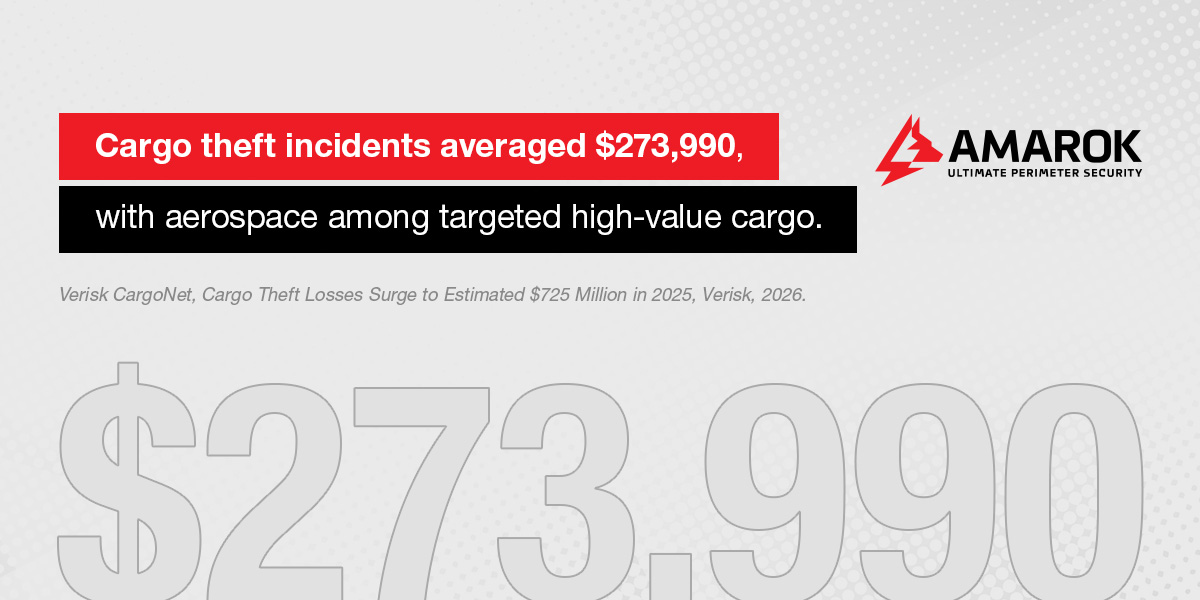
High-value cargo theft is on the rise. Across the nation, cargo theft increased by 18% in 2025, resulting in a loss of almost $725 million. The average value of each incident rose to $273,990, as organized crime groups increasingly targeted top-dollar goods, including those found at aerospace facilities.
Alongside engines, aerospace facilities house high-value items such as avionics, exotic alloys, and specialized tools. Beyond replacement costs, theft of such valuable items can cost companies up to millions in reputational damage, operational downtime, and delivery delays. Aerospace facilities need to invest more in their perimeter security and find a reliable solution for unauthorized breaches.
The Compliance Gap
Adhering to federal compliance is about more than appeasing auditors and avoiding fines. When you align your perimeter security with federal regulations, you are more likely to protect your cargo.
Chain-link fences can be compromised with an everyday pair of wire cutters, giving thieves quick, easy access to your assets. Traditional barriers offer no active deterrence or threat-detection capabilities and therefore often fail to comply with federal security guidelines.
Compliance audits increasingly look for performance-based perimeter security, meaning your system must demonstrably stop or delay an intruder, not just mark a boundary line. In addition to ensuring successful audits, meeting this criterion will also increase the safety of your property.
Defining Restricted Area Integrity for Compliance
Aerospace facilities must maintain restricted-area access control. This involves preventing unauthorized access to airspace and ground zones, as well as mitigating the risks associated with hazardous operations.
Air Operations Area (AOA) vs. Security Identification Display Area (SIDA) Zones
An aerospace AOA encompasses the portion of an airport dedicated to take-off, landing, airplane maneuvering, and runways. SIDA zones are defined as any areas that require workers or visitors to continuously display an official airport ID badge. An AOA is often also a SIDA.
Establishing and maintaining a secure perimeter for both zones is essential, as unauthorized breaches of either are considered federal violations. All airports are required by the Code of Federal Regulations and TSA guidelines to detect every unauthorized presence in the AOA.
Federal Mandates for Controlled Boundaries and Detection
Military specifications require that restricted areas have defined boundaries. According to Federal Aviation Administration (FAA) facility security requirements, these boundaries must be carefully controlled and monitored. Beyond having clear perimeters, facilities need to employ proactive security measures.
According to regulations, aerospace facilities must have controlled boundaries that both detect and prevent unauthorized entry, including by:
- Displaying signs on all AOA access points and perimeters, providing a warning of the prohibition against unauthorized entry.
- Carrying out appropriate measures for controlling entry to the AOA.
- Providing for the detection of and response to every unauthorized movement or presence in the AOA.
Today, an integrated approach to perimeter security is no longer just beneficial; it is mandatory.
The Integrated Solution: Layering Security for Maximum Protection
To comply with strict regulations and prevent theft, aerospace facilities need a multi-layered approach that detects and deters criminal activity. At AMAROK, our integrated solutions bring together real-time threat verification with robust physical deterrents.
The Electric Guard Dog® Fence
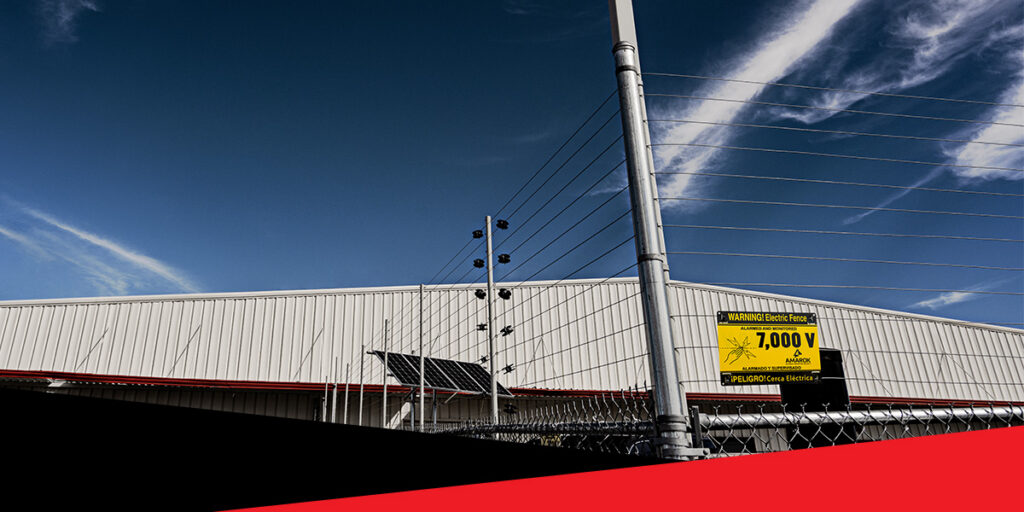
The first line of defense is The Electric Guard Dog Fence that prevents crime before it begins. Continually powered by 7,000 volts, The Electric Guard Dog Fence deters would-be intruders with a safe but memorable shock, minimizing their chances of breaching your perimeter. Along with preventing 99% of external theft after installation, AMAROK’s electric fencing meets ECFR requirements for unauthorized entry prevention.
For effective perimeter security that meets federal guidelines, The Electric Guard Dog Fence detects and helps prevent unauthorized entry to your aerospace facility.
FORTIFEYE®
FORTIFEYE® is a comprehensive perimeter security solution that combines electric fencing with video surveillance and remote monitoring. With FORTIFEYE, your facility can identify and prevent unauthorized access to restricted areas. Surveillance cameras and real-time threat verification support the Electric Guard Dog Fence in satisfying the monitoring and detection requirements of 49 CFR 1542 to help you stay compliant.
By investing in video surveillance and perimeter monitoring, you can reduce false alarms and respond quickly to verified threats.
Gate Access Control
Entry points are your perimeter’s weakest link. For aerospace facility managers, it is crucial that all entrances and exits are reinforced with robust security measures to help minimize breaches and ensure compliance.
With Gate Access Control, you gain comprehensive perimeter access control across your site. With features like license plate recognition and AI cameras, credential readers, video and audio intercoms, and pan-tilt-zoom and fixed cameras, your facility can securely manage who can enter your premises.
Enhance Your Aviation Asset Protection With AMAROK
Aerospace facilities face increasingly strict regulations and a rise in high-value cargo theft. Preventing unauthorized access and ensuring compliance with federal regulations are more important than ever.
Don’t wait for a failed audit or stolen engine to upgrade your perimeter security. AMAROK can help you determine whether your aerospace security system is fully compliant and effective, then recommend solutions to proactively prevent and deter theft.
Contact AMAROK today for a free risk assessment.