
Auto theft trends are changing fast. While National Insurance Crime Bureau data through the first half of 2025 shows a 23% decline in reported U.S. vehicle theft, criminals have shifted their focus. Organized groups now target commercial assets with precision, exploiting vulnerabilities in fleet yards and supply chains.
For freight and automotive professionals, shifting theft trends directly impact pricing, operations, delivery schedules, and reputation. Asset theft disrupts operations, increases insurance premiums, exacerbates delays, and harms a company’s reputation. One lost asset ripples across logistics and customer commitments. It forces route changes, missed deliveries, and increases rental costs to maintain service levels.
Why Commercial Fleets Are the New Prime Targets
Commercial fleets have become increasingly appealing targets due to their offering of scale, value, and predictability. Organized groups look for efficiency, which most fleet environments provide through:
- Volume efficiency: Thieves see the wholesale value in commercial fleets. Stealing multiple vehicles from a dealership or a fleet ensures a bigger payday.
- High-value assets: Commercial vehicles commonly carry tools, equipment, or cargo worth tens or hundreds of thousands of dollars.
- The “soft target” perception: Many fleet yards and commercial lots lack multi-layered security, making them easy targets for organized groups looking to breach quickly.
This combination creates a high-reward, low-resistance profile that attracts sophisticated theft rings.
The 3 Leading Auto Theft Trends
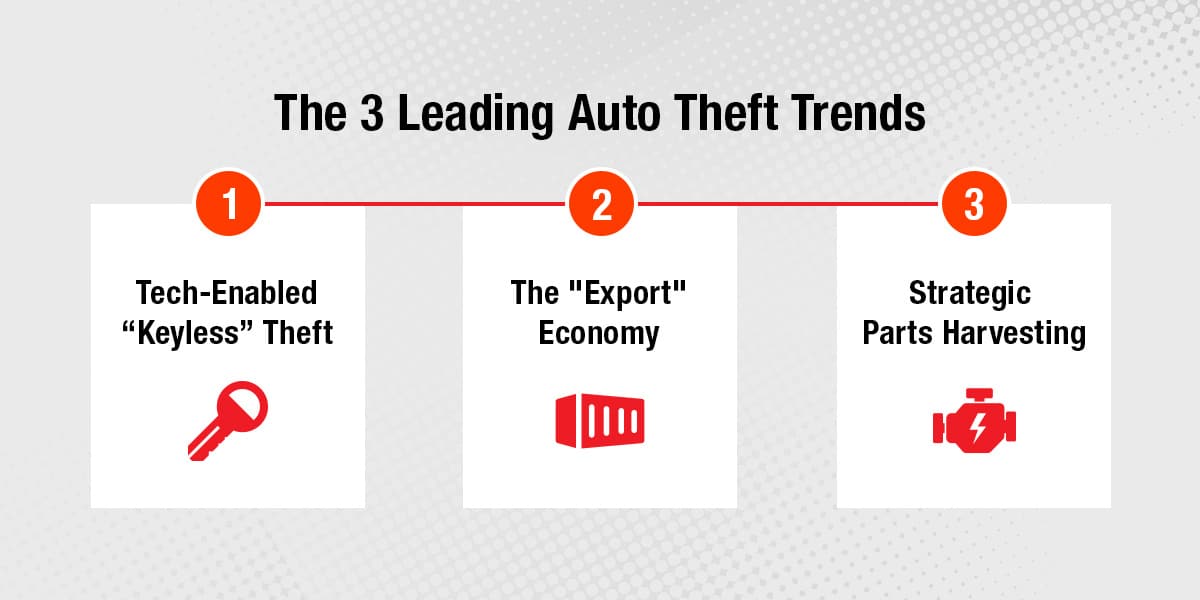
Auto theft trends are shifting toward a complex crime model increasingly supported by technology, logistics, and secondary markets. Three key trends currently shape this commercial threat landscape:
1. Tech-Enabled “Keyless” Theft
Modern theft tactics now combine physical access with electronic exploitation. Two methods are standing out:
- Relay attacks: Thieves use inexpensive signal-relaying devices to bridge the communication between a vehicle and its key fob. These devices grab or amplify the key fob’s signal, tricking the vehicle into thinking the authorized key is nearby. That lets thieves unlock and start the car without ever touching the key.
- CAN bus injections: The Controller Area Network (CAN) targets a vehicle’s internal communication network. By accessing points such as headlight wiring or diagnostic ports, attackers inject crafted electronic commands into the vehicle’s systems to bypass immobilizers or authentication. These digital commands mimic legitimate inputs, allowing thieves to start or drive off without any fob present.
These methods highlight a core problem. Standard locked gates and reactive defenses do nothing against electronic intrusion. Thieves bypass these perimeter barriers, access a vehicle’s electronics, and complete a theft before anyone notices.
2. The “Export” Economy
Stolen vehicles and components are often exported almost immediately after theft. Criminal rings use freight infrastructure to containerize stolen cars and ship them overseas.
At major U.S. ports, law enforcement agencies routinely intercept containers carrying stolen vehicles, often bound for West Africa, the Middle East, Central America, and South America. Vehicles may be loaded with legitimate cargo, mislabeled, or even disguised as carrying household goods to evade detection. Recovery rates drop at this point, and many reach their destination before they are detected.
Syndicates use VIN cloning or re-VINing to disguise stolen vehicles as legitimate exports. This process involves assigning a stolen vehicle a clean identity from a scrapped title or unused VIN, reducing red flags in paperwork.
3. Strategic Parts Harvesting
Theft trends now extend beyond entire vehicles. Criminals are targeting high-value resale components, such as engines, transmissions, telematic modules, and catalytic converters. Pickup trucks like the Ford F-150 and SUVs like the Honda CR-V are among the most targeted vehicles for parts harvesting. Premium wheels and tires from luxury vans or trucks, as well as tailgates and electric vehicle (EV) cables or adapters, can fetch substantial sums due to limited aftermarket supply.
The consequences for operators are severe. Removing wheels or EV charging hardware leaves vehicles on-site, but renders them inoperable. Repairs, downtime, and claims from parts theft can be as costly as full vehicle loss. Ongoing global supply chain disruptions, as well as part replacements for niche or high-demand components, prolong vehicle downtime and increase rental costs.
What Auto Theft Really Costs You
Auto theft holds high financial and operational costs for commercial operators. Recent data shows the breadth of the impact and why theft prevention matters beyond the price of the vehicle itself:
- Cargo theft surge: In 2024, CargoNet tracked 3,625 cargo theft incidents in the U.S. and Canada, with the average value per theft exceeding $202,000.
- Industry losses: The American Transportation Research Institute reported average theft losses exceeding $520,000 per motor carrier and $1.84 million per logistics service provider.
- Hidden expense escalation: Replacement vehicles, investigation time, claims handling, and risk mitigation efforts add tens of thousands to the bottom line for each incident.
Together, these factors show the true cost of auto theft. Operators pay through premiums, downtime, asset replacement, and operational friction that erode margins across logistics networks. A proactive perimeter security strategy reshapes the threat equation. It reduces the number of claims, helps satisfy insurance requirements, and strengthens operational resilience.
The Challenges of Traditional Lot Security
Many fleet yards still rely on basic security measures that provide visibility, but don’t prevent theft. CCTV alone isn’t enough. Cameras record incidents, but they don’t stop them. Criminals look for camera locations and blind spots, working around them when they enter your property. Additionally, when there are no active barriers, thieves can enter, steal, and exit a property within a few minutes.
Passive security reacts after the fact. Active security intervenes during an attempted breach.
Active perimeter solutions introduce friction. They delay entry, trigger alerts, and draw attention to illicit activities. As risks rise, criminals are deterred by tougher security measures.
Protect Your Inventory With AMAROK
Commercial auto theft is no longer a random occurrence. It’s strategic. Thieves exploit keyless entry systems, sell stolen vehicles abroad, and lift high-value parts, leaving vehicles unusable for extended periods. The real cost of auto theft extends beyond lost assets. Businesses face higher insurance costs, extended downtime, and operational disruptions that negatively impact their reputations.
AMAROK designs perimeter security solutions for commercial environments where asset value, scale, and uptime matter. These systems focus on prevention. Our flagship product, The Electric Guard Dog® Fence, prevents 99% of external theft for customers after installation. Other elements of our multi-layered security strategy include video surveillance systems, Gate Access Control systems, and perimeter alarm-based lighting systems that work together for a manageable monthly fee.
Protect your fleet before a perimeter breach occurs. Contact AMAROK for a free risk assessment and strengthen your first line of defense.