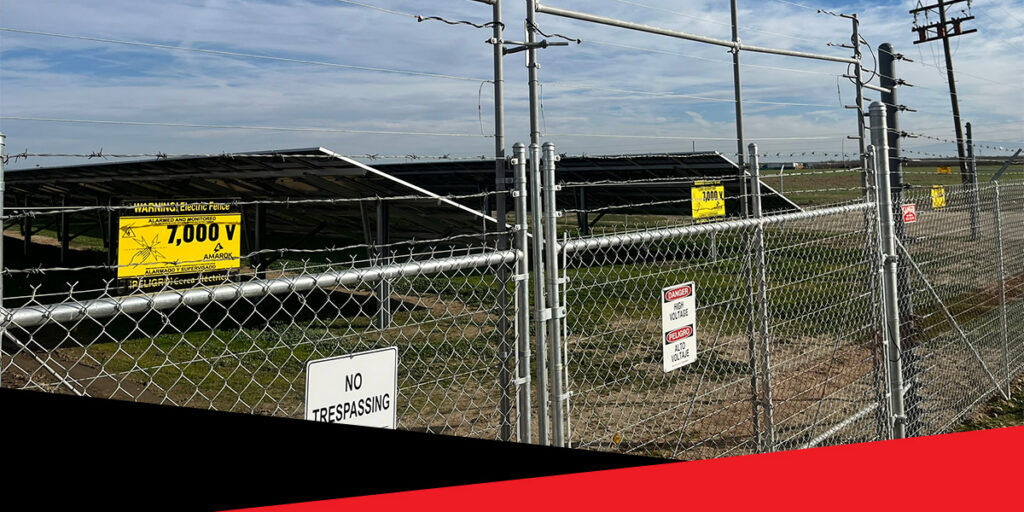

Critical infrastructure includes the assets, systems, and networks essential for daily life. Energy grids, water treatment facilities, transportation hubs, and communication networks fall under this category. Attacks on these operations can debilitate national security, the economy, and public health. Protecting these facilities requires a deep understanding of targeted systems and highly trained individuals to address complex risks.
However, relying solely on security guards has become unsustainable. Training gaps, resource limitations, and performance constraints create vulnerabilities. High turnover rates also plague the industry. Multi-layered security solutions strengthen perimeter security without increasing headcount.
Why a Guard-Based Security Model Is Unsustainable
A guard-based security model is unsustainable due to rising labor costs, extreme turnover, and human limitations. Rising labor costs strain budgets annually, while turnovers compromise consistent performance. Meanwhile, human limitations create gaps that criminals exploit. Staffing-independent security solutions address these core problems.
Rising Labor Costs
Security guards require solid wages, benefits, and training to maintain peak performance. You must account for minimum wage increases, inflation adjustments, and annual raises. Sixty-one percent of security service providers struggle with rising hourly pay rates. Unarmed guard wages range from $7.25 to over $25 per hour, while armed guard wages cost $13 to over $30 per hour. Labor costs increase when you expand operations.
Additionally, criminals employ increasingly sophisticated tactics. You must continuously train guards to keep pace with evolving threats. This training adds to the ongoing costs. New hires who undergo training but leave within a few months result in lost investments.
Critical infrastructure facilities with limited budgets benefit from exploring alternatives. Modern security solutions, like electric fencing, are more cost-effective in the long term.
High Turnover Rates
Turnover ranks as a top challenge for 40% of security service providers, and 52% struggle with labor shortages. Turnover and shortages lead to performance inconsistencies. With turnovers, you create inexperienced teams that lack familiarity with your vulnerabilities, while labor shortages create inconsistent patrol routines.
Security guards performing extra work due to shortages also become fatigued, affecting response times and decision-making capabilities.
Human Limitations
Physical and mental limitations impact performance and response capabilities. When guards work extended periods, attention drops over time, creating vulnerabilities. Complacency also develops in low-threat environments, leading to reduced scanning behavior. In high-pressure, stressful situations, fight-or-flight responses can override guard training.
Working solely with security guards represents a single-layer security strategy. Guards monitor only limited areas at a time, while personnel changes create transition vulnerabilities. Skill levels also differ across personnel. Adopting a multi-layered security system provides continuous protection that doesn’t depend on human endurance.
How to Increase Critical Infrastructure Security Without Security Guards
You need to adopt advanced security strategies to enhance the security of critical infrastructure without security guards. Sophisticated breaches and inherent human limitations increase vulnerabilities. Perimeter security without guards becomes achievable through proactive measures, continuous surveillance, and automated access control. These solutions protect facilities based on their unique risks while maintaining automated 24/7 protection.
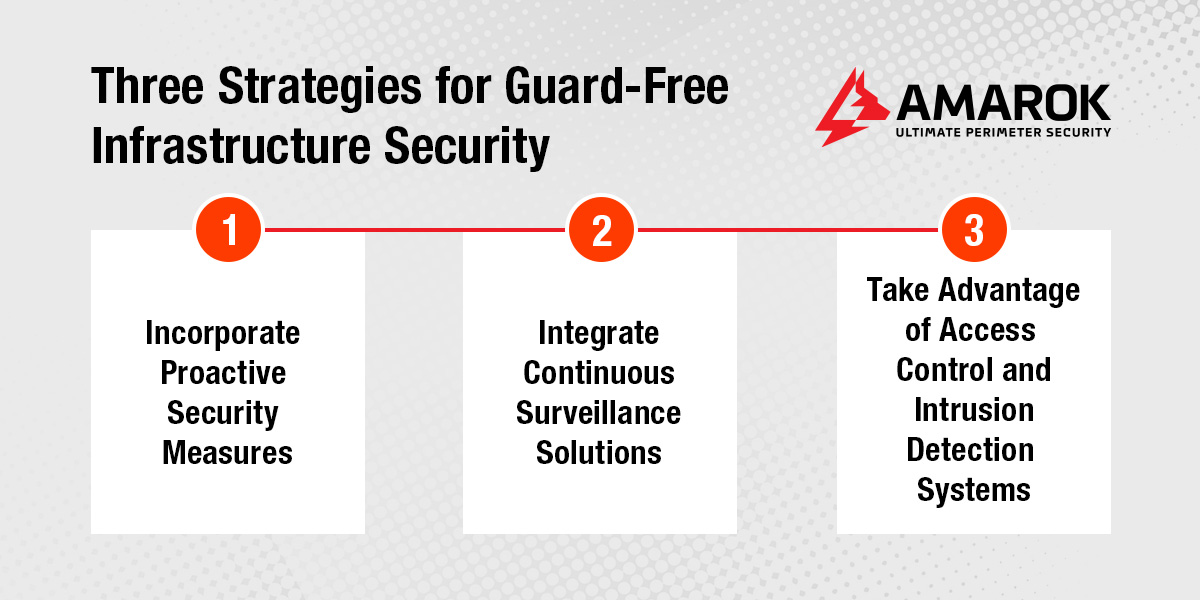
1. Incorporate Proactive Security Measures
Proactive security measures identify and address vulnerabilities before criminals exploit them. This forward-thinking approach emphasizes prevention over reaction. Reducing security staffing needs starts with strategic planning that involves:
- Conducting risk assessments: Perimeter security experts evaluate risks specific to your environment. They consider local crime data, analyze facility layout, and identify high-value targets within your operations.
- Adopting appropriate security solutions: Choose solutions aligned with your operations and risks. For instance, installing an electric fence keeps criminals off your property. The fence secures your site even during off-hours without requiring human monitoring to function effectively. Siren and lighting systems provide extra protection for your remote, high-risk locations.
- Training employees and security personnel: Educate them on security protocols. Training reinforces policies and equips individuals to respond effectively to potential threats.
Proactive security proves cost-effective long-term. You avoid expenses associated with incidents, investigations, and legal consequences. You also protect employee safety, your reputation, and stakeholder trust.
2. Integrate Continuous Surveillance Solutions
External theft, trespassing, after-hours activity, and operational blind spots necessitate continuous surveillance. Security guards only see a fraction of large sites. Relying solely on guards becomes risky for properties with multiple entry points. Continuous surveillance gives you access to trained security specialists who monitor your facility in real time.
You’ll be working with trained security providers without the cost of expanding your workforce. Security specialists escalate incidents immediately to on-site personnel or authorities. This approach provides continuous oversight of valuable assets, enabling prompt responses to suspicious activity.
Continuous monitoring transforms video surveillance from a reactive to a proactive strategy. Cameras no longer just passively record incidents. Access to live and recorded footage also makes it easy to check your site, even if you’re away from your facility. Sharing evidence with law enforcement becomes straightforward when incidents occur.
Additionally, continuous monitoring solutions help you comply with regulatory requirements for critical infrastructure sectors. For instance, nuclear power sectors must include surveillance, observation, and monitoring in their physical protection programs to check the integrity of physical barriers. Certain jurisdictions also require visual confirmation before dispatching local police. Active security specialists and on-hand footage make compliance easier.
3. Take Advantage of Access Control and Intrusion Detection Systems
Access control systems authorize or deny access to your facility, protecting it at the perimeter. Intrusion detection systems notify you of suspicious activity and attempted breaches. You set authorization levels for each person based on their roles, protecting critical areas even if you accept visitors.
Systems include key fobs, entry cards, PIN codes, and other locking mechanisms. You don’t need security guards to manually approve or deny access at entry points. The system logs entry and exit times of authorized employees. Motion detectors, door contacts, and window contacts detect potential intrusions within your buildings.
Secure Your Critical Infrastructure With AMAROK
AMAROK provides advanced, multi-layered perimeter security solutions that eliminate the need for additional security guards. The Electric Guard Dog® Fence alone prevents 99% of external theft at the time of installation. This fence delivers a safe but memorable pulsed electric shock of up to 7,000 volts every 1.3 seconds. It serves as a physical and psychological deterrent that encourages potential intruders to take their activity elsewhere.
Our remote and mobile video monitoring systems enable you to work with security specialists who monitor your site 24/7. You’ll also be able to access live and recorded footage from any device. FORTIFEYE® integrates our video and monitoring solutions with the fence to deter, detect, and detain criminals. With active surveillance, you’ll receive prompt responses during incidents.
Complete your security strategy with Gate Access Control and building intrusion detection systems that secure all access points. They prevent unauthorized access to your office, warehouse, and other spaces within the facility. AMAROK protects 9,000+ happy customers with our integrated solutions. Contact your local AMAROK representative today or call (800) 432-6391 to become one of our happy customers.