Chemical facilities are high-value targets for theft, trespassing, and sabotage. These sites face growing physical security threats at a time when regulatory oversight has shifted. Chemical Facility Anti-Terrorism Standards (CFATS) enforcement lapsed in July 2023, removing the compliance floor that many facilities relied on to guide their security posture.
However, physical threats did not lapse with the regulation. Without mandated oversight, the stakes for proactive chemical plant security are higher than ever. This article addresses the documented threats chemical facilities face, why standard security measures fail to protect against them, and the multi-layered approach that actually works.
Physical Threats to Chemical Facilities
Chemical plants are attractive targets due to the abundance of chemical products, raw materials, and specialized equipment with high resale value. The main physical security threats to your chemical facility include:
- Unauthorized access and trespassing
- Theft of chemicals and raw materials
- Sabotage and tampering
- Unauthorized chemical handling
These threats result in physical harm to personnel, operational disruption, and financial losses from stolen assets, plus emergency response costs.
Why Standard Security Measures Fall Short
Under CFATS, baseline chemical facility physical security requirements provided a steady framework to follow. Now that enforcement has lapsed, facilities that once operated at compliance minimums now set their own standards, often without realizing how much exposure that creates. Chain-link fences, unmonitored cameras, and guards contribute to a visible security presence but fail to prevent determined intrusion.
Chain-Link Fences Provide No Active Deterrent
Bolt cutters or wire snips cut through chain-link fences in minutes. The fence establishes a property line but triggers no alarm when breached, does not deter intrusion, and offers no notification to security personnel. By the time anyone discovers the breach, intruders have already accessed the property.
Gates Create Multiple Vulnerabilities
Without documented access controls and real-time monitoring, gates become the weakest point in the perimeter. Unauthorized vehicles may tailgate authorized ones, while contractors and delivery personnel receive temporary access credentials that may not be properly vetted or revoked after completion. Gates left open during high-traffic periods eliminate the barrier entirely.
Unmonitored Cameras Only Document Crime
Security cameras capture footage, providing evidence for law enforcement investigations. However, passive recording does nothing to prevent criminals from accessing the property, stealing materials, or tampering with equipment. Without immediate response capability, cameras serve as documentation tools rather than preventive security measures.
Guards Face Coverage Gaps
Security guards cannot patrol an entire facility simultaneously, leaving areas of your site unmonitored. Shift changes and weather events create transition periods when coverage thins, making it easier for criminals to target your facility.
The median annual salary for a security guard in 2024 was $38,390, excluding emergency coverage and overtime. For businesses operating multiple plants that require extensive 24/7 coverage, salaries create a high ongoing expense.
6 Ways to Improve Physical Security at Your Chemical Facility
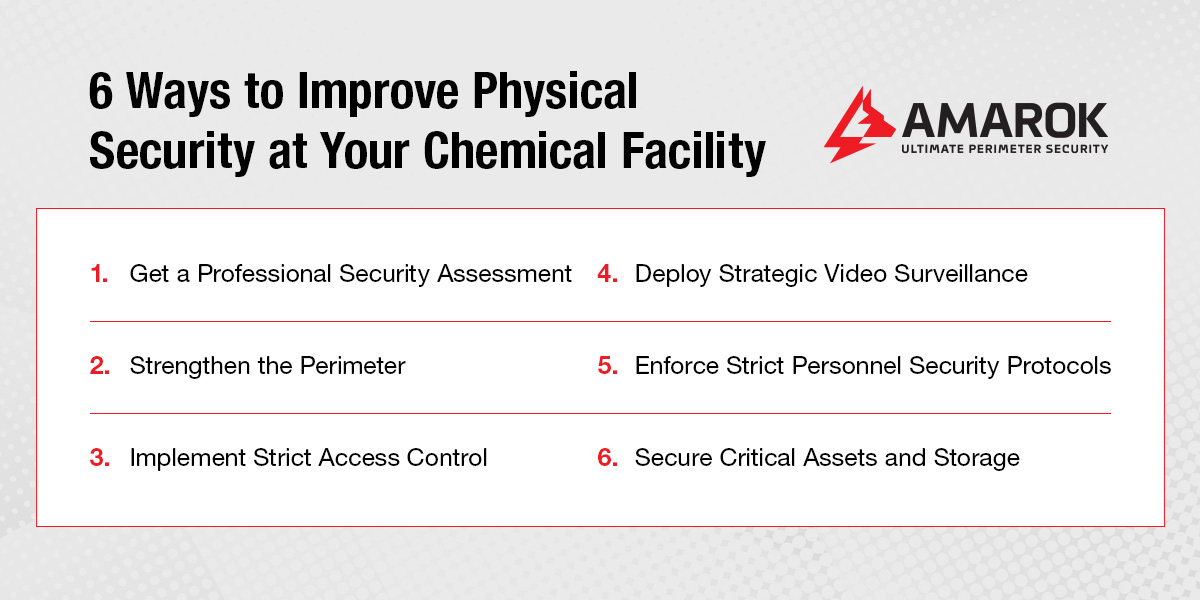
Improving physical security for chemical plants requires layering defenses that address different threat vectors simultaneously. Effective protection comes from multiple barriers that deter opportunistic criminals, delay determined trespassers, and enable rapid response if a breach occurs.
1. Get a Professional Security Assessment
Before you invest in specific measures, a qualified security professional should assess your site. They are trained to evaluate entry points, perimeter integrity, surveillance blind spots, storage zone exposure, and personnel access patterns for vulnerabilities that internal teams often overlook.
The Cybersecurity and Infrastructure Security Agency’s ChemLock program offers voluntary, no-cost security assessments for facilities that handle hazardous chemicals. In the post-CFATS environment, this program helps you establish baseline security standards and identify gaps.
2. Strengthen the Perimeter
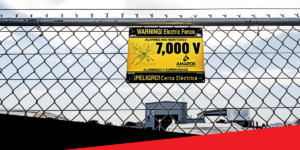
The perimeter is the first physical line of defense. Unlike standard chain-link fencing, electric security fencing provides the most active deterrent. Warning signs and the imposing height establish a psychological barrier, creating doubt before anyone attempts entry. If a criminal tries to cut or climb the fence, it delivers a medically safe pulsed shock that deters them.
Beyond the electric fence, additional barriers ensure chemical plant perimeter security, making it even harder for criminals to force their way into your facility. Physical barricades at access points eliminate easy entry. Vehicle crash-rated bollards at approach roads and entry points prevent unauthorized vehicular entry.
3. Implement Strict Access Control
A hardened perimeter is still vulnerable if you do not control who enters and exits the facility. Credential-based access systems featuring key card, fob, or PIN systems at vehicle and personnel entry points create documented records of access events. Intercoms provide identification capability through video and audio verification.
Access control is most effective when the number of active entry points is minimized, and there is a documented challenge procedure for unrecognized personnel or vehicles. It also requires integration with broader perimeter security measures, where access events trigger camera recording, lighting activation, and notification to monitoring personnel if unusual patterns occur.
4. Deploy Strategic Video Surveillance
Video surveillance extends visibility across the perimeter and throughout the facility, recording all events that happen as evidence in case of an incident. Cameras require two supporting elements:
- Strategic lighting: Alarm-triggered lighting around the fence line improves footage clarity while creating sudden exposure that deters criminals.
- Remote monitoring: Pairing surveillance with a live 24/7 monitoring team allows personnel to verify suspicious activity and alert law enforcement in real time. This coordinated response eliminates the gap between breach detection and police notification.
5. Enforce Strict Personnel Security Protocols
Chemical safety and security extend beyond the fence line to people operating inside the facility. Background checks and vetting for personnel with access to dangerous chemicals minimize insider threat risks. Additional protocols to reduce threat exposure include:
- Strict access badge policies: Do not allow tailgating or shared credentials. Encourage immediate reporting of lost or stolen badges.
- Visitor escort procedures: All visitors must be accompanied by authorized personnel at all times while on-site.
- Clear reporting channels: Ensure employees know how to report suspicious activity without fear of retaliation.
- Defined off-hours access restrictions: Access to sensitive areas requires additional authorization outside normal operating hours.
Ongoing security awareness training ensures employees recognize unusual behavior, protect sensitive information, and report suspicious incidents immediately. Regular refreshers keep security protocols active and adapt to emerging threats as facility operations change.
6. Secure Critical Assets and Storage
Added physical security measures within high-risk storage zones ensure defense in depth, securing hazardous materials and protecting against insider threats.
- Restricted access credentials: Credentials for chemical storage areas remain separate from general facility access, limiting entry to essential personnel only.
- Reinforced enclosures: Containment structures for the highest-risk chemicals provide physical barriers that slow unauthorized access attempts.
- Intrusion detection devices: Door and window contacts, motion detectors, plus glass-break sensors trigger immediate alerts when storage areas are accessed outside authorized periods.
- Dedicated surveillance coverage: Cameras focused specifically on storage areas capture all activity, creating audit trails and deterring theft.
Protect Your Chemical Facility With AMAROK
Protecting a chemical facility requires more than a fence. It requires an integrated approach where each layer of security reinforces the others and where the perimeter actively deters intrusion, not just marks a boundary.
AMAROK is a trusted perimeter security partner for over 9,000 commercial properties across the United States, including critical infrastructure facilities such as chemical manufacturing and distribution sites. Our multi-layered solution is built on The Electric Guard Dog® Fence integrated with video surveillance, Gate Access Control, and optional remote monitoring, preventing 99% of external theft for customers after installation.
Contact us today online or at (800) 432-6391 for a free risk assessment.