
Government and utility sites face a threat far more sophisticated than opportunistic theft. Organized crime rings are targeting critical infrastructure, conducting surveillance, exploiting vulnerabilities, and executing coordinated attacks. These professional crews aren’t deterred by standard chain-link fences or other typical security measures. They study your site and strike when defenses are lowest.
Security leaders recognize this isn’t casual crime. It’s organized and calculated. The question isn’t whether your site is vulnerable, but whether your current security posture can withstand a professional-grade assault. Understanding how these theft rings operate is the first step toward building a defense that works.
The Scale of Organized Infrastructure Theft
The infrastructure theft epidemic affecting government and utility operations isn’t anecdotal. The numbers paint a stark picture of an accelerating crisis:
Network attacks surging: There were over 19,000 attacks on U.S. communications networks in 2025, representing a 59% increase since 2024.
Incident frequency doubling: From January to June 2025, reported incidents jumped from 5,770 to 9,770, totaling over 15,540 incidents annually.
Massive financial and societal impact: Attacks have affected over 11.8 million customers and carry societal costs ranging from $294 million to $1.47 billion.
Why Thieves Target Government Assets
Critical infrastructure encompasses the physical and virtual assets essential to society’s health, safety, and economic well-being. Professional organized crime groups are targeting utilities and government sites for specific reasons.
Three factors make government property theft particularly attractive to organized theft rings:
High resale value of materials: Government and utility sites contain large quantities of copper wiring, valuable metals in transformers, and fleet vehicle parts, such as catalytic converters. These materials all command strong prices on the resale market. Copper prices increased by more than 40% in 2025 alone, directly correlating with metal theft trends.
Vulnerability of sites: Government facilities are ideal targets for professional crews. These sites are typically large, remote, and understaffed. The presence of passive security measures, such as traditional fencing, does not deter thieves, either.
Operational anonymity: Stolen government assets are sometimes harder to trace immediately. For example, thieves may steal government license plates to attach to getaway vehicles, evading law enforcement while committing further crimes.
How Professional Theft Rings Operate
Understanding the methods organized theft rings use is critical for developing effective countermeasures. They follow established protocols, assign specialized roles, and execute with precision.
1. Advanced Surveillance and Planning
These are not crimes of opportunity. Professional operations consist of members with specific roles, including planners, lookouts, thieves, and drivers. Before striking, professional crews conduct extensive reconnaissance.
They assess security measures and identify the best time to strike, often targeting dark areas off the street. Crews document patrol patterns, camera blind spots, shift changes, and access points. They look for the path of least resistance and the moment of maximum vulnerability. Thieves also identify the type and quantity of valuable materials on-site, calculating potential return on investment before committing resources to the operation.
2. Exploiting Security Weaknesses
Once reconnaissance is complete, crews act swiftly. Thieves use tools, such as bolt cutters, to breach perimeter fences and gain access. Professional crews work efficiently to remove high-value targets, often completing operations in under 15 minutes to minimize exposure and detection risk.
Organized criminals searching for copper often cut adjacent fiber-optic cables, causing widespread service outages. Recent analysis of business theft and security trends shows this pattern across industries and regions.
The True Cost of Infrastructure Theft
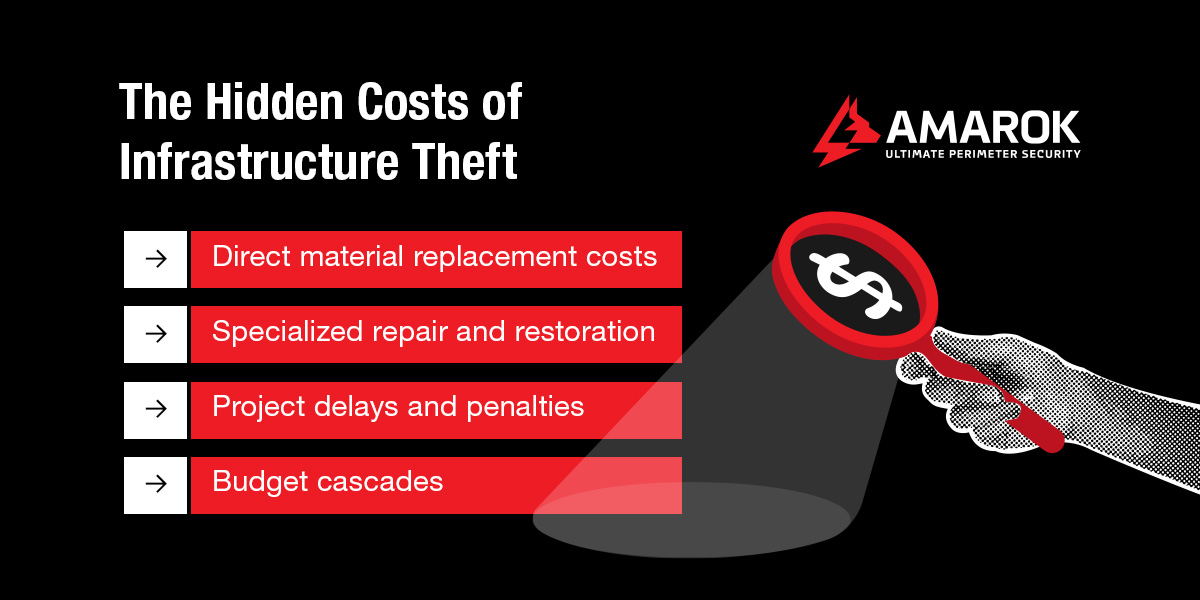
The true impact extends far beyond stolen materials. The asymmetry between theft and recovery costs is striking. The theft of a few hundred dollars of copper can cost a company tens of thousands of dollars in repairs. The true financial impact includes:
Direct material replacement costs: Facilities must source replacement materials at current market rates.
Specialized repair and restoration: Organizations must hire repair crews, conduct safety inspections, and restore systems to operational status.
Project delays and penalties: An investigation in March 2026 found that a utility contractor lost approximately $400,000 from a single site over several months. This figure doesn’t capture project delays, contract penalties, or the staff hours diverted to security concerns rather than core operations.
Budget cascades: For government entities operating on fixed budgets, these unplanned expenses create cascading problems across multiple programs.
At the same time, critical infrastructure outages caused by theft and vandalism can disable essential public services:
Emergency response systems: Attacks compromise emergency systems and dispatch capability.
First responder communications: Police, fire, and EMS communications networks go dark. Responders are forced to operate without real-time coordination.
Healthcare infrastructure: Hospital networks fail, disrupting patient care and inter-facility coordination.
Transportation systems: Airport operations systems experience outages, creating delays and safety concerns.
A theft taking minutes can leave responders operating blindly for days. The societal cost of these disruptions, measured in delayed emergency response and compromised public safety, is incalculable.
Why Traditional Security Is Not Enough
Standard perimeter barriers provide false security. Chain-link or barbed-wire fences can be quickly and quietly cut, climbed, or bypassed by organized criminals with basic tools and planning. At best, traditional fences slow intruders by seconds or minutes. When breached, they provide no alarm, no notification, and no escalation. Security personnel discover the breach only after the damage is done.
Video surveillance remains common but has significant limitations against organized theft rings. These systems are fundamentally reactive. Cameras record crime, but they do not prevent it. Surveillance documents what happened, provides evidence for investigation, and may support prosecution. By the time security reviews footage and responds, the criminals are gone, and the loss is complete.
For facilities serious about protection, resources on comparing different security solution types reveal the critical gap between passive barriers and active deterrence systems.
How to Build a Proactive Defense
Stopping organized theft rings requires shifting from reactive to proactive deterrence. A proactive defense begins with an active, intimidating barrier that deters criminals before they breach your property. Advanced electric security fencing creates a powerful physical and psychological deterrent. An active response at the perimeter line prevents intrusion attempts immediately. Some systems trigger an alarm to monitoring personnel in real time.
Surveillance becomes proactive when integrated with active perimeter defenses and professional monitoring. A multi-layered strategy combines the perimeter fence with video surveillance and remote monitoring to create a system where each component enhances the others. When an alarm triggers at the fence line, a monitoring team can promptly verify the threat and dispatch law enforcement with confirmed information.
Protect Your Property from Organized Theft With AMAROK
The rise of organized theft rings targeting government property demands a proactive, multi-layered defense strategy. Traditional passive barriers and reactive surveillance cannot stop professional criminals who plan their attacks with precision.
AMAROK protects critical infrastructure and government facilities nationwide with an integrated security approach built around The Electric Guard Dog® Fence. Our solutions deliver active deterrence at the perimeter, stopping threats before they breach your property. By preventing 99% of external theft post-installation for over 9,000 commercial properties, we provide the protection government sites need.
We work with federal, state, and local agencies to design and implement security solutions tailored to your facility’s unique requirements. To secure your property, request a free risk assessment from our perimeter security experts today.