
Traditional security methods, such as guards and unmonitored video surveillance, increase operating costs and create financial volatility for commercial properties. Meanwhile, an integrated, tech-driven security strategy makes security spending predictable, reduces losses, and protects assets, delivering long-term financial benefits.
Virtually any type of organization can reap the benefits of investing in a proactive security strategy.
Converting Volatility Into Predictable Operating Expenses
With guard-heavy models, seasonality and contract renewals lead to fluctuating security costs, making it difficult to maintain a balanced budget. Maintaining your own security equipment presents similar challenges, with upkeep and repair needs proving difficult to anticipate.
Conversely, switching to a managed subscription model delivers predictable, flat monthly expenses and eases financial uncertainty.
Ease of Budgeting
Knowing exactly what perimeter security will cost each month lets you plan capital and operating budgets with confidence. With fixed fees, you won’t have surprising line items like emergency fence repairs or overtime after incidents. This clarity supports long-range planning and aligns with enterprise risk management strategies.
Risk Transfer
Partnering with a full-service perimeter security provider transfers financial and operational risk. Typically, a service provider includes warranties, ongoing maintenance, and monitoring, effectively creating a buffer against unforeseen equipment failure or performance gaps. For example, a service agreement may cover repairs and replacements, shielding your business from large, unexpected capital outlays.
Tax Efficiency
For many companies, expensing regular service fees provides immediate tax deductions, whereas depreciating large capital expenditures spreads the tax benefits over several years. Depending on the tax strategy and jurisdiction, converting capital expenditures into predictable operating expenses can improve tax efficiency and near-term cash flow for commercial operations.
Reducing Liability Exposure
Liability exposure represents another financial security risk for commercial properties. Key mechanisms that reduce liability exposure include:
- Guard liability reduction: Integrated systems reduce guard liability by enabling remote observation and early detection, thereby minimizing the need to put guards in harm’s way during face-to-face confrontations.
- Fence risk mitigation: Integrated systems mitigate passive fencing risks by actively warning and deterring intruders, thereby limiting liability arising from inadequate or failing barriers that cannot effectively stop unauthorized access.
- System verification: Technical advantages with integrated detection and verification systems provide documented evidence of incidents, reducing liability disputes and supporting insurance claims.
Scalability and Asset Value Protection
Commercial environments change fast as sites expand, operations shift, and asset profiles grow. Security should scale with your operations to provide long-term value.
Flexibility is often limited by traditional security infrastructure. With each level of expansion, new costs, contracts, and risks are triggered. Customizable perimeter security aligns protection with business growth.
Protecting High-Value Assets
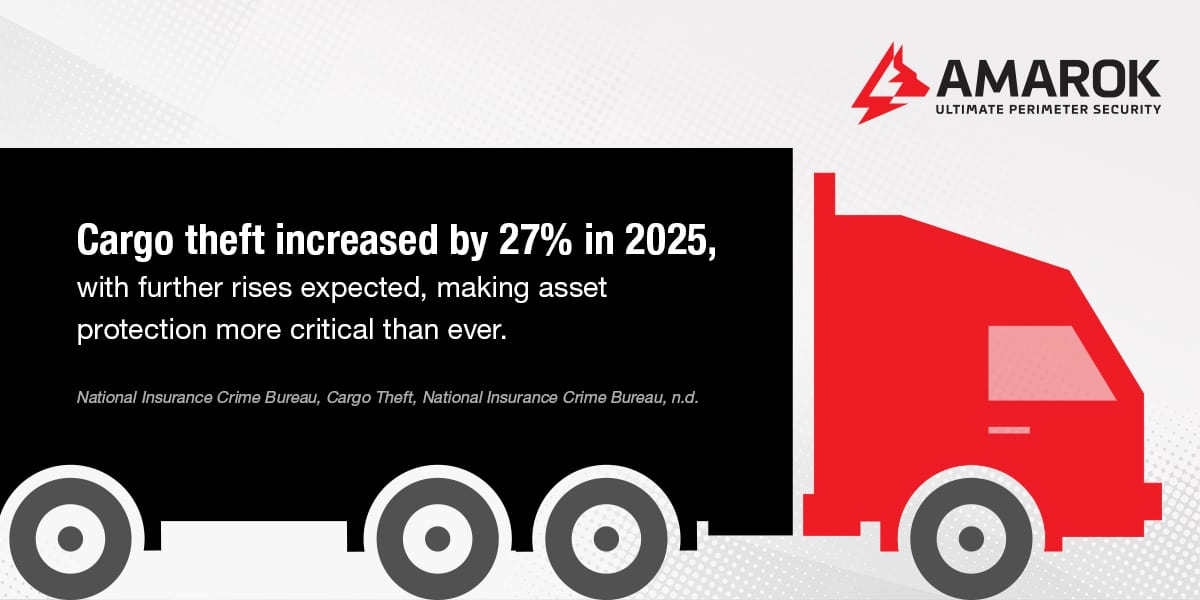
High-value assets attract organized, repeat offenders. Cargo theft, for example, increased by 27% in 2025, with further increases expected. A customizable perimeter strategy prioritizes asset safety. Sites can adjust access control, remote monitoring, and perimeter visibility as asset values change.
For industries such as logistics, manufacturing, and energy, asset protection directly supports revenue continuity. Preventing theft helps you avoid the cascading costs of halted production, missed shipments, or regulatory exposure.
Flexible Expansion
Passive infrastructures struggle with flexible expansion. Extending fencing or increasing guard coverage demands new capital approval, timeline adjustments, and contract renegotiations. These delays leave assets exposed during transitions.
With customizable perimeter security, sites can adjust monitoring and access controls in response to changing asset values, avoiding overprotection in low-risk zones and underprotection in high-risk areas.
Resale Value
Asset valuation is significantly influenced by security decisions. Alongside revenue potential, buyers and investors assess risk. Hidden liabilities often plague sites with unresolved security vulnerabilities.
Active perimeter security systems demonstrate risk awareness and reduce exposure to theft-related interruptions. These factors support stronger valuations during refinancing, sale, or mergers. Future business owners will inherit a system that adapts to new use cases, tenant mixes, and operating models. That flexibility reduces future capital needs and improves long-term asset appeal.
The Total Cost of Ownership of Passive Security
Total cost of ownership (TCO) covers all costs, including purchase, maintenance, operation, and failures, over a system’s lifespan. Standard fencing and unmonitored barriers require the owner to cover upkeep and repairs, which can be particularly costly if the site has numerous security incidents.
Paying security guards can be costly as well, with 24/7 coverage often exceeding six figures per year. Meanwhile, staffing shortages and high turnover in the security workforce hinder service quality and push costs even higher.
The opportunity cost becomes clear when resources can instead support proactive, integrated systems that prevent incidents and reduce reliance on manual intervention.
The True Cost of Deterrence Failure
When legacy perimeter deterrence systems fail, the financial impact multiplies. Without an active perimeter security system, the true loss from incidents such as construction material or catalytic converter theft includes direct and indirect costs, such as:
- Downtime: Sites may halt operations during investigation or repairs.
- Service-level agreement penalties: Contract commitments may include financial penalties for service disruptions.
- Insurance increases: Frequent claims tend to drive higher premiums or increased deductibles.
Effective perimeter security uses a multi-layered approach based on the 5 D’s of perimeter security, a widely recognized strategic framework for building robust defenses that lowers the probability of loss:
- Deter: Weak or purely passive deterrents invite repeated attempts at security breaches. When deterrence works, incidents never occur.
- Detect: If deterrence fails, detection can prevent silent breaches. Undetected intrusions lead to greater loss, longer dwell times, and higher downstream costs.
- Deny: Without denial, a detected threat can still result in loss. Effective denial limits an intruder’s progress, reducing damage and liability.
- Delay: Delay mitigates the cost of detection gaps. Even if the response isn’t immediate, slowing the intruder reduces the likelihood of successful theft or vandalism, as well as the associated operational disruption.
- Defend: When earlier layers fail, defense limits final loss. A controlled response prevents escalation, collects evidence, and reduces the likelihood of repeat incidents.
Invest in AMAROK Perimeter Security Solutions
Investing in perimeter security transforms this line item from a cost center into a strategic asset. Integrated, tech-driven solutions reduce incident risk and protect your bottom line over time. Commercial leaders who adopt this approach gain clarity in budgeting, transfer risk, and enhance operational resilience.
AMAROK is a leader in perimeter security solutions for commercial environments. Using our flagship product, The Electric Guard Dog® Fence, we design and implement integrated, multi-layered strategies for properties in various industries. Our solutions are solar-powered, so your line of defense stays active even during power outages. With our security-as-a-service model, you have zero up-front costs for security that blocks 99% of external theft.
Schedule a free risk assessment to strengthen your perimeter strategy and start flattening operating costs.