
Most perimeter security assessments begin with a checklist, revealing only visible assets. Without deeper analysis, critical weaknesses can go unnoticed, leaving sites vulnerable under real threat conditions.
Beyond a simple checklist, an effective site security assessment looks at how your site operates, where risks are highest, and how intruders might get in. The right perimeter security questions will reveal actual weaknesses, not just what seems secure.
Foundational Perimeter Security Questions
A trustworthy professional assessor will treat each site layout as unique. Multi-tenant properties, commercial facilities, industrial plants, data centers, and logistics hubs face vastly different threats. A one-size-fits-all audit reflects surface-level familiarity instead of deep expertise.
1. Do You Audit from the Outside In or the Inside Out?
The right assessment combines both perspectives. Outward inspection identifies physical entry points and sensor coverage. Adding an inside-out perspective to the assessment tests how access control, internal workflows, shift patterns, and asset locations create blind spots that intruders could exploit. A perimeter assessment must marry both lenses to reveal the routes a criminal may take on the way in, and the ways that inadequate internal practices could enable escalation once inside.
2. What Specific Standards Do You Use to Benchmark Our Security?
Standards provide a consistent benchmark for evaluation. Ask which frameworks guide the assessor’s methodology. If the assessor only uses their own scoring system and doesn’t follow widely accepted standards, that’s a warning sign. Ask for the exact standard version they use, and how they map findings to documented benchmarks. Specifically, look for references to:
- ASIS Security Risk Assessment (SRA)
- Physical Asset Protection (PAP) standards
- NFPA 730 Guide for Premises Security
- DHS Interagency Security Committee (ISC) Physical Security Criteria
3. Does Your Assessment Include a Penetration Test Perspective?
Physical breaches can cost businesses $100,000 per incident, making thorough inspection critical. Penetration testing simulates real adversaries to uncover vulnerabilities that standard reviews may miss. A reliable assessor sees your site through many eyes, including corporate, operational, regulatory, and criminal.
Vulnerability-Specific Questions
Once you have a clear methodology, drill into vulnerabilities. Asking these questions reveals whether the assessor understands complex, real-world industrial facility risk.
4. How Does Your Solution Function During a Total Power Outage?
Power outages can happen due to weather events, interruptions, and infrastructure failures. Your perimeter security must keep functioning during total power loss, including:
- Emergency power sources that automatically engage
- Detection and communication systems that stay live
- Gate controls and batteries that are fail-safe
Ask exactly how long backup systems operate and request verification methods, such as generator load stress or battery discharge logs.
5. What Is Your Solution’s False Alarm Rate, and How Is It Verified?
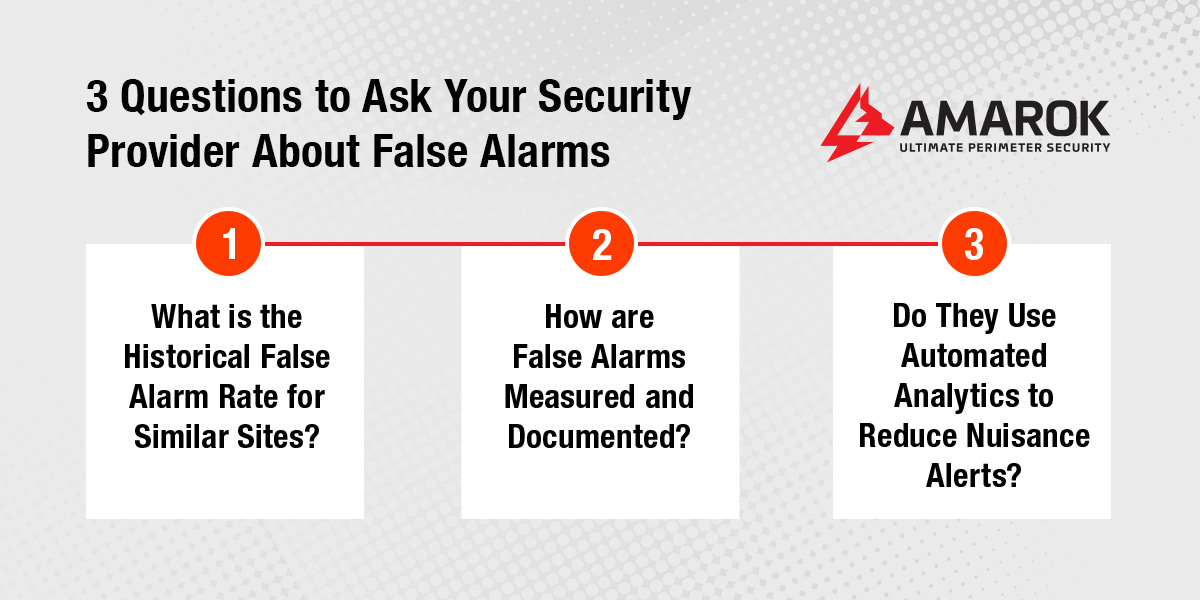
Ask how often false alarms happen. It’s not realistic to have zero false alarms, but good standards and checks should be in place. Ask:
- What is the historical false alarm rate for similar sites?
- How are false alarms measured and documented?
- Does the assessor use automated analytics to reduce nuisance alerts?
The answers will show you that they understand both detection and effective verification.
6. How Do You Eliminate Night-Time Blind Spots?
Poor lighting invites breaches. Ask for specifics, including:
- Are low-light cameras used where needed?
- How do you cover high-risk zones?
- Are vegetation, terrain, and weather factored into detection and sightlines?
A competent assessor will map exact coverage gaps and propose precise fixes, not generic products.
Liability and Operational Questions
Security is primarily about stopping intruders, but it’s also about protecting your business, your compliance, and your people.
7. Do You Offer Indemnification if Your System Fails or Causes Injury?
A perimeter security system can create liability if it harms employees, visitors, or contractors. Ask what indemnification or liability protections exist in the service level agreement (SLA) and what the exclusions or limitations are. If the assessor avoids the question, dig deeper. Clear accountability protects your organization.
8. Does Your System Require Our IT Team’s Bandwidth?
Many perimeter solutions include technology such as video analytics, networked sensors, cloud services, and mobile apps. It’s important to understand the operational impact on your internal teams by asking:
- How much IT support is required?
- Are cybersecurity controls built in?
- Does the solution demand heavy network resources or special configurations?
The “After-Action” Questions
A perimeter assessment report is only valuable if it leads to action and measurable improvement.
9. What Are Your Response Time Guarantees?
Ask for precise metrics related to response time, including:
- Response time SLAs
- Average dispatch escalation intervals
- How alerts are escalated if unattended
10. How Often Is the Risk Assessment Updated?
Security is dynamic as threats evolve and regulations change. Risk assessments should be ongoing, not a one-time report. Ask the following questions:
- How often do you revisit risk profiles?
- Do updates consider changes in operations, local crime trends, or tech advancements?
- Is there a recurring schedule for reassessment?
Bonus Questions Not to Miss
These prompts show you whether the assessor truly understands perimeter defense, long-term risk, and operational reality:
- How does your assessment account for multi-layered defenses like electric fencing combined with surveillance and alarms?
- Can you quantify real outcomes, such as theft prevention or guard cost savings?
- What compliance standards do you build into your physical barriers and warning signs?
- Can you tell me more about post-installation service and support?
- How do you account for unique terrain or environmental factors?
Your security partner should answer directly with examples and data, not broad claims or a sales pitch. The answers will help reveal whether their recommendations are built on real, measurable security practices.
Perimeter security assessments require more than surface-level checklists. They demand a structured methodology, real-world validation, specific vulnerability analysis, operational transparency, and ongoing vigilance. The questions above will help you distinguish paper recommendations from an actionable security strategy.
Turn to AMAROK for data-driven answers to all of these questions. During a free risk assessment, our team will evaluate your site as well as its existing security systems and environment, reflecting an outside-in and inside-out methodology grounded in recognized security standards. We also account for outages with solar-powered security infrastructure, plus vegetation management and strict code compliance.
Contact AMAROK for a risk assessment that offers clarity, precision, and proven expertise.