
Trucking and transportation companies are under increasing pressure to protect high-value cargo, expensive equipment, and critical infrastructure while meeting evolving security compliance requirements. And cargo theft isn’t slowing down. CargoNet reported 884 theft incidents in the second quarter of 2025 alone, a 13% jump from the same period in 2024.
For many companies, the financial hit is just the beginning. Weak security can put you at risk for regulatory fines, insurance headaches, and the kind of reputational damage that can cost you contracts and customers. Perimeter security compliance does more than keep thieves out. It proves to regulators, insurers, and your customers that you’re serious about protecting their assets.
Understanding the regulatory landscape and how to address it is the first step to protecting your company’s assets and bottom line.
Key Compliance Regulations
Transportation and logistics operations must meet federal, state, and industry-specific regulatory requirements that can affect truck yard perimeter security. These requirements exist to protect critical infrastructure, maintain supply chain integrity, and keep the nation’s transportation networks secure and operational.
The Federal Motor Carrier Safety Administration (FMCSA) of the U.S. Department of Transportation sets baseline security standards for commercial motor carriers, especially for those hauling hazardous materials. While FMCSA regulations focus heavily on driver qualifications and vehicle maintenance, they also require carriers to implement security measures that prevent unauthorized access to vehicles and cargo. The Transportation Security Administration (TSA) adds another layer through its Highway Security-Sensitive Materials program, which mandates comprehensive security plans that include facility protection.
Occupational Safety and Health Administration (OSHA) standards for the trucking industry create additional security obligations. Trucking facilities must demonstrate they’re adequately protecting employees from external threats, such as unauthorized entry and theft-related incidents. OSHA’s General Duty Clause requires employers to maintain workplaces free from recognized hazards, which courts have consistently interpreted to include reasonable security measures in high-crime areas or industries with documented theft issues.
Insurance carriers have also gotten into the game, increasingly tying coverage terms and premium rates to security system documentation. Many commercial auto and cargo policies now include specific perimeter security requirements, and insurers will conduct site audits to confirm that your security measures are in place and functioning correctly.
Compliance Challenges
Maintaining compliance across these overlapping regulations creates legitimate operational challenges. Transportation facilities often span multiple jurisdictions, each with its own permitting and security requirements. This regulatory patchwork eats up management time and creates compliance gaps when facility managers can’t keep up with the ever-changing rules.
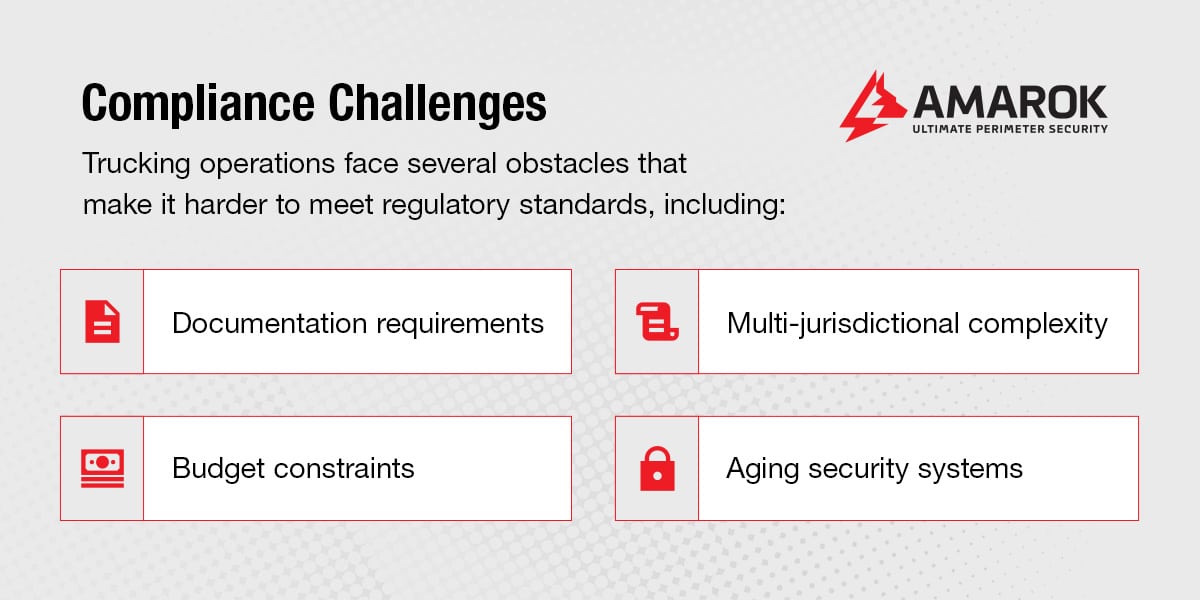
Trucking operations face several obstacles that make it harder to meet regulatory standards, including:
- Documentation requirements: Insurers and regulators demand proof that security measures work as intended through service records, alarm logs, and incident reports. Companies with disjointed security setups involving multiple vendors often can’t produce the comprehensive documentation that auditors expect.
- Budget constraints: Transportation operates on thin margins, making it challenging to justify up-front capital spending for an adequate security system. Traditional approaches require substantial initial investments in equipment, installation, and ongoing maintenance contracts.
- Multi-jurisdictional complexity: Trucking companies operating terminals in multiple states must comply with different local codes while simultaneously meeting federal FMCSA and TSA requirements.
- Aging security systems: Security equipment becomes outdated, requiring ongoing capital investments to remain compliant with evolving standards.
The consequences of noncompliance go far beyond regulatory fines. OSHA violations related to workplace security can carry penalties of up to $16,550 per incident, with willful or repeat violations carrying penalties of up to $165,514. TSA security plan deficiencies trigger enforcement actions that can shut down operations until corrected. Insurance claim denials from inadequate security leave companies absorbing the full cost of theft losses.
In addition to financial penalties, noncompliance can harm customer relationships and competitive positioning. Shippers increasingly audit carrier security programs before awarding contracts, particularly for high-value or time-sensitive freight. A single cargo theft incident can lead to contract terminations and trouble securing new business.
How Truck Yard Perimeter Security Helps Support Compliance
Effective perimeter security is essential for meeting regulatory compliance requirements at transportation facilities. The proper security measures help you comply with multiple regulations simultaneously while protecting the assets that regulators want protected. Truck fleet security works best with a multi-layered approach that aligns with compliance frameworks requiring defense-in-depth strategies, including:
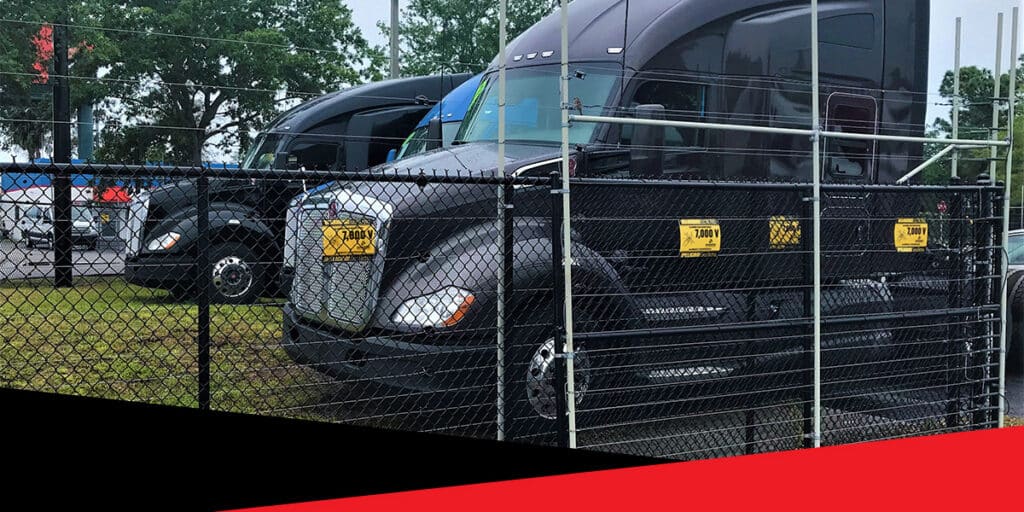
- Electric fencing: Creates an imposing physical barrier that delivers a safe but memorable shock, directly addressing FMCSA and TSA requirements.
- Video surveillance: Records and documents perimeter activity and provides evidence for insurance claims and law enforcement investigations.
- Access control solutions: Allows only authorized personnel to enter the facility and creates audit trails that demonstrate compliance with security plan requirements.
- Alarm-based lighting: Activates when the fence goes into alarm, improving response effectiveness and deterring criminals who rely on darkness.
- Building intrusion detection: Protects offices, warehouses, and other on-site structures with motion detectors that monitor entry points and provide instant mobile alerts.
The benefits of these solutions go beyond regulatory compliance. Fewer incidents of theft mean fewer insurance claims, potentially lower premiums over time, and uninterrupted operations that keep trucks moving and revenue flowing. Security investments also protect your reputation with customers and employees who expect professional transportation providers to safeguard their interests.
Implementing a Compliance-Focused Security Strategy
Understanding your facility’s unique vulnerabilities is an essential first step toward compliance. Every trucking terminal or distribution facility faces distinct challenges based on location, cargo types, operational hours, and existing infrastructure. Through a risk assessment, security experts can identify specific compliance gaps and security weaknesses that criminals could exploit.
The experts can evaluate your property to determine which regulatory requirements apply and how to address them cost-effectively. These professionals understand how federal regulations, state codes, and local permitting requirements connect and impact security installations. In addition, they assess factors like property layout, neighboring land uses, crime patterns, and existing security measures to recommend solutions that meet compliance obligations while aligning with your operational needs.
Customized perimeter security solutions address industry-specific compliance requirements rather than taking a one-size-fits-all approach. Transportation facilities need physical security measures that account for constant truck traffic, multiple access points, and the challenges of securing large outdoor storage areas. Working with the experts allows you to design solutions that protect your assets without creating bottlenecks that delay loading, unloading, or dispatch operations.
Strengthen Your Security Compliance With AMAROK
Transportation companies rely on AMAROK to meet perimeter security compliance requirements while protecting their operations from external theft.
AMAROK’s approach systematically addresses compliance and security. Our compliance team handles all permitting and jurisdictional requirements, ensuring your security installations meet federal, state, and local standards. Many of our solutions meet internationally recognized safety codes and standards, with third-party certifications that satisfy regulatory audits.
AMAROK, as sole owner of The Electric Guard Dog® Fence, guarantees that it will protect and defend you. AMAROK is backed by liability insurance and will defend its customers, who are contractually added as additional insured.
To learn more about how our capabilities can benefit your commercial business, contact our perimeter security experts for a free risk assessment.