
As a business owner, you’re constantly under pressure to cut costs, and when it comes to security, the allure of a low up-front price can be powerful. The choice between a budget-friendly option and a premium integrated system may seem simple on the surface, especially if you’ve experienced little to no crime. However, this decision is about more than the one-time cost. It needs to take into account your company’s stability, safety, and future.
Opting for a cheaper security solution may seem smart at first, but it often introduces a flood of hidden costs, operational disruptions, and vulnerabilities that can far outweigh any initial savings. To make a sound financial decision, you must look beyond the sticker price to understand the total cost of ownership and the long-term value of any security strategy.
This guide to business security costs from AMAROK explores the true price of cheap security and offers a framework for making a smarter, value-based investment to protect your property and profitability.
Why Does Cheap Security Seem Like a Smart Choice?
Budget constraints, competing priorities, and the absence of immediate threats may push you toward decisions that favor short-term savings over long-term protection.
1. The Allure of Short-Term Savings
Financial pressures drive many security decisions. When you’re reviewing quarterly expenses or annual budgets, the tangible cost of a security system stands out clearly. The immediate savings of a cheap option are concrete and measurable, while the potential losses from theft, vandalism, or security failures remain abstract and uncertain.
Normalcy bias will pull you toward the cheap option. If your facility hasn’t experienced a major incident yet, it’s easy to assume you’re not truly at risk. You might convince yourself that your business isn’t a target or that your location is safe enough without needing to make a significant investment.
2. The “Good Enough” Fallacy
The belief that any security is better than none can drive you toward cheap options. On the surface, this reasoning seems logical. A visible security measure, even a low-quality one, should deter at least some criminals.
However, this perspective overlooks a critical reality. Below a certain quality point, security systems stop preventing threats altogether. Criminals can often identify cheap equipment by its appearance, mounting quality, or visible brand. They know which systems are easy to disable or avoid, which means a cheap security option will not deter them.
3. The Information Gap
You understand your industry, your operations, and your customers, but you’re not a security expert. Security is a specialized field with its own terminology, technologies, and best practices. Without this knowledge, it’s difficult to assess what level of protection your business actually needs.
This information gap extends to the hidden costs of inadequate security. You might focus solely on the purchase price, overlooking maintenance contracts, monitoring fees, replacement costs, and the operational impact of system failures. By the time these expenses become obvious, the cheap system is already installed and failing.
What Are the Hidden Costs of Cheap Security?
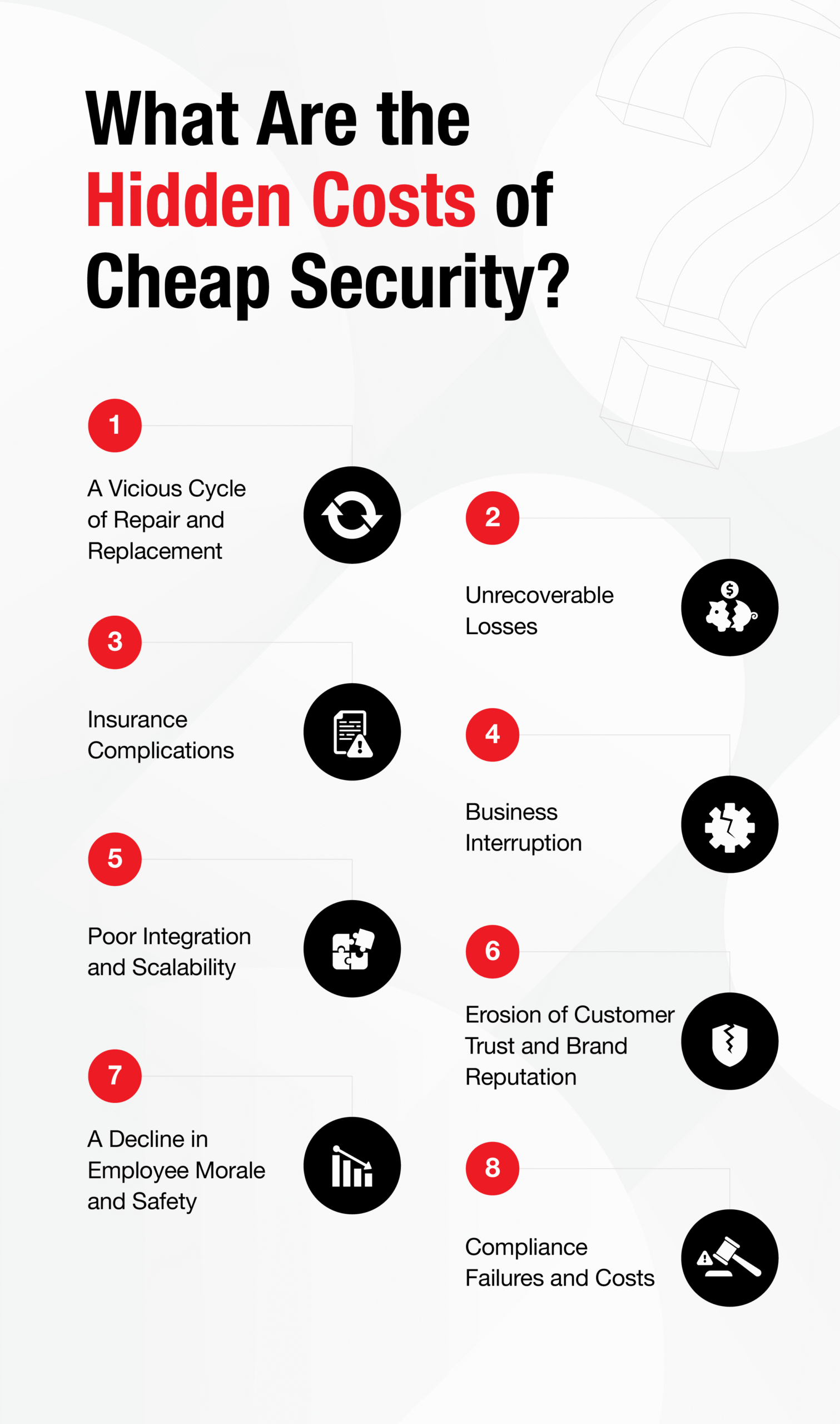
The initial price tag of a security system is just the tip of the iceberg. The real financial impact reveals itself over time through numerous, often unexpected, expenses like replacement costs, losses from crime, system failures, and a loss of customer trust. These hidden costs can accumulate quickly, turning what appeared to be a smart budget decision into a significant drain on resources.
The potential risks of choosing cheap security options include:
1. A Vicious Cycle of Repair and Replacement
Low-quality hardware fails frequently. Cheap cameras develop image problems, weather seals deteriorate, and sensors malfunction. Plastic housings crack in temperature extremes. Each failure creates a security gap that leaves your property vulnerable until repairs are complete.
The recurring costs add up quickly.
- Service calls can be costly, even for minor issues.
- Replacement parts for budget systems are often hard to find, forcing you to replace entire units rather than fix them.
- Some manufacturers discontinue support for older models within just a few years, leaving you with equipment that you can’t repair.
2. Unrecoverable Losses
Many cheap security systems act as passive witnesses rather than preventive measures. Professional thieves can identify vulnerable systems by their appearance, positioning, or lack of visible monitoring, then devise a plan to defeat them easily.
The costs of theft can be staggering. Supply chain crime incidents alone resulted in nearly $725 million in losses in 2025, a 60% increase from 2024, according to Verisk. For businesses with high-value assets such as vehicles, heavy equipment, copper wiring, and bulk inventory, losses from theft can be difficult to recover from.
3. Insurance Complications
Insurance providers assess risk carefully. When they review your security measures, they’re determining how likely you are to file a claim. A non-certified or unreliable security system signals a higher risk, which can translate into higher premiums.
The impact extends beyond premiums. When a theft or vandalism incident occurs, insurers scrutinize your security measures during the claims process. If your system is found inadequate or improperly maintained, they may dispute the payout or reduce the settlement amount.
The process of filing an insurance claim after a theft can be complex and time-consuming, requiring detailed documentation that many low-cost systems lack.
4. Business Interruption
Beyond stolen items, a security breach costs you time. Following an incident, operations grind to a halt while you file a police report, deal with insurance adjusters, handle cleanup, and manage repairs. Key personnel spend hours or days away from their core responsibilities.
The downtime managing the direct aftermath of a crime is a small portion of the business interruption cost. Additional expenses include:
- The costs of overtime pay for cleanup
- Rush fees for replacement equipment
- The loss of revenue due to project delays
5. Poor Integration and Scalability
Budget security systems typically operate as stand-alone units. They don’t integrate with your access control, inventory management, or building automation systems. They exist in isolation, generating information that never reaches the people who need it.
This lack of integration creates operational problems:
- Your team can’t correlate security footage with transaction data to investigate internal theft.
- You can’t automate responses based on security triggers.
- Your system can’t expand when your business grows.
- You face costly rip-and-replace scenarios when upgrading.
6. Erosion of Customer Trust and Brand Reputation
A security incident affects how customers and partners perceive your business. When news spreads that your facility was robbed or vandalized, stakeholders begin to question your competence and the safety of their assets within your premises.
Reputation damage is difficult to quantify but easy to observe. Potential customers choose competitors they perceive as more stable, while existing ones start asking questions about your business continuity plans. In industries where trust is vital, a single incident can cost you relationships that took years to build.
7. A Decline in Employee Morale and Safety
Your employees notice when security is inadequate. They see the cheap cameras with blurry footage. They notice when intrusion alarms fail or trigger false alerts so frequently that everyone ignores them. These inadequate security measures make them feel unsafe and undervalued.
The consequences extend beyond morale. Employees who feel unsafe are less productive and less engaged, making them more likely to seek employment elsewhere. High turnover incurs additional costs for recruitment, hiring, and training, as well as the loss of institutional knowledge.
8. Compliance Failures and Costs
If your business operates in industries like healthcare or finance, you face strict regulations for securing data, assets, or facilities. A cheap security system may fail to meet these standards.
When regulators audit your facility, insufficient security can result in fines, mandatory upgrades, legal fees, and potential liability if a breach occurs. The costs of noncompliance often exceed the amount you would have spent on proper security in the first place.
How Do You Calculate the True Return on a Security Investment?
Moving beyond the sticker price requires you to analyze security spending through the lens of a long-term investment rather than viewing it as a necessary evil or a pure expense.
1. Shifting from an Expense to an Investment Mindset
The language you use shapes how you think about security. When you call it an expense, you naturally look for ways to minimize it. When you recognize it as an investment, you begin asking different questions:
- What returns will this generate?
- How does it protect revenue?
- What risks does it eliminate?
This shift helps you see that your security has measurable benefits, including:
- Protecting revenue by preventing theft losses
- Reducing the number of insurance claims made annually
- Minimizing downtime by deterring incidents before they occur
Each outcome has financial value that can be compared directly against the system’s cost.
2. Understanding Total Cost of Ownership (TCO)
TCO includes every expense associated with a security system throughout its useful life. When calculating TCO, include:
- The up-front purchase price
- Installation fees
- Ongoing monitoring charges
- Annual maintenance contracts
- Staff training costs
- Software license renewals
- Hardware replacement cycles
- Technical support costs
For cheap systems, TCO often exceeds that of premium solutions. Over the system’s typical lifespan, multiple replacements and installation labor can exceed the cost of a commercial-grade security solution that lasts significantly longer and delivers better performance.
3. Calculating the Cost of Inaction
Risk analysis provides another framework for security decisions. Annualized Loss Expectancy (ALE) quantifies your potential monetary loss from security incidents in a single year. To calculate it, multiply the estimated loss per incident by the probability of that incident occurring annually.
For example, if a theft incident would cost your business a significant amount in stolen inventory and lost operations, and you estimate a moderate probability of such an incident occurring annually, you can calculate your baseline ALE.
A professional security system that substantially reduces your incident probability creates measurable risk reduction value that you can compare against the system’s cost to determine the payback period.
What Steps Should You Take to Choose the Right Security Solution?
To make an informed security decision, you must schedule a risk assessment, know your primary security goals, and assess your options strategically. Rather than shopping by price or relying on vendor marketing claims, follow this structured process to align your security investment with your actual business needs.
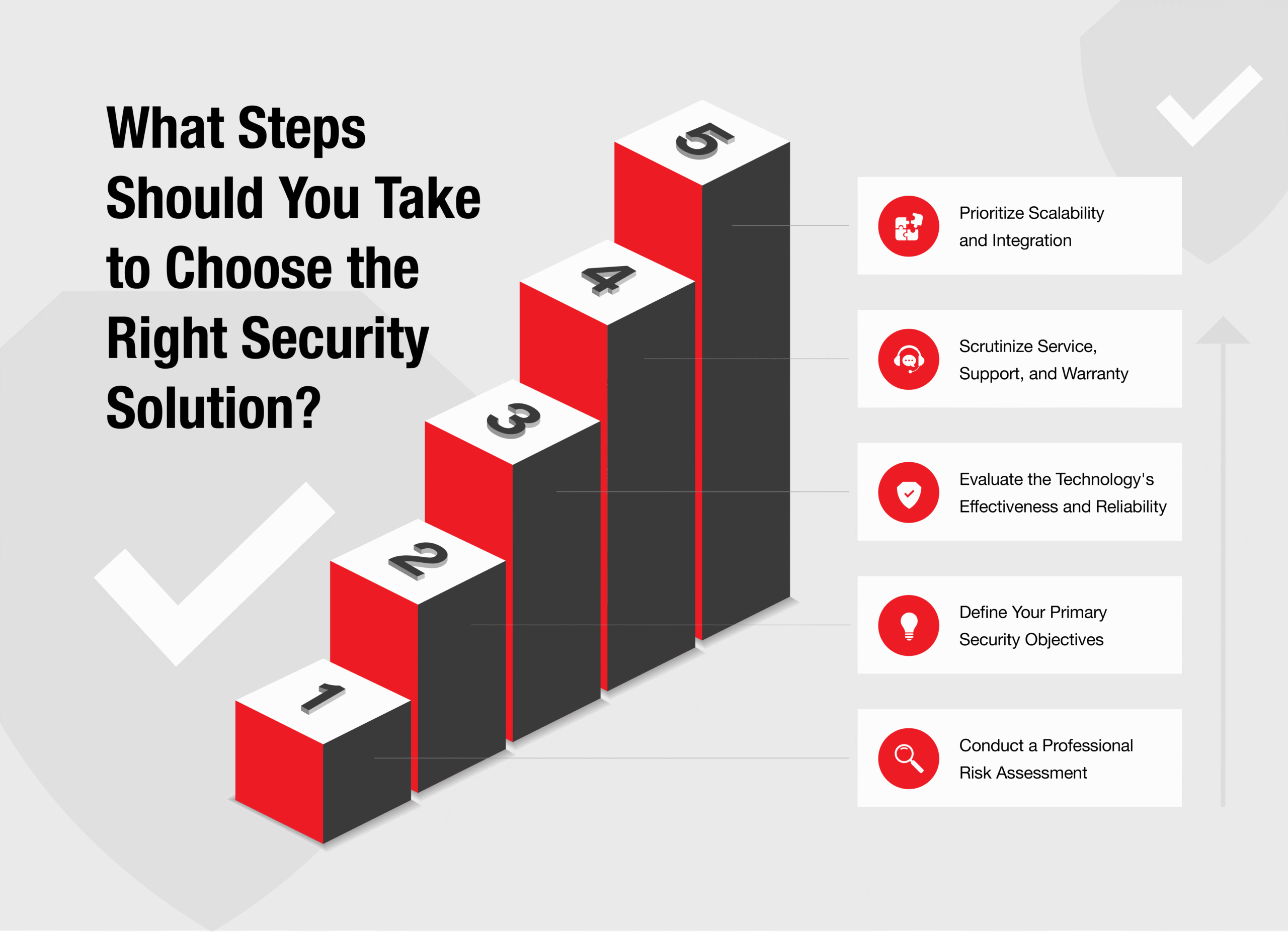
1. Conduct a Professional Risk Assessment
Start with a professional risk assessment of your property. Security professionals can identify vulnerabilities you might overlook. They consider factors like your facility’s location, the nature of your business, local crime patterns, and the specific assets you need to protect.
This assessment provides a foundation for every other decision. Without understanding your specific risks, you can’t determine what level of protection you need or allocate resources effectively.
2. Define Your Primary Security Objectives
Security systems serve different purposes. For example, medically safe electric fencing is designed to provide a visible deterrent and help prevent unauthorized access. Other solutions focus on detecting intrusions and triggering rapid responses. Some systems delay intruders long enough for law enforcement to arrive.
Your business needs to prioritize the right security measures. If you operate in a high-theft area with valuable portable inventory, deterrence and detection are critical. If you handle sensitive data or proprietary information, access controls and audit trails are priorities. An integrated security solution detects, deters, and delays intrusions, offering complete protection against external threats.
3. Evaluate the Technology’s Effectiveness and Reliability
Look beyond marketing claims to assess the actual performance of security system options. Camera resolution matters, but only if the video surveillance system also has proper lighting, correct positioning, and sufficient storage for usable footage. Sensor accuracy is meaningless if false alarms are so common that everyone ignores them.
Evaluate solutions thoroughly by:
- Asking for references or reviews from businesses similar to yours.
- Requesting data on system uptime, mean time between failures, and response times.
- Reviewing independent testing results rather than vendor specifications.
4. Scrutinize Service, Support, and Warranty
The relationship with your security provider goes beyond the initial sale. It’s important to evaluate their services beyond purchase and installation. Key questions to ask include:
- What’s the response time when equipment fails?
- Are software updates included, or are they charged annually?
- Does technical support offer 24/7 availability?
- What are your warranty terms, and what do they cover?
5. Prioritize Scalability and Integration
Your business will change. You may open new locations, expand existing facilities, or add new capabilities. Choose security systems that can grow with you, such as the ability to monitor multiple locations on a single platform or support for emerging technologies like AI-powered analytics.
Integration capabilities extend your security system’s value. When security data flows into your business intelligence platform, you can identify patterns that inform operational decisions and automate employee access management to reduce the chance of internal theft.
Moving Beyond Sticker Price to Protect Your Profitability
The true cost of security isn’t found on a price tag. It’s measured in smooth operations, safe employees, confident customers, and a protected bottom line. While cheap security offers up-front savings, you end up paying more through constant repairs, theft losses, higher insurance rates, business downtime, limited growth options, a damaged reputation, low morale, and compliance problems.
Your security solution is more than a one-time purchase. It’s an investment in your business’s stability and future. When you understand the total cost of ownership, calculate what inaction could cost you, and choose integrated solutions that match your real needs, you’re better positioned to avoid many of the expensive problems that can come with cutting corners on security.