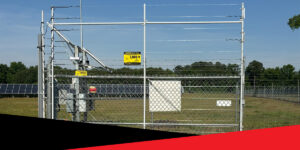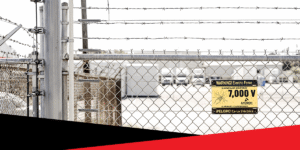
A gate serving dozens of truck drivers, employees, vendors, and third-party carriers daily must stay locked down during overnight shifts and weekends. At the same time, it must continue to process legitimate traffic without delay. The challenge is maintaining both security and throughput.
Organized criminals increasingly use credential impersonation and identity fraud at gates, contributing to the 596 confirmed cargo theft incidents and $131.58 million in estimated losses during Q1 of 2026 alone. Today’s criminals often use tactics that exploit common points of access control failure at entry and exit points.
With the right access control system, you can match your operation’s specific demands and protect your site from potential trespassers.
Top Gate Access Control Features
The right gate access control system combines different security components, matching each one’s strengths to your operation’s demands. When looking for and comparing gate access control solutions, you should assess how each feature can adapt to your site’s needs.
1. Credential Readers
Credential readers streamline gate traffic and help identify fraudulent activity before unauthorized individuals breach your perimeter. The technology you choose determines security strength, as well as how quickly you can process legitimate traffic and respond to credential compromise.
There are three main credential types in logistics environments:
- Encrypted proximity cards and key fobs: A meaningful security advantage in high-turnover environments
- Mobile credentials using Bluetooth or NFC: Allow remote issuance and revocation, but depend on device availability
- PIN codes: Shareable with no individual accountability, arguably making them one of the least secure stand-alone options
According to a 2023 report, 8% of organizations reported fake or stolen credential incidents in a six-month period, underscoring why encrypted, individually revocable credentials outperform shared PIN systems. Evaluate read range, processing speed, weather resistance, and credential capacity to make the right choice.
2. License Plate Recognition (LPR) for Documentation
LPR is a documentation and audit trail tool. It captures and logs vehicle identification at entry and exit while creating timestamped records of every vehicle movement. With organized criminals increasingly using credential impersonation tactics at gates, documented vehicle identity records serve as critical evidence. LPR is most valuable at high-volume yards with unpredictable third-party carrier traffic.
3. Video and Audio Intercoms for Verification
Intercoms allow gate personnel or a remote team to verify visitor identity without physically approaching the gate. If an unexpected visitor activates the intercom, your team can assess the situation and deny entry if needed. This capability is essential when legitimate visitors arrive without credentials, such as first-time vendors or contractors arriving outside scheduled appointments. These devices add a layer of security, serving as the manual verification layer above automated verification systems.
4. Gate Locks and Site-to-Site Control
Logistics facilities commonly have multiple entry and exit points. Integrated gate access control systems allow teams to monitor and coordinate access across these points simultaneously.
Many cargo theft incidents involve criminals entering through one access point and exiting through another to avoid detection. Coordinated lockdown capability lets you secure all gates simultaneously during security incidents with a single command. For multilocation operators, a unified platform manages credentials, schedules, and activity reports across locations from one interface.
5. After-Hours Coverage and System Reliability
Trucking terminals, warehouses, and distribution centers run 24/7. Gate access control failures during unstaffed hours create uncontrolled access vulnerabilities. Buyers should evaluate these reliability criteria:
- Internet connectivity independence: Does the system operate without continuous internet connectivity? Edge-based systems process credentials locally and sync activity logs when connectivity returns, ensuring continuous operation.
- Power interruption behavior: Does the gate fail open (unlocked) or fail secure (locked) during power loss? Fail-secure configuration prevents unauthorized access.
- Maintenance commitments: What are the provider’s repair response commitments? A gate failure in the middle of the night on Sunday can create an unauthorized access vulnerability during an active shift unless you have guaranteed emergency service.
- Always-on capability: Is there a capability independent of external power sources? Battery backup systems maintain operation during brief outages, while generator integration ensures continued operation during extended power loss. Calculate your required backup duration based on your facility’s power reliability history.
These site security assessment questions help you address reliability criteria directly.
Gate Access Control by Facility Type

According to security experts, each site type has distinct threat profiles requiring distinct priority responses. Understanding your facility’s requirements helps your team choose the most secure option.
Trucking Terminals
Among other factors, gate access control on these sites must handle high daily truck volume, a mix of regular fleet vehicles and unpredictable third-party carriers, and 24/7 operations. Common theft targets include tires, wheels, catalytic converters, and CPC modules, making gate access control for trucking terminals a primary perimeter control solution.
Warehouses
Gate access control for warehouses must manage constant flux as employees, contractors, temporary laborers, and vendors come and go. Access zone management is critical because different areas carry different security requirements.
Distribution Centers
Gate access control for distribution centers must accommodate high-velocity inbound and outbound truck traffic. Multiple entry points are typical, each with varying security requirements. Gate processing speed directly affects dock scheduling and fulfillment.
Frequently Asked Questions About Gate Access Control
Learn more about how to choose the right gate access control solution with these answers to FAQs:
How do I compare gate access control systems for my commercial property?
Evaluate gate access control systems using three steps:
- Define your property’s needs: Assess daily vehicle and personnel traffic volume, identify your user base (employees, contractors, vendors, carriers), and determine which entry points require different security levels.
- Compare core technology: Evaluate credential reader types, LPR capabilities, intercom systems, and gate lock mechanisms to ensure the technology matches your operational demands.
- Evaluate system integration and management: Determine whether the system connects to video surveillance, building access control, or multisite platforms.
What makes a gate access control system reliable for a high-traffic facility?
Consider these criteria when assessing the reliability of gate access control:
- Minimal unplanned downtime: The system must operate consistently during peak and off-peak hours without unexpected failures.
- Fail-secure behavior: During power interruptions, the gate should default to a secure state rather than allowing uncontrolled access.
- Real-time activity logging: All entry and exit events must be documented, even without personnel present, to create a complete audit trail.
- Clear maintenance and support model: Repair response time matters when a gate failure at 3 a.m. means uncontrolled access during an active shift.
What should I look for in a gate access control system for a distribution center?
Distribution centers require high-throughput credentialing, LPR for inbound carrier documentation, on-demand activity reports, integration with existing perimeter security, and site-to-site scalability. A perimeter security expert can identify which integrated Gate Access Control capabilities best serve your operational profile.
Receive a Free Risk Assessment from AMAROK
AMAROK delivers the integrated solution that trucking terminals, warehouses, and distribution centers require through our integrated Gate Access Control system. The platform includes multiple credential types, license plate recognition for documentation, intercoms, specialized gate locks, site-to-site enterprise control, and 24/7 operational reliability.
AMAROK secures over 9,000 commercial properties across the United States, and our solutions prevent 99% of external theft for customers after installation. Book a free risk assessment today or call us at (800) 432-6391 to speak to your local representative.