
Clear protocols combined with detailed business security procedures protect operations, employees, and assets before disruptions occur. Clear standards reduce risk and help teams act quickly. For commercial environments, especially large outdoor sites, security planning is an operational necessity.
Large commercial facilities face heightened exposure due to size, visibility, and predictable patterns. Proactive security measures strengthen your operational resilience and safeguard operations. Robust security planning improves employee and guest safety while supporting continuity across industries such as manufacturing, logistics, utilities, and energy operations.
The Difference Between Security Policies, Protocols, and Procedures
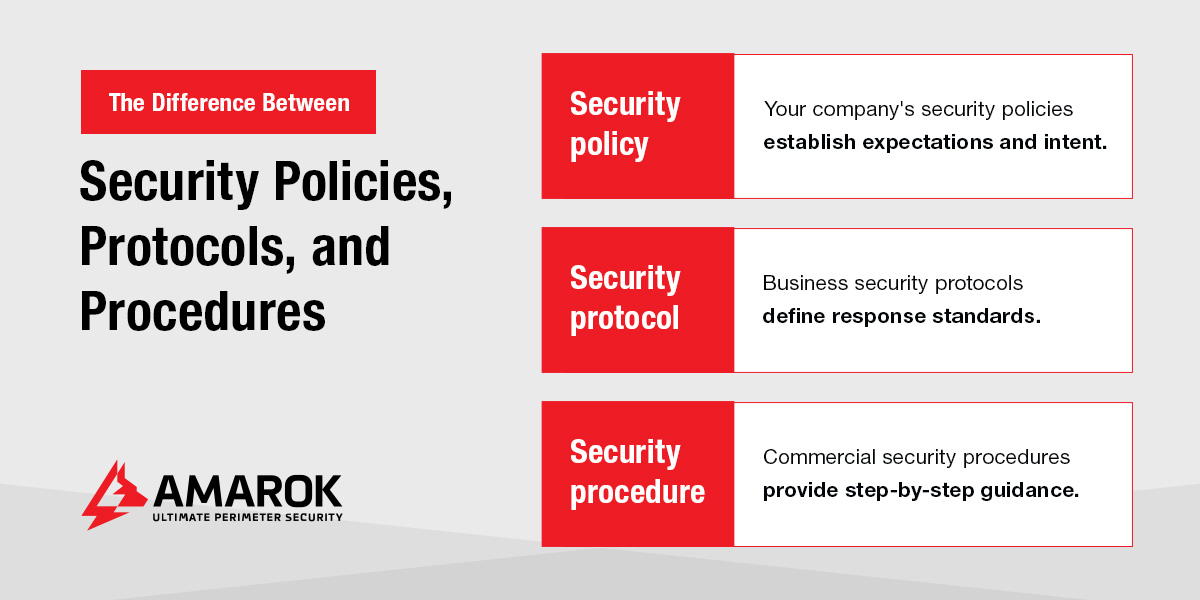
Confusion between policies, protocols, and procedures often causes delays during high-pressure situations. Defining each term ensures teams respond consistently when time matters most:
- Security policy: Your company’s security policies establish expectations and intent. Leadership sets high-level rules, such as restricting perimeter access to authorized personnel only.
- Security protocol: Business security protocols define response standards. Protocols outline actions to take during specific scenarios, including alarms or intrusions.
- Security procedure: Commercial security procedures provide step-by-step guidance. Procedures outline the steps involved in tasks, such as logging after-hours vehicle entries.
Separating these concepts promotes coordination. Clear terminology reduces hesitation during emergencies while improving overall efficiency.
5 Steps to Create Your Security Protocols and Procedures
Proactive security programs outperform reactive ones. Effective frameworks identify risks, document responses, and support teams through ongoing training. Many organizations also partner with experienced security providers to enhance planning without increasing internal strain.
The following five steps offer a practical roadmap for building reliable security policies and procedures:
1. Plan a Comprehensive Risk Assessment
Every security program starts with risk identification. Each site’s geography, design, hours, and assets shape its risks, as do operational factors like employee access levels and digital security. Documenting findings from this risk assessment guides your security prioritization and resource allocation.
A thorough assessment evaluates physical conditions, operational patterns, and your historical incident data. Key considerations include the following:
- Fence lines, gates, and boundary conditions
- Lighting coverage and visibility limitations
- Shift changes and unattended time frames
- High-value equipment or material storage
- Employee movement patterns and isolated zones
- Previous theft, vandalism, or trespassing
- Local crime trends and emergency response capabilities
For example, in utility environments, assessments reveal vulnerabilities near substations due to remoteness and limited overnight visibility. Logistics yards often reveal vulnerabilities around trailer staging zones, where predictable dwell times can attract theft.
Regardless of the industry you’re in, it’s best to consult a team with security expertise to ensure your risk assessment covers all applicable variables.
2. Document Essential Security
After identifying risks, you must define how protection works during daily operations. Written procedures create consistency across shifts, locations, and employees. Documentation should emphasize prevention, detection, and accountability in these areas. Establishing clear procedures for these processes will reduce reliance on memory or assumption:
- For perimeter enforcement, describe inspection routines, escalation protocols, and corrective actions for breaches.
- Maintain accurate access records to track gate openings, deliveries, and after-hours entries.
- Track issuance, returns, and exceptions related to keycard usage to minimize losses and support investigations.
- Record inventory movement using a documented chain of events from arrival through departure.
Operations in different sectors may have specific protocols in place that should be documented as well. For example, energy sites often record material movement, vehicle access, and custody changes during maintenance windows. Manufacturing facilities benefit when documented perimeter routines standardize inspections across multiple shifts and rotating supervisors.
3. Set Operational Protocols
Protocols guide decision-making under pressure. Setting defined triggers for various scenarios supports faster actions while reducing uncertainty about how to respond. Examples of security protocols include:
- Emergency response protocols for after-hours security incidents or unauthorized personnel near operating equipment.
- Lone worker safety standards with check-in schedules, escalation thresholds, and rapid response expectations.
- Role-based access control that restricts access to systems containing personal data.
- Multi-factor authentication in digital spaces, for remote access and administrative accounts.
- Regulatory alignment measures that ensure protocols comply with industry-specific legislation, including those set by the Occupational Safety and Health Administration (OSHA).
- Incident reporting templates with standardized forms that capture time, location, actions, and resolution details.
As an example of security protocols in action, construction teams rely on predefined response steps when there’s unauthorized entry near active equipment during low-visibility conditions. Utility operators use scenario-based protocols to protect workers following perimeter alerts near energized infrastructure.
4. Train Employees
Employee manuals alone rarely prepare teams for real-world conditions, so training converts documentation into practical performance. Effective programs focus on engagement, repetition, and accountability with these best practices:
- Conducting hands-on drills and guided walk-throughs
- Practicing responses during varied shifts and conditions
- Scheduling recurring refresher sessions
- Testing awareness with unannounced compliance checks
- Verifying adherence during routine operations
- Publicly recognizing individuals demonstrating exemplary performance
In distribution centers, this principle might look like running live drills during night shifts when staffing levels are limited. In manufacturing operations, walk-throughs during shift conditions improve adherence, reinforcing expectations through repetition.
5. Automate Enforcement
Automated systems, whether for access or monitoring, reinforce human efforts and maintain security when oversight options are limited. This technology ensures consistent security standards and provides advantages like the following:
- Surveillance without fatigue-related gaps
- Immediate alerts when there’s an attempted perimeter breach
- Standardized responses activated by incidents
- Reduced reliance on visual detection alone
- Faster escalation during urgent situations
Energy facilities maintain consistent standards through automated monitoring that detects boundary changes without constant patrols. Logistics operations reduce response delays when alerts trigger predefined actions rather than relying on visual observation alone.
The ROI of Proactive Planning
Well-designed protocols minimize reaction time during incidents, which lowers escalation costs. Faster choices prevent minor perimeter events from becoming full operational shutdowns. This prevention is the start of your return on investment (ROI) with proactive security planning.
Standardized procedures lead to direct cost savings. For example, if your security system and protocol development costs $10,000, protecting you against theft, damage, or legal reviews totaling $60,000, you have a positive ROI. This strong return boosts your company’s financial health and resilience.
During audits, these written protocols shift discussions from subjective judgment toward objective evidence. That defensibility shortens review cycles and reduces legal preparation costs.
Over time, protocols convert security from a reactive expense into a manageable operational investment. This shift defines true return rather than short-term loss avoidance.
Secure Your Business Perimeter With AMAROK
Your security protocols and procedures provide maximum value when clarity, enforcement, and reliability align. Each step, from assessment through automation, strengthens equipment protection, employee safety, and operational continuity. While multiple strategies strengthen business security, effective perimeter protection is essential for deterring external threats and providing true peace of mind. That’s where expert solutions can make the greatest difference.
AMAROK is an industry leader in providing commercial and industrial perimeter security. We deliver turnkey solutions under a security-as-a-service model, which means you benefit from the full capability of our proven technology with zero up-front cost and one predictable monthly fee. Our flagship product, The Electric Guard Dog® Fence, is 99% effective at preventing external theft after installation.
AMAROK systems enable rapid response, monitoring, and consistent enforcement across your whole perimeter. Contact us today to schedule your free risk assessment.

Commercial property crime creates a relentless cycle of loss. It causes recurring disruptions that drain budgets, derail operations, and erode the confidence of employees and customers. Beyond the initial cost of replacing stolen goods, the impacts of property crime threaten a company’s operational stability, financial health, and reputation.
This guide explores the full scope of these damages and presents a definitive framework for effective property crime prevention.
6 Impacts of Property Crime That Threaten Your Business
Commercial property crime, including burglary, theft, and vandalism, declined by 8.1% in 2024, but it remains a major concern. Specific types of commercial property crime, such as catalytic converter theft, copper wire stripping, and cargo theft from distribution yards, remain significant. The downstream effects of these acts are potentially catastrophic.
1. Crippling Financial Drain
The total financial damage from a single incident unfolds in stages, creating a significant burden that is often underestimated. Each layer of cost compounds the next, draining resources that could otherwise fuel growth.
These cascading financial effects include:
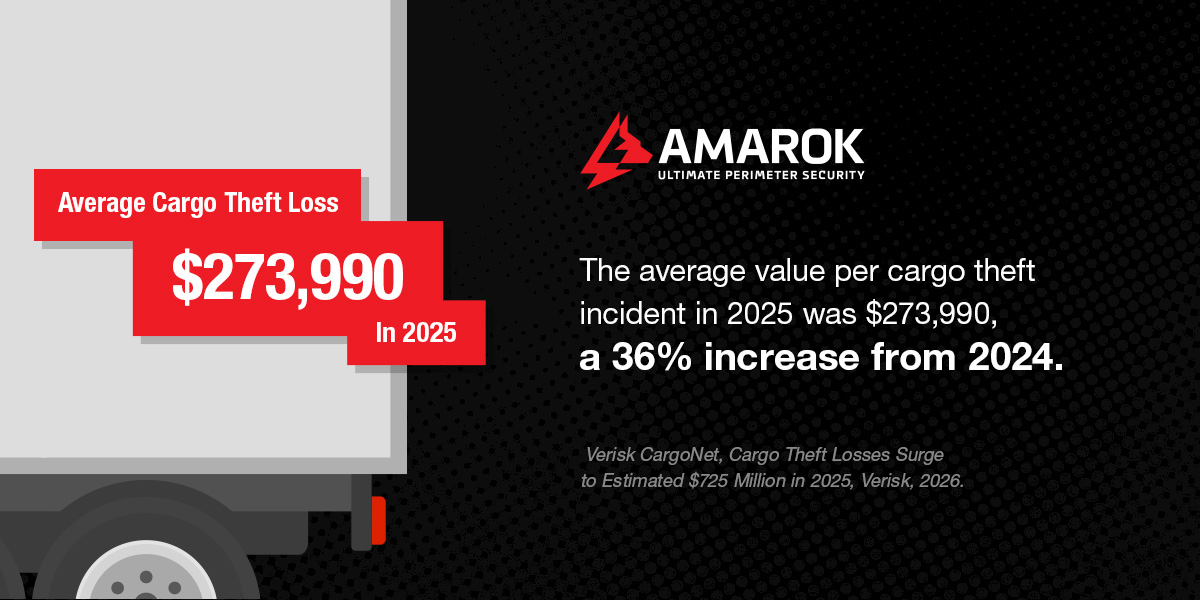
- Immediate capital costs: Direct expenses add up fast when they include replacing stolen assets, repairing damaged property such as fences or equipment, and covering cleanup fees. The average value per cargo theft incident in 2025 was $273,990, a 36% increase from 2024.
- Long-term insurance penalties: Filing a theft claim can lead to increased insurance premiums or, in some cases, the risk of nonrenewal. With U.S. commercial insurance rates holding at a 3.8% aggregate increase through Q3 2025, a single claim from property crime can trigger steeper, targeted hikes or make coverage prohibitively expensive.
2. Severe Operational Disruptions
Until stolen or damaged equipment is repaired or replaced, daily operations are paralyzed. This downtime directly leads to missed project deadlines, broken customer commitments, and an immediate halt in revenue that cannot be recovered.
Competitors gain market share while affected businesses struggle to restore normal operations. The longer the disruption lasts, the harder it becomes to regain momentum and rebuild customer confidence.
3. Erosion of Productivity and Morale
An unsafe work environment carries a human cost that businesses often overlook. The psychological toll of repeated incidents affects both current performance and long-term retention:
Decreased staff productivity: Anxious employees lose focus on core responsibilities. Teams waste valuable hours dealing with incident reports, police filings, and insurance claims, rather than performing essential job functions.
Increased turnover costs: Employees who feel unsafe will seek employment elsewhere. Companies absorb substantial recurring expenses for recruiting, hiring, and training replacements.
4. Irreparable Brand and Reputation Damage
A security breach signals unreliability to the market. When customer goods stored on-site are stolen, or project schedules are missed due to theft-related downtime, trust evaporates immediately.
This damage is often permanent. Lost contracts, negative word of mouth, and a diminished standing in the industry follow. Recovering that reputation is difficult, requiring years of consistent, flawless performance. Even if businesses uphold this rigorous standard, they may not fully recover.
5. The Vicious Cycle of Repeat Victimization
The most frustrating aspect of crime against property is that repeat victimization is a critical, predictable threat. Research from Arizona State University’s Center for Problem-Oriented Policing shows that previous victimization is the single best predictor of future victimization.
Criminals view a previously targeted property as a proven, low-risk opportunity. They know the layout, understand the security weaknesses, and recognize the value of accessible assets. This repeat victimization creates a relentless cycle of loss, frustration, and escalating recovery costs that compounds every other impact of property crime.
6. Stifled Growth and Potential Insolvency
Reactive security spending creates a death spiral for business growth. Capital intended for proactive business investments, such as a new vehicle fleet, upgraded technology, or market expansion, gets diverted to replacing stolen assets and paying for escalating insurance premiums.
This constant reactive spending prevents proactive growth. Businesses cannot invest in revenue-generating initiatives when budgets are consumed by theft recovery, trapping companies in a defensive posture. For some businesses, the cumulative financial strain becomes unsustainable, ultimately threatening solvency.
How to Prevent Property Crime
Proactive property crime prevention centers on hardening the facility to make it less attractive to criminals. The security goal is to deter and prevent threats at the property line before incidents occur. The following strategies form a comprehensive defense that addresses vulnerabilities.
Establish a Strong Perimeter
The perimeter serves as the absolute first line of defense against intrusion. An electric fence provides the ultimate perimeter protection, delivering a formidable physical, visual, and psychological barrier. It stops intruders before they set foot on the property.
Unlike traditional chain-link fencing, which criminals cut through in seconds, an electric fence delivers a safe but memorable shock that eliminates the property as an easy target.
Control Access Points
Managing all entry points prevents unauthorized access and creates accountability for everyone entering the property. Automated Gate Access Control systems vet, log, and control every vehicle at the entrance while credential readers verify authorization before granting access.
Beyond the gate, further access control measures inside the property create secure zones that restrict movement in high-value areas. This layered approach to access ensures that even if an unauthorized person bypasses your perimeter, they face multiple additional barriers to entry. It also helps prevent employee theft attempts.
Increase Visibility
Criminals rely on darkness and blind spots. Eliminating potential hiding spots is essential for comprehensive site security. Strategic placement of commercial property lighting fully illuminates critical areas, including:
Fence lines and gates
Building entrances and exits
Loading docks
Equipment storage yards
Parking lots
Thieves avoid well-lit properties because they cannot operate undetected. Alarm-activated lighting systems add an extra layer of deterrence by flooding dark areas with light when a breach attempt is detected.
Layer Surveillance and Detection
Technology acts as a force multiplier, providing continuous monitoring across the entire property. Multiple integrated systems work together to detect any suspicious activity around the clock.
A comprehensive surveillance strategy includes:
Surveillance cameras: Video surveillance systems capture activity and serve as visual deterrents to criminal behavior.
Video monitoring: Remote and mobile monitoring allows property managers or security professionals to respond to alerts in real time, enabling immediate intervention when threats emerge.
Integrated perimeter alarms: If a criminal tries to tamper with your fence, Sentinel perimeter alarm systems flash bright lights and blare loud sirens, scaring potential intruders while notifying security teams of the attempt.
Asset-specific alarms: Individual protection systems safeguard high-value items within the property, adding another defensive layer beyond perimeter security.
Prevent Property Crime With AMAROK
The impacts of property crime are avoidable with the right strategy. Reactive measures like cameras and guards will never eliminate the threat. The solution is a proactive, unified security system that starts at the perimeter and stops intruders before they cause damage.
Since 1973, AMAROK has been helping businesses prevent property crime and its impacts with our fully integrated perimeter security solutions. AMAROK’s multi-layered approach combines a formidable solar-powered electric fence, The Electric Guard Dog® Fence, with integrated surveillance and access control. Our unified system prevents 99% of external theft after installation and saves the average customer $120,000 annually compared to security guards.
Stop the cycle of crime for good. Contact our security specialists online for a free risk assessment. We’ll identify vulnerabilities and design a solution that protects operations, finances, and reputation.