
Government agencies face an impossible equation. Security budgets are under constant pressure, yet the cost of inadequate protection keeps climbing. Every theft, every act of vandalism, every stolen catalytic converter creates a cascade of expenses that ripple through operations and strain already-tight budgets.
The solution lies in spending smarter and lowering facility security expenses. When approached strategically, perimeter security is a budget-positive investment that protects assets, eliminates recurring costs, and delivers returns that far exceed the initial commitment.
Moving from Reactive Expense to Proactive Investment
Traditional security models often operate on a reactive principle. Agencies spend money on personnel and barriers, then wait to see if crime occurs. When it does, costs multiply. Replacement parts, insurance claims, service disruptions, and increased premiums create a cycle that drains budgets without addressing the root problem.
A proactive investment model reverses this approach. By deterring crime, you can cut the cascading costs that follow security breaches. The right perimeter security partner delivers solutions that stop theft, reduce guard costs, and eliminate the financial impact of equipment loss. This return transforms security from a necessary expense into a strategic asset.
Calculating the True Cost of Security Failure
Government spending on crime-related expenses reaches staggering levels. The broad system of mass incarceration costs the government and families of system-involved people at least $445 billion every year. While agencies cannot control systemic costs, they can control facility-level spending by preventing crime on their properties.
The Financial Drain of Security Guard Services
Security guards are among the largest ongoing expenses in facility protection. The median annual salary is $38,370, and facilities that require multiple posts face rising monthly costs. These figures reflect only base hourly rates and standard benefits.
Hidden costs amplify the financial burden through constant recruitment and training cycles. Each departing guard requires replacement hiring, background checks, onboarding, and supervised training before reaching full effectiveness. Liability concerns add another layer of cost. Agencies must maintain insurance coverage for guard-related incidents and ensure proper supervision to meet duty-of-care obligations.
Performance inconsistencies further reduce the value proposition. Guards can only monitor one location at a time, leaving gaps in coverage across larger properties. Human factors such as fatigue, distraction, and varying skill levels create unpredictable protection levels.
The Impact of Operational Disruptions and Demand for New Staff
Beyond the immediate financial losses, security failures impose a significant, often unbudgeted, demand for staff and resources. When incidents occur, agencies must reallocate existing personnel or even hire temporary staff to manage the crisis, adding to operational costs.
Impact on critical service delivery: Security breaches often lead to service interruptions, requiring dedicated staff to manage the fallout. Whether it’s rerouting services, coordinating repairs, or addressing public inquiries, these crises divert personnel from their primary duties.
Administrative overload and resource diversion: Each security incident triggers a cascade of administrative tasks, from compiling detailed incident reports to coordinating with law enforcement and insurance providers. This burden falls on existing staff, pulling them away from everyday responsibilities.
Reputational damage and increased scrutiny: A loss of public trust due to security failures can lead to greater oversight, requiring additional personnel for public relations, compliance reporting, and audits.
The Hidden Costs of Passive Fencing
Standard chain-link fencing alone creates a perimeter boundary with minimal crime deterrence. Determined thieves may cut through or climb over these barriers in seconds, making them ineffective. The catalytic converter theft epidemic demonstrates this vulnerability with costly clarity.
Sacramento County facilities, for example, lost over $100,000 to this theft in 2021 despite having fenced perimeters. Vehicles sit inoperable while awaiting repairs, disrupting services that citizens depend on. School buses cannot transport students, emergency vehicles cannot respond to calls, and municipal fleets cannot complete scheduled work.
Insurance costs can rise with each claim filed. Premiums increase after theft incidents, resulting in a permanent increase in annual expenses. Administrative time devoted to filing claims, coordinating repairs, and managing service disruptions adds soft costs that compound the financial burden.
A 3-Part Strategy to Lower Security Spending
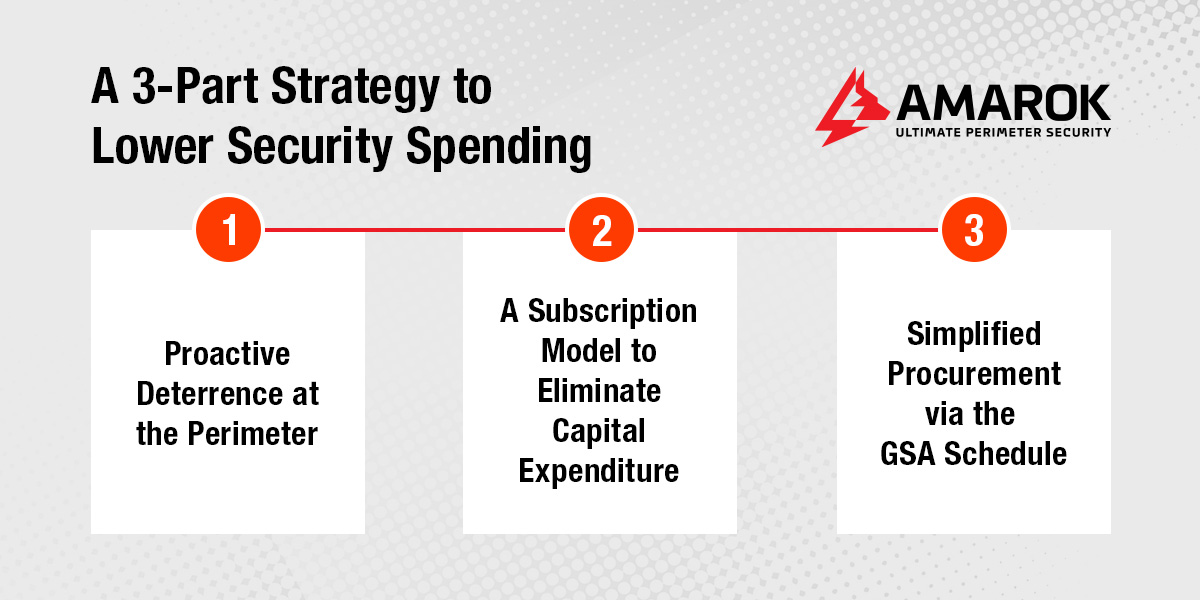
Government security cost reduction requires a comprehensive approach that addresses deterrence, budget structure, and procurement efficiency. By proactively deterring crime, agencies can reduce the need for round-the-clock security personnel and emergency staffing. They also avoid the costly, staff-intensive efforts required to regain public trust. A multi-layered perimeter security solution delivers measurable financial benefits while strengthening protection.
Part 1: Proactive Deterrence at the Perimeter
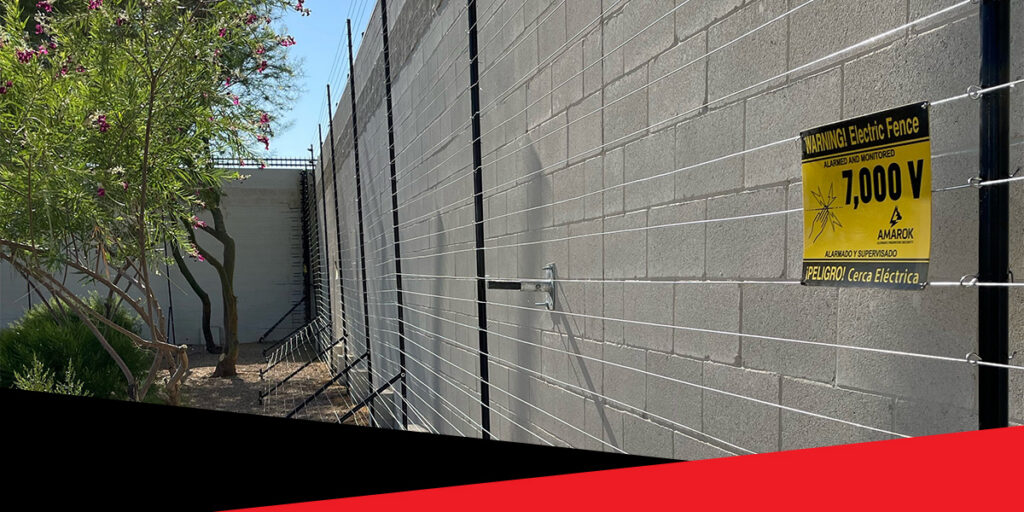
Electric security fencing is the most effective crime-prevention technology available for government facilities. These fences combine physical barriers with active deterrence to prevent intrusions before they occur.
Visible warning signage with universally recognized electrical hazard symbols communicates the risk immediately. The imposing height and robust construction signal that this perimeter requires serious effort to breach.
Part 2: A Subscription Model to Eliminate Capital Expenditure
Government budget cycles present unique challenges for major security investments. Capital expenditure requests compete with numerous priorities and often face approval delays. Cost-effective security solutions that operate as predictable monthly subscriptions solve this problem.
Opting for a partner that uses a security-as-a-service model requires zero up-front costs. Installation, equipment, permitting, and compliance management all occur without capital outlay. You pay a single manageable monthly fee that covers the entire security system, ongoing maintenance, repairs, and lifetime equipment support.
Part 3: Simplified Procurement via the GSA Schedule
Government procurement requires adherence to complex regulations and competitive bidding processes. The General Services Administration (GSA) Multiple Award Schedule streamlines this process. By using GSA Schedule contracts, you get prenegotiated pricing that complies with federal acquisition regulations without lengthy bidding procedures.
GSA Schedule vendors undergo rigorous vetting for national safety and code compliance, financial stability, and service capability. This prequalification reduces agency risk and administrative burden. Procurement teams can move quickly from need identification to contract execution, shortening timelines from months to weeks.
Learn How AMAROK Delivers Cost Reductions
Government facilities nationwide face the same security challenge. Protecting critical assets while managing constrained budgets requires strategic thinking. The difference between agencies that succeed and those that struggle comes down to approach. Reactive security drains resources. Proactive deterrence delivers returns.
AMAROK offers a proven path to transform security for government facilities from a financial burden into a strategic asset. With zero up-front costs, a predictable monthly service model, and simplified procurement through the GSA Schedule, agencies gain multi-layered perimeter protection that prevents 99% of external theft. Over 9,000 commercial properties trust AMAROK to safeguard their operations, and the average AMAROK customer saves $120,000 per year by replacing 24/7 security guards with our system.
Experience an average 5x return on investment. Get a no-obligation risk assessment to discover how your facility can achieve budget-positive security.