
Federal contracts represent billions in annual opportunities for businesses. The challenge lies in choosing the right federal procurement process to pursue federal work. There are two primary routes: the General Services Administration (GSA) Multiple Award Schedule program and traditional open market bidding.
Each offers distinct advantages. Understanding these differences helps you align your approach with your business capacity and growth strategy. The decision you make shapes both your initial investment and your long-term competitive position in the federal marketplace.
What Is the GSA Multiple Award Schedule Program?
The GSA Multiple Award Schedule program establishes long-term contracts between commercial
vendors and the federal government. This system creates a pre-vetted supplier list that government buyers can access quickly.
Schedule holders gain access to a market of agencies seeking proven solutions. The initial application process involves pricing submissions, performance documentation, and compliance verification. Once approved, your contract lasts a few years with renewal options.
Key Benefits for Sellers
GSA schedule approval transforms how you pursue federal work. The benefits go beyond simplified sales to create strategic advantages in public sector procurement. Three core advantages shape your competitive position:
-
Streamlined sales cycles: Agencies can purchase from schedule holders without lengthy competitive processes. This can lead to faster transactions and more predictable revenue. Agencies get expedited access to solutions for critical needs such as facility security.
-
Reduced competition: Only approved vendors can compete for scheduled purchases, which narrows the field versus open bidding. Agencies benefit from this prequalification because it reduces their evaluation workload while maintaining quality standards.
-
Long-term stability: Multiyear contracts provide consistent government market access. You can invest in capabilities with an established sales channel.
What Is Traditional “Open Market” Procurement?
The traditional procurement process operates through project-by-project competitive bidding. Federal agencies issue requests for proposals under Full and Open Competition principles established in the Federal Acquisition Regulation. Each contract opportunity requires a unique proposal tailored to specific agency requirements.
This system ensures maximum competition and better value for taxpayers. Agencies define their needs, publish solicitations, and evaluate submitted proposals. The process follows strict procedures for fairness and transparency. Any qualified business can compete regardless of preexisting government relationships.
Key Challenges for Sellers
Traditional bidding demands significant resources with uncertain returns. The competitive landscape affects both small and large contractors in these ways:
-
High proposal costs drain resources: Each bid requires technical writing, pricing, and compliance review. Companies may invest weeks of staff time on proposals that fail to win awards. The cost-to-compete becomes a major factor in deciding which opportunities to pursue.
-
Intense competition: Open market bids attract numerous qualified respondents. Standing out requires technical capability, exceptional proposal quality, and strategic pricing.
-
Lengthy timelines: The traditional procurement process typically takes a few months from solicitation to award. Complex acquisitions may extend even longer. Businesses must maintain pursuit teams and manage cash flow through extended bid cycles with no guarantee of success.
Detailed Comparison: GSA vs. Traditional Procurement
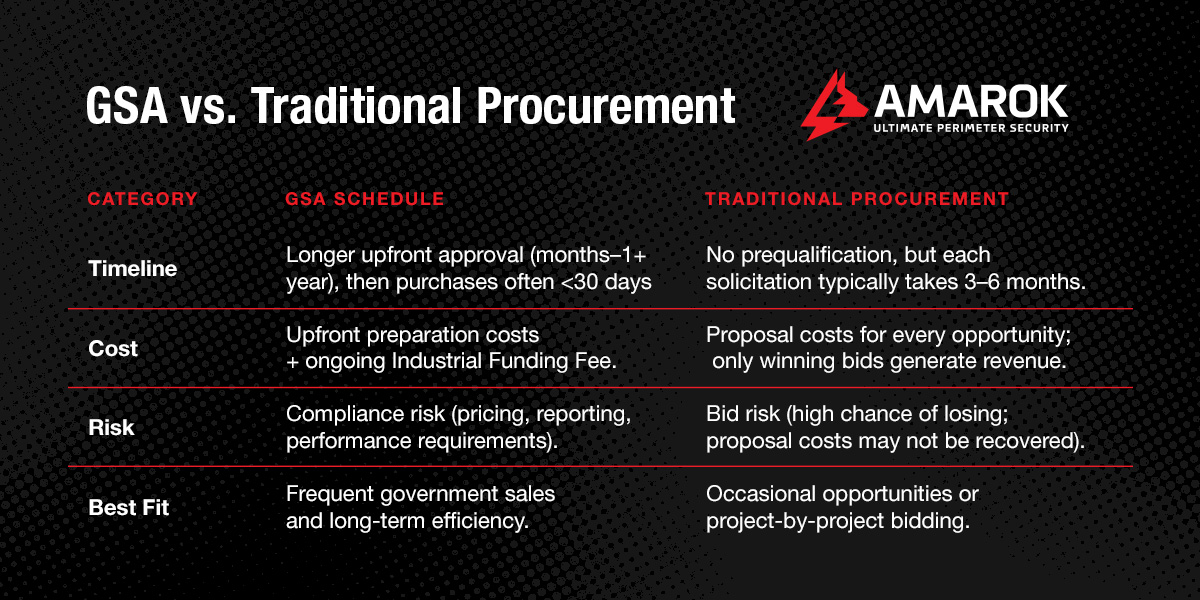
Understanding GSA contract and traditional contract differences requires examining these critical dimensions:
Timeline
GSA and traditional paths follow fundamentally different timeline models. The GSA schedule requires substantial up-front time but enables rapid purchases afterward. Initial schedule approval can take several months to over a year, depending on application completeness and agency review workload. However, once approved, agency purchases are often completed in under 30 days.
Traditional procurement avoids the application phase entirely. You face no prequalification period. Instead, each opportunity triggers a complete bid cycle. Individual solicitations typically run 90 days minimum, with four to six months common from a request for proposal to contract award.
Cost
Both pathways require financial commitment, but the cost structures differ significantly. GSA schedule holders face preparation costs, including legal review, pricing analysis, and documentation assembly. Once approved, the program charges an Industrial Funding Fee on all sales. This predictable operating expense supports program administration while remaining manageable for most contractors.
Traditional procurement operates on a cost-per-opportunity basis. Each proposal demands internal resources for writing, pricing, and coordination. Companies competing frequently may maintain dedicated proposal teams. The uncertainty compounds the cost because proposal investment yields no return on losing bids. This creates a pure cost-to-compete model where only winning proposals generate revenue.
Risk
Different risk profiles characterize each pathway. GSA schedule holders face compliance risk as their primary concern. Contracts include strict terms for pricing integrity, reporting accuracy, and performance standards. Violations can result in schedule suspension or termination. Maintaining compliance requires diligent contract administration and regular internal audits.
Traditional procurement carries execution risk concentrated in the bid phase. The high probability of losing individual competitions means most proposal investments yield zero return. Companies may only win a few bids in competitive environments, creating significant financial exposure when pursuing multiple opportunities simultaneously.
Both approaches benefit from demonstrating adherence to established standards. Showing recognized safety and quality codes strengthens your position, whether pursuing schedule approval or competing for specific contracts.
How to Position Your Business for Government Contracts
Success in federal contracting demands the right procurement pathway plus reliable, compliant solutions. Agencies prioritize solutions that deliver reliability, maintain compliance, and reduce their administrative workload. Your positioning should emphasize these qualities, whether pursuing GSA schedule approval or traditional bidding.
Consider adopting a security-as-a-service model for government work. This structure provides predictable costs through subscription pricing as an operating expense. It includes comprehensive maintenance that prevents technology obsolescence. Government buyers value this approach because it simplifies budgeting and eliminates surprise costs. Building a strong business case around these benefits positions you favorably against competitors.
Your solution portfolio should demonstrate breadth and integration. Agencies increasingly seek vendors who can address multiple needs through coordinated offerings. Comprehensive multi-layered solutions reduce the number of contracts agencies must manage.
Secure Your Future With AMAROK
Both traditional and GSA procurement pathways offer access to federal contracts. Success requires delivering reliable, compliant solutions with minimal administrative burden. The GSA schedule provides streamlined purchasing for ongoing needs, while traditional procurement suits targeted, high-value opportunities.
AMAROK secures commercial facilities nationwide with integrated perimeter security systems designed to prevent external theft, protect assets, and ensure operational continuity.
Our security-as-a-service model delivers the predictable costs, comprehensive maintenance, and compliance assurance that government agencies value. With solutions preventing 99% of external theft for our customers, AMAROK provides the peace of mind that allows businesses to focus on growth opportunities such as federal contracting.
Receive a free risk assessment to discover how AMAROK can protect your operations while you pursue your next contract.