
As you expand your operations, scaling security for your vehicle fleets is a priority to protect your assets and property. Trucks, vans, and service vehicles face risks such as theft and vandalism. Traditional security methods alone — like chain-link fences and security guards — often aren’t enough as your fleet grows. More vehicles and more locations mean more entry points for unauthorized access and external theft.
It’s essential to choose security systems that can easily scale up so every vehicle and site stays protected. Learn more about how fleet security scaling can help safeguard your assets while you’re expanding your operations.
The Challenges of Scaling a Fleet
Scalability is among the largest strategic challenges for any business. It introduces significant security concerns as operations expand and become more complex. The main issues revolve around maintaining control, visibility, and cost efficiency while protecting assets, data, and people across operations.
Key security challenges in commercial fleet management as you scale include:
1. Maintaining Control, Visibility and Standardization
As fleets grow, goods pass through multiple hands, including subcontractors and third parties. This fact makes it challenging to maintain consistent and standardized security from point A to point B. All parties in the supply chain must know where and when cargo is moving. Secure and traceable handovers at every stage help prevent theft, tampering, and contamination — especially for sensitive cargo like food or pharmaceuticals.
Challenges related to visibility with a scaling fleet also include compliance and protocol standardization. Processes that work for a small fleet may not scale effectively. As fleets expand geographically, maintaining consistent, controlled processes for tasks like vehicle inspections, maintenance, and reporting becomes tricky. This lack of standard operating procedures can lead to human error, a lack of efficiency, and the risk of non-compliance.
2. Adequate Asset Protection and Cost Control
High-value vehicles and components like catalytic converters are expensive to replace or repair. Stolen or vandalized assets or cargo result in many challenges that financially affect your operations, including:
- Significant downtime and operational disruption that affects your bottom line.
- Direct losses due to the stolen cargo or vehicle, which are typically impossible to recover.
- Increased insurance premiums as a result of filing claims with your commercial insurance provider.
- Damage to your brand reputation due to loss of trust among customers and stakeholders.
- Employee turnover due to decreased morale, including the expenses required to recruit and hire new drivers and other employees.
3. Proper Access Control
Access management is a cornerstone of fleet security, ensuring only authorized personnel can access vehicles, cargo, parking lots, and facilities. Manual protocols like paper logs and spreadsheets are prone to errors and cannot provide real-time visibility. Without integrated access control systems, it’s difficult to know who accessed what, when, and for how long. This lack of visibility makes it hard to enforce accountability or investigate incidents.
4. Data Management and Integration
Fleet managers have access to vast amounts of data. However, without integrated systems, information can become siloed. Plus, the sheer volume of data can quickly overwhelm traditional systems and manual processes when it comes to:
- Vehicle telematics
- Driver behavior
- Fuel usage
- Maintenance records
- Route optimization
- Access control
Companies may adopt specialized software in an attempt to gain visibility into this data, but the reality is that this often creates more siloes. For example, you may have one platform for tracking driver behavior, and another for organizing maintenance records and access control credentials. These disparate software systems may not always integrate with each other, making it even more challenging to see and manage all of the data available to you.
Why Traditional Security Measures Fall Short
As commercial fleets scale and threats become more sophisticated, traditional security measures often fall short of providing comprehensive, proactive protection when used alone.
Here are three examples of traditional security measures and their limitations in safeguarding businesses against external theft:
- Chain-link fences: Traditional fencing like chain-link is not sufficient on its own. Opportunistic thieves can easily cut through a chain-link fence using bolt cutters. The interwoven pattern of this type of fence also makes it relatively simple to climb over. Ultimately, a chain-link fence alone is not enough to deter theft and prevent intrusion.
- Security guards: Security personnel can patrol storage sites, monitor entry and exit points, and perform checks of vehicles and cargo. Employing guards around the clock can become expensive, especially for large or multiple sites. In addition, a finite number of guards can only monitor so much area at once, leaving gaps in your physical security strategy.
- Basic GPS tracking: Many vehicles have GPS devices that transmit location data. While basic GPS provides real-time or historical location data, it does not monitor access, cargo status, or unauthorized use. A GPS cannot prevent fleet theft — it only helps locate a vehicle after the fact. Knowledgeable thieves can also disable, jam, or remove GPS devices.
As fleets grow, the cost and complexity of scaling traditional security measures become unsustainable.

How to Build a Scalable Security Strategy for Your Fleet
Fleet security requires an integrated approach that combines multiple layers to effectively deter property crime. Take the following steps to build a scalable security strategy for your fleet:
1. Start With a Risk Assessment
During a risk assessment, perimeter security experts will identify your current vulnerabilities and the most high-risk areas. Together, we will work to develop a more proactive approach that addresses your fleet’s level of susceptibility to external theft, particularly as your operations grow and scale.
2. Install Electric Fencing and Alarm-Based Lighting
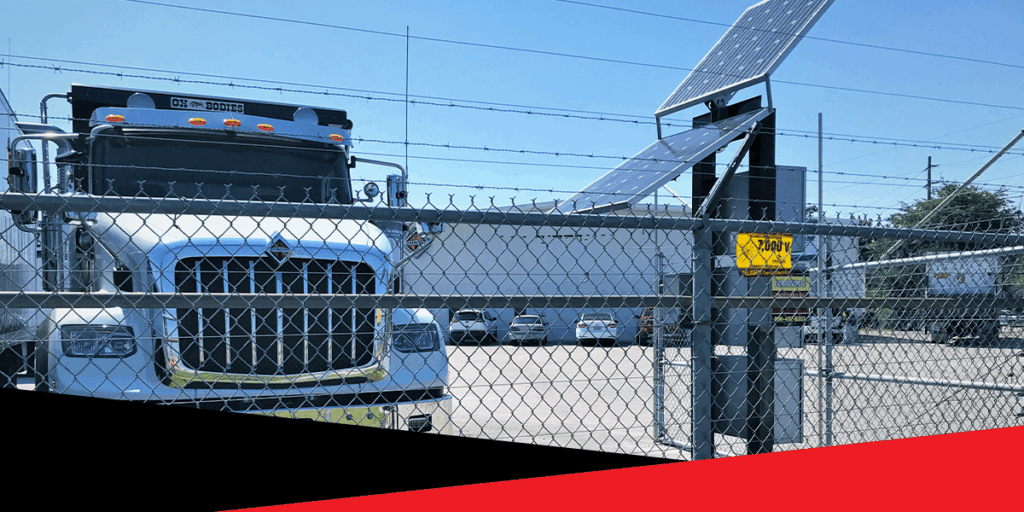
Deter intruders before they can even set foot on your property with electric fencing. If an unauthorized individual attempts to breach the perimeter, they receive a medically safe but memorable shock. Enhancements like laydown fencing and security bollards make it even more difficult for opportunistic criminals to gain access to your property.
Alarm-based lighting systems help you safeguard your premises and fleet day and night. Options like Spot Lighting and Zone Fence Lighting integrate with your electric fencing, providing immediate detection of potential security breaches for quick response times.
As your business adds locations or vehicles, you can safeguard your new perimeters and assets with additional, unified security solutions.
3. Integrate Gate Access Control
Ensure your entry and exit points are fully controlled and completely secure with Gate Access Control. This solution keeps your site and fleets protected with features at the gate like video and audio intercoms, credential readers, license plate recognition, and more. Drivers enjoy quick and secure access with key fobs, PIN codes, and encrypted proximity cards for a better user experience. On the management side, you can handle user accounts and permissions for multiple sites all in one place with a comprehensive platform for access control management.
Gate Access Control brings together a number of access components for a customized result that’s tailored to your specific operational requirements.
4. Add Video Surveillance and Remote Monitoring
Surveillance cameras can be installed in key areas, like parking lots and entrances and exits, to keep watch over your entire perimeter. High-quality footage can be used as video proof when alerting the authorities as well as compelling evidence in criminal investigations.
Integrate your cameras with remote and mobile monitoring for real-time protection around the clock. View any camera anytime, from wherever your business takes you. Plus, you can rest assured that your site is being monitored 24/7 for fast response to any threats.
As your operations scale, additional cameras can be integrated to ensure comprehensive coverage.
Secure Your Fleet With Perimeter Security from AMAROK
Transportation fleets face unprecedented security challenges. As operations grow and expand, the risk of theft and unauthorized access increases. Scalable, integrated physical security solutions are essential for protecting your assets and your people.
AMAROK’s perimeter security solutions are designed to be easily expanded or adapted as your fleet and facilities grow. It all starts with The Electric Guard Dog® Fence, which prevents external theft for 99% of our customers after installation.
Find a perimeter security expert near you and see how we can protect your fleet with a customized plan.