
Federal security managers face a constant challenge: translating dense, multi-layered compliance mandates into a practical security strategy that actually works. Official frameworks such as the Interagency Security Committee’s (ISC) Risk Management Process provide the structure, but implementing them requires navigating risk assessments, procurement bureaucracy, and evolving compliance standards simultaneously.
This playbook is designed to cut through the complexity. It breaks down official requirements into actionable steps, transforming regulatory requirements into resilient, multi-layered security solutions for government facilities.
The Modern Threat Landscape for Government Facilities
Thieves exploit vulnerabilities across physical and digital domains simultaneously. These threats are evolving beyond single-layer security approaches. A multi-layered approach to government facility security services is essential to deter criminals effectively.
The overlap of physical and cyber threats, combined with state-sponsored activity and the accessibility of commercial technology, creates a complex threat environment. These threats include:
Converged threats: Critical infrastructure attacks now blend physical breaches with cyber intrusions. Adversaries target control systems, combining unauthorized access with digital sabotage to maximize disruption.
Commercial technology weaponization: Criminals increasingly use low-cost, commercially available technology such as drones for espionage. These tools provide sophisticated capabilities without requiring specialized equipment or training.
Insider threats: Employees or contractors with authorized access pose unique risks. Their familiarity with security protocols allows them to bypass conventional deterrents.
Opportunistic criminals: Government facilities often store high-value assets that attract organized theft rings. Thieves target valuable equipment, metals, and sensitive materials.
The Three Pillars of a Compliant Federal Security Plan
Effective federal security planning rests on risk management, compliance, and strategic solutions. Mastering these pillars allows you to build a security program that meets regulatory standards while protecting critical assets.
Pillar 1: The Risk Management Process
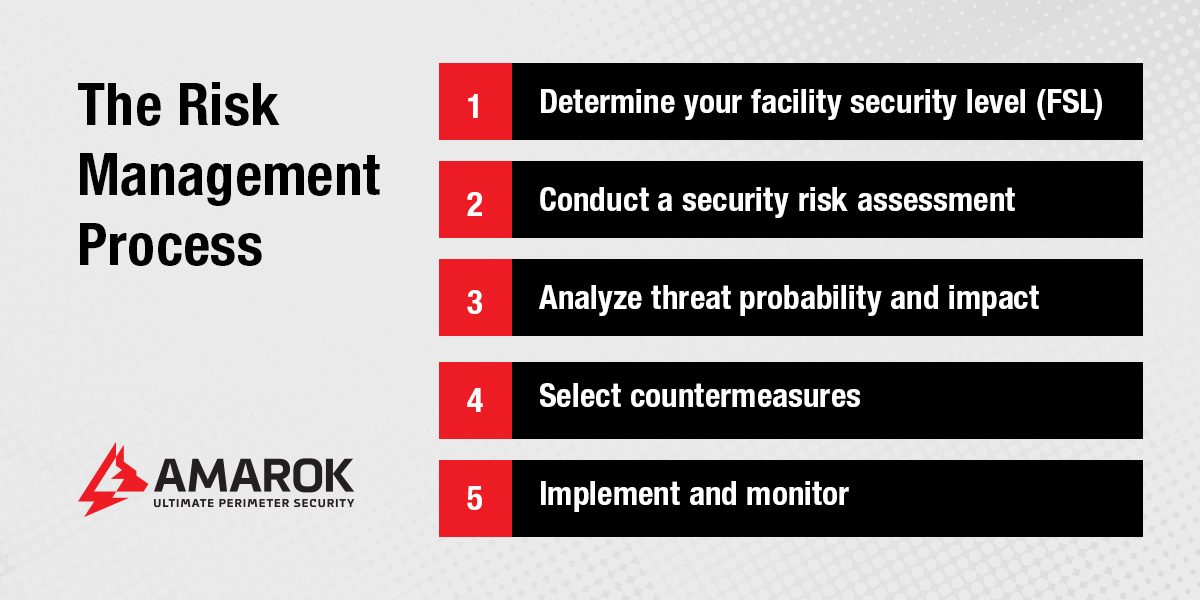
The ISC Risk Management Process provides the official framework for federal facility security. Breaking it down into five actionable steps makes implementation manageable:
Determine your facility security level (FSL): The ISC assigns facilities to one of five levels based on mission criticality, symbolism, and population. Your FSL determines baseline security requirements.
Conduct a security risk assessment: Identify vulnerabilities across your perimeter, access points, building systems, and operational procedures. Document physical barriers, lighting, surveillance coverage, and access control effectiveness.
Analyze threat probability and impact: Evaluate which threats are most likely to occur based on your facility’s location, mission, and profile. Assess the potential consequences of each threat scenario on operations, personnel safety, and mission continuity.
Select countermeasures: Choose security solutions that address identified vulnerabilities while aligning with your FSL requirements. Prioritize measures that provide multiple layers of protection.
Implement and monitor: Deploy selected countermeasures according to your implementation timeline. Establish metrics to measure effectiveness. Conduct regular reviews to ensure your security posture adapts to emerging threats.
Pillar 2: Physical Security Compliance Frameworks
Compliance is non-negotiable in the federal environment.
The ISC Standards establish baseline physical security criteria for federal facilities. Physical security compliance management requires documenting how your facility meets these standards across access control, perimeter security, surveillance, and security personnel requirements. Regular audits verify continued compliance.
Customs Trade Partnership Against Terrorism applies to eligible facilities involved in supply chain operations. This framework mandates specific perimeter security measures, including fencing standards, access controls at entry points, and surveillance systems that monitor cargo movement.
The National Defense Authorization Act (NDAA) governs technology procurement for federal security systems. Facilities must verify that video surveillance equipment meets NDAA requirements. Using NDAA-compliant surveillance cameras protects against supply chain vulnerabilities.
Each framework has specific documentation requirements. Maintaining detailed compliance records simplifies audits and demonstrates due diligence.
Pillar 3: A Multi-Layered Security Strategy
Security solutions must work together as an integrated system. The defense-in-depth approach creates multiple barriers that delay, detect, and deter threats at different stages. This layered methodology is becoming the standard for protecting high-value government assets because it ensures that if one security measure fails, others remain in place to prevent or delay intrusions.
Government facilities typically implement a multi-layered security system that includes several components. Each layer serves a specific function within the broader security architecture. Together, these elements create a comprehensive defense that addresses threats at multiple points.
Active perimeters: Government facility security fencing establishes your first line of defense. Hardened barriers and electric fencing deter unauthorized access while clearly defining facility boundaries.
Surveillance and monitoring: Video cameras provide continuous observation of key perimeter areas, entry points, and sensitive areas. Remote monitoring allows security teams to verify threats in real time.
Access control: Credential-based systems at gates and entry points restrict access to authorized personnel. License plate recognition and visitor management systems document who enters your facility.
Perimeter alarm-based lighting: Strategic illumination removes concealment opportunities at the fence line when the fence alarm triggers. Well-lit perimeters deter opportunistic threats while supporting surveillance effectiveness.
Modern resilience planning prioritizes function-centric resilience to maintain critical operations during security incidents. This approach assesses interdependencies between systems, ensuring that perimeter security for government facilities maintains operational capability even when specific assets are compromised.
Navigating the Federal Procurement Process
Securing funding for security improvements requires understanding federal procurement mechanisms. Strategic planning makes the approval process more efficient.
Key procurement considerations for government facility security services include multiple pathways and classifications. Federal facility managers must navigate these options strategically to secure approval within their organizational structure. Each approach offers distinct advantages depending on your facility’s budget cycle and approval authority.
General Services Administration (GSA) Schedule contracting: Federal agencies can streamline procurement using the GSA Multiple Award Schedule. Vetted vendors on the GSA Schedule have already demonstrated compliance with federal contracting requirements, reducing approval timelines.
Operating expense classification: Structuring security as an operating expense simplifies budget approval by avoiding the lengthy capital project approval process. Monthly service fees provide a predictable budget impact while enabling faster implementation.
Building a data-driven business case: Quantify the risks your facility faces. Document potential losses from theft, vandalism, or operational disruption. A business case that connects security investments to risk mitigation helps stakeholders understand the return on investment. Include compliance costs of security failures in your analysis.
Demonstrating budget impact: In fiscal year 2024, the GSA reported paying almost $82 million for security services across federal buildings it owns. This demonstrates the scale of government security spending. Position your proposal within this context to show alignment with federal security priorities.
Get Started With AMAROK
Government facilities require security solutions that balance regulatory compliance, threat deterrence, and operational efficiency.
AMAROK simplifies the process with our security-as-a-service model. We provide multi-layered perimeter security solutions designed to meet federal standards with zero up-front expenses. Our team handles compliance coordination, permitting, and installation. With 24/7/365 support and a manageable monthly fee structure, you get enterprise-grade security without the complexity. Protect your facility with a partner who understands both the threats you face and the regulations you must follow.
Call us at (800) 432-6391 or schedule a free risk assessment to evaluate your facility’s vulnerabilities and identify the most effective perimeter security strategy.